|
Join Global Health on |
|
 |
Follow CII on |
|
 |
|
|
USAID’s A Vision for Action in Digital Health, released in 2020, provides policy guidance for Agency investments in digital technologies that support health programs in partner countries. It identifies four strategic priorities to guide related USAID planning, procurements, and programs. These priorities are to assess and support: country digital health capacity, national digital health strategies, and national digital health architecture, including where relevant through leveraging global goods.
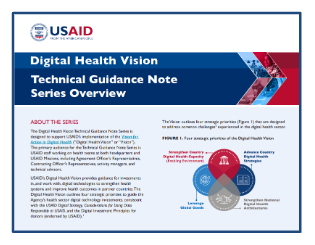
To operationalize this Vision, USAID is launching a series of Technical Guidance Notes. As the Series Overview outlines, each Note introduces a strategic priority; outlines why USAID investments are important in that area; recommends promising approaches USAID staff should consider; incorporates personas depicting how fictitious but prototypical USAID staff incorporated recommendations into their work; and includes a checklist that highlights key takeaways to help implement the Digital Health Vision throughout the USAID Program Cycle.
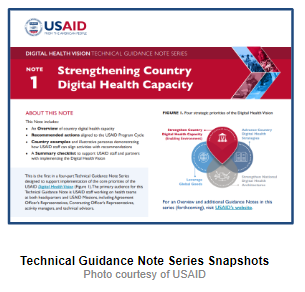
The first Technical Guidance Note to launch – Strengthening Country Digital Health Capacity – addresses ways to invest in country-level capacity to manage and sustain digital health systems and the data they enable, through targeted support to a country’s digital health enabling environment.
|
|
 |
|
CII serves as judge for Global Surgical Training Challenge |
|
|
CII Senior Innovation Advisor Rachel Wood served on the panel of judges for the three-year Global Surgical Training Challenge, which just awarded a grand prize of $700k to Team ALL-SAFE to continue building surgical self-training modules for laparoscopic skills. The runner-up prize of $300k went to Team Tibial Fracture Fixation (TFF), which builds modules using 3D printing to teach skills to treat common fractures in low and middle income settings. The Challenge, run by Challenge Works in partnership with Intuitive Foundation, Royal College of Surgeons in Ireland, MIT Solve, and Appropedia, started with 42 teams from 44 different countries. Its goal is to stimulate the creation of novel, low-cost surgical training modules that are open-source to help surgical practitioners learn and assess new skills to improve the health of their communities.
|
|
 |
|
CII's Digital Health: Planning National Systems course adopted in Mongolia |
|
|
Mongolia has pioneered a country-specific adaptation of one of CII’s global goods, the Digital Health: Planning National Systems course. This CII-supported course is co-delivered with the World Health Organization and International Telecommunication Union, and the content is open and available online. Dr. Bayaabatar Bold found the course content and saw immediate use for it in his country. He founded the Mongolian Society of Artificial Intelligence in Medicine last year, which seeks to address universal health care coverage by leveraging AI. Through that society, they coordinated a small funding pot through UNESCO and the National Center for Health Development to translate the full Planning National Systems course into Mongolian. They’re also seeking to deliver blended versions of the course throughout the country, and in particular, offer it through the National Center for Health Development as a requirement for physicians and pharmacists to renew their medical licenses.
|
|
 |
|
OECD i30 session shares CII’s experience bringing innovations to scale |
|
|
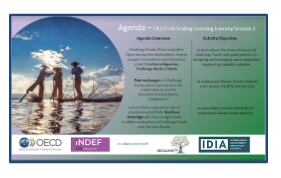
Last autumn, the OECD i30 Group – the peer-learning mechanism on development innovation for members of the OECD Development Assistance Committee – held the first two sessions of their three-part learning journey on scaling innovation. The main insights of the learning journey thus far are summarized on the OECD Development Matters blog: Scaling Innovations to Accelerate Progress towards Development and Climate Goals. On January 18th, the OECD i30 group held the final session of the learning journey. This session focused specifically on Challenge and Innovation Funds,Challenge Prizes and other open innovation vehicles. CII Innovation Advisor Nilima Mehta presented on USAID’s learnings with regards to bringing innovations to scale through mechanisms such as our Saving Lives at Birth (SL@B) and Combating Zika Grand Challenges. The final summary is forthcoming.
|
|
CII is now on LinkedIn! Connect with us here to hear first about our latest publications, opportunities, events, and other not-to-be-missed updates.
|
|
Gautam Chakraborty, Development Assistance Specialist, USAID/India
Gautam is a Development Assistance Specialist based out of the USAID/India country office, focusing on innovative health financing – including working closely with CII on the world’s first health development impact bond, the Utkrisht DIB. He believes any problem is solvable with enough creativity and strategic leverage, and enjoys seeking these out-of-the-box health solutions. He has been with USAID for six years following a career in investment banking.
In his free time, Gautam reads and creates poetry, learns about military aviation, and analyzes peace, conflict, and other strategic issues.
Read more about Gautam here.
|
|
USAID's Center for Innovation and Impact (CII) takes strategic risks to incubate new ideas, put them into practice, and scale effective approaches for critical health issues. We apply our expertise in innovation, market-based solutions, and digital health to work in partnership and through institutional change.
|
|
|
|
|











 USAID on Facebook
  USAID on YouTube
  USAID on LinkedIn