|
JULY 2026
“Hazmat Highlights” is the FAA’s Office of Hazardous Materials Safety monthly newsletter with public updates from government sources related to the safe transportation of hazardous materials by air.
|
|
Digital Safety Promotion Posters
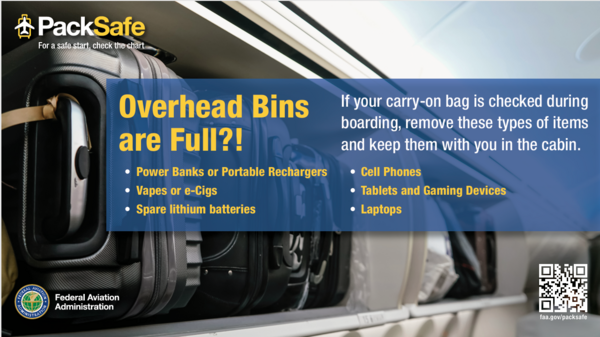
New and updated digital versions of safety promotion posters have been posted to the FAA’s PackSafe and SafeCargo web pages for use by airports and operators. These cover lithium battery watt hours, power stations, camping fuels, fireworks, and general PackSafe and SafeCargo campaign safety messages. The newest safety poster, Overhead bins are full!, reminds passengers to remove lithium battery devices if their carry-on bag is checked at the gate.
 Visit the FAA's PackSafe site for the latest information.
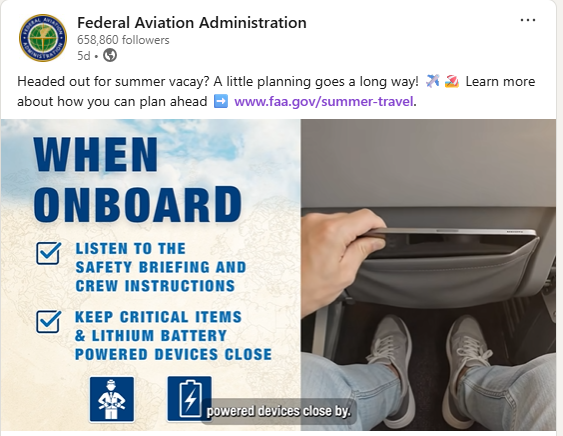
 Headed Out for Summer Vacay?
A little planning goes a long way! ✈️🏖️ Learn more about how you can plan ahead ➡️ .
Visit the FAA's Facebook, X, and Instagram pages for the latest information.
 Know Before You Ship
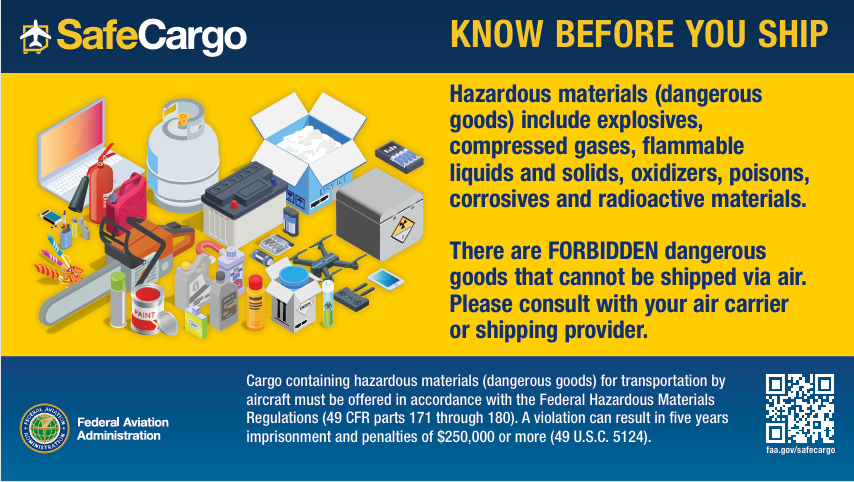
A landscape digital version of the ‘Know Before You Ship’ poster is now available on our website. This poster can be displayed wherever shippers offer packages and meets the requirements of 49 CFR 175.26.
 Visit the FAA's SafeCargo site for the latest information.
 Lithium Battery Air Incidents
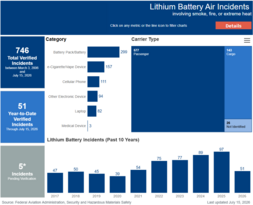
Note: These are lithium battery related events involving smoke, fire, or extreme heat that the FAA is aware of and should not be considered a complete listing of all such incidents. The methods of collecting and recording these incidents and the data involved has changed over the life span of this chart as the FAA’s Office of Hazardous Materials Safety has evolved. The incident summaries included here are intended to be brief and objective. They do not represent all information the FAA has collected, nor do they include all investigative or enforcement action taken.
This chart was last updated on July 15, 2026.
|

|
|
 PHMSA INTERPRETATIONS
You can find all PHMSA Interpretations by clicking here.
Transporting Lithium Batteries
Lithium cells and batteries power many everyday devices—from phones and laptops to tools and vehicles—and are essential to modern, mobile life. As these batteries become increasingly energy-dense, they present greater safety risks, including potential fires during transport. To mitigate these risks, lithium batteries are regulated as hazardous materials under the HMR. Shippers play a critical role in ensuring compliance and safe transportation across all modes: air, highway, rail, and water.
For additional information on lithium batteries, access the webpage here: Transporting Lithium Batteries
Read the latest from PHMSA's newsroom by clicking here.
 Aviation Safety Reporting System (ASRS) 'CALLBACK' Newsletter Highlights
Routine Summer Operations
This month, CALLBACK shares examples of routine summer weather encounters appearing as primary contributors or complicating factors in reported incidents.
Read the full newsletter from ASRS here.
 Recent Recalls & Product Safety Warnings
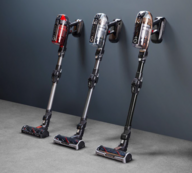
RECALL: Rowenta Recalls Cordless Vacuum Cleaners
Date: July 2, 2026
Hazard: The recalled lithium-ion battery in the vacuum cleaner can overheat and ignite, posing a risk of serious injury from fire and burn hazards.
Read more about the Cordless Vacuum Cleaners recall.
|

RECALL: Greenworks Tools Recalls 24V and 48V Kobalt Yard Power Tools with USB-C Batteries
Date: July 9, 2026
Hazard: Charging the lithium-ion batteries through the USB-C port while the batteries are inserted in the yard power tools can cause the batteries to short-circuit, posing a risk of serious injury from fire hazard.
Read more about the Greenworks Tools recall.
|

RECALL: Flaunt Recalls Magsafe Battery Chargers
Date: July 9, 2026
Hazard: The lithium-ion battery in the recalled power banks (chargers) can overheat and ignite, posing a risk of serious injury or death from fire and burn hazards.
Read more about the Magsafe Battery Chargers recall.
|
Click here to view all recalls and product safety warnings by the Consumer Product Safety Commission.
|
|
|
|