|
APRIL 2026
“Hazmat Highlights” is the FAA’s Office of Hazardous Materials Safety monthly newsletter with public updates from government sources related to the safe transportation of hazardous materials by air.
|
|
FAA Proposes Civil Penalties
The FAA alleges in May 2024, Verizon offered three shipments of between 2,000 and 3,000 cell phones containing lithium-ion batteries to FedEx for transportation by air. Lithium-ion batteries are classified as a hazardous material.
The FAA alleges the materials were not properly classed, described, packaged, marked, labeled, or in the proper condition for shipment. Further, Verizon did not provide required emergency response information.
Verizon has 30 days after receiving the FAA’s enforcement letter to respond to the agency.
The FAA alleges WEP offered three shipments of battery packs containing lithium ion batteries to United Parcel Service (UPS) for transportation by air. Lithium ion batteries are classified as hazardous materials. In one instance, employees at the UPS sorting facility in Ontario, California, discovered the shipment was smoking, with a burn hole in the package.
The FAA alleges the materials were not accompanied by the required shipping paperwork and not properly classed, described, packaged, marked, labeled, or in the proper condition for shipment. The FAA also alleges the state of charge of the lithium ion batteries exceeded 30% of their rated capacity. Further, WEP did not provide the required emergency response information.
WEP has 30 days after receiving the FAA’s enforcement letter to respond to the agency.
The FAA alleges that on two flights in January 2025, Devinaire accepted two shipments of radiopharmaceutical materials for transportation by air. Radiopharmaceutical materials – drugs that contain radioactive substances – are classified as a hazardous material.
The FAA alleges Devinaire failed to ensure its employees who accepted these shipments were trained in transporting hazardous materials and the shipping papers did not include a description of the physical and chemical form of the radioactive material. Further, the FAA alleges the company did not keep the shipping papers and information provided to the pilots on file for the required amount of time.
Devinaire has 30 days after receiving the FAA’s enforcement letter to respond to the agency.
|
|
|
|
 Transport Lithium Batteries in Carry-on Luggage
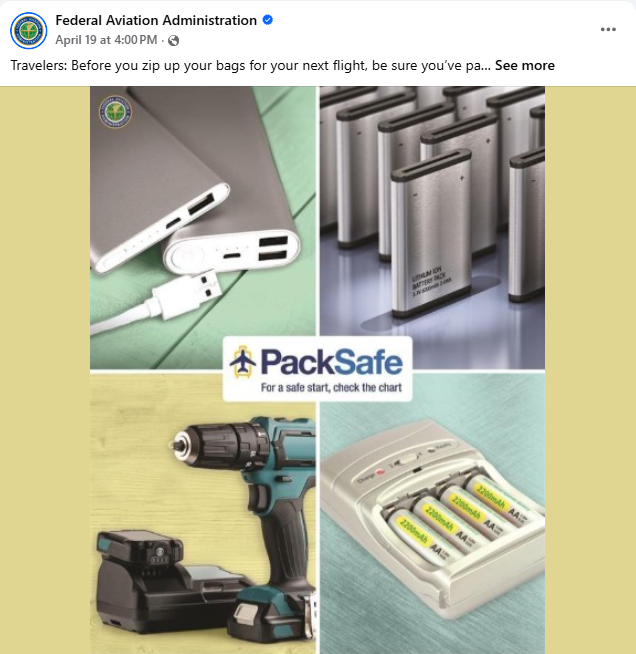
Travelers: Before you zip up your bags for your next flight, be sure you’ve packed safely. Lithium battery electronic devices must be in carry-on luggage, not checked. See our guidance at faa.gov/packsafe and check your airline’s policy around lithium batteries and other hazmat.
Visit the FAA's Facebook, X, and Instagram pages for the latest information.

Lithium Battery Air Incidents
|
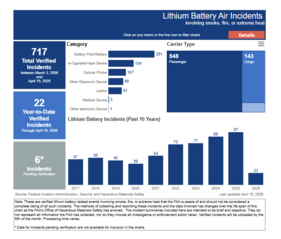
Note: These are lithium battery related events involving smoke, fire, or extreme heat that the FAA is aware of and should not be considered a complete listing of all such incidents. The methods of collecting and recording these incidents and the data involved has changed over the life span of this chart as the FAA’s Office of Hazardous Materials Safety has evolved. The incident summaries included here are intended to be brief and objective. They do not represent all information the FAA has collected, nor do they include all investigative or enforcement action taken.
This chart was last updated on April 15, 2026.
|

|
|

Date
|
Agency
|
Title
|
|
04/15/2026
|
PHMSA
|
Hazardous Materials: Notice of Applications for Modification to Special Permits
|
|
04/15/2026
|
PHMSA
|
Hazardous Materials: Notice of Actions on Special Permits
|
|
04/15/2026
|
PHMSA
|
Hazardous Materials: Notice of Applications for New Special Permits
|
|
04/16/2026
|
FAA
|
Special Conditions: ALOFT AeroArchitects, Gulfstream Aerospace Corporation Model G-IV, GIV-X, GV, and GV-SP Airplanes; Rechargeable Lithium Batteries and Battery System Installations
|
|
04/16/2026
|
FAA
|
Special Conditions: Honeywell International Inc., Boeing Model 757-200, 757-200PF, 757-200CB, and 757-300 Airplanes; Non-Rechargeable Lithium Batteries and Battery System Installation
|
|
04/22/2026
|
PHMSA
|
Hazardous Materials: Notice of Public Meetings in 2026 for International Standards on the Transport of Dangerous Goods
|
|
04/24/2026
|
DOT
|
One-Page Document on Passenger Rights
|
|
04/27/2026
|
DOT, OST, PHMSA, FMCSA, NHTSA, FTA
|
Administrative Rulemaking, Guidance, and Enforcement Procedures
|
|
Visit the Federal Register by clicking here.
|
|
|

 Request for Comments for the 2028 Emergency Response Guidebook
PHMSA is announcing the open period for comments on the 2028 Emergency Response Guidebook (ERG). To pursue the objective of continually improving the ERG, PHMSA is open for comments related to new methodologies and considerations for future editions of the ERG.
Please submit any recommendations to improve the 2028 ERG to ERGComments@dot.gov. Comments must be submitted by January 1, 2027, for consideration.
Read the latest from PHMSA's newsroom by clicking here.
|
|
 Aviation Safety Reporting System (ASRS) 'CALLBACK' Newsletter Highlights: 50 Years of Turning Safety Reports Into Safer Skies
This edition of CALLBACK recalls ASRS’s history and its successes in the tradition of nurturing a robust aviation safety culture that strives for excellence and continuous improvement. It is dedicated to our reporters, readers, and stakeholders, to whom we are indebted for their help in influencing aviation safety in a significant way.
Read the full newsletter from ASRS here.
|
|
 NTSB to Hold Two-Day Investigative Hearing on November 2025 UPS Cargo Airplane Crash in Kentucky
The National Transportation Safety Board will hold a two-day investigative hearing May 19–20 as part of its ongoing investigation into the Nov. 4, 2025, crash of United Parcel Service flight 2976, a Boeing MD-11F cargo airplane, shortly after takeoff from Louisville, Kentucky.
On Nov. 4, 2025, at about 5:14 p.m. Eastern time, the airplane, operating as a domestic cargo flight from Louisville to Honolulu, was destroyed after impacting the ground shortly after takeoff. The three crewmembers aboard the airplane and 11 people on the ground were killed. One person on the ground who was seriously injured died 51 days after the accident. Twenty-three people on the ground were injured.
The hearing will be held at the NTSB boardroom in Washington where it will also be livestreamed. The agenda, witness list and other details will be announced in the coming weeks.
The NTSB conducts investigative hearings to assist in obtaining information necessary to determine the facts and circumstances of transportation accidents or incidents under investigation. Although the investigative hearing is open to the public, only NTSB board members, investigators, witnesses and parties to the hearing are allowed to participate.
Links to video of media briefings, photos, the preliminary accident report, investigative updates and other related materials are available on the investigation webpage.
To report an incident/accident or if you are a public safety agency, please call 1-844-373-9922 or 202-314-6290 to speak to a Watch Officer at the NTSB Response Operations Center (ROC) in Washington, DC (24/7).
|
|
|
|
|