|
MARCH 2026
“Hazmat Highlights” is the FAA’s Office of Hazardous Materials Safety monthly newsletter with public updates from government sources related to the safe transportation of hazardous materials by air.
|
|
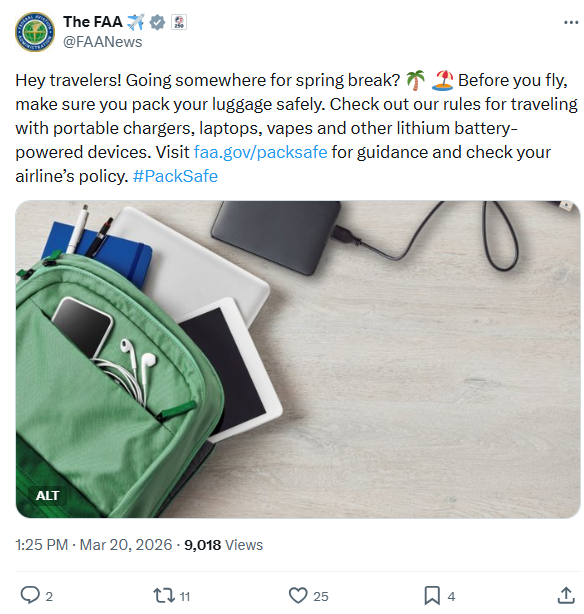
SPRING BREAK
Before you head to the airport, check the latest rules at www.faa.gov/packsafe for flying with devices like power banks, laptops, and vapes.
Visit the FAA's Facebook, X, and Instagram pages for the latest information.

|
|
Know Before You Ship
More than 3 billion tons of regulated dangerous goods, also known as hazardous materials, are transported in the United States each year. Over 261,000 tons of these dangerous goods are transported by air.
Air transportation is the catalyst for the quick and efficient delivery of goods. Express and expedited shipping options mean a shipment is more likely to end up on an aircraft. In addition, the expansion of e-commerce has made buying and selling dangerous goods quicker and easier than ever. With these lower barriers to entry and a resulting increase in new entrants to the marketplace, cargo safety is imperative. It is increasingly important that all stakeholders engaged in shipping and the e-commerce supply chain are aware of the risks and are connected to the appropriate safe shipping resources.
Read more at the how to ship cargo safely.
|
|
Mandatory and Voluntary Incident Reporting
Incident Reporting Saves Lives! It is critically important that all injuries and accidents, including near misses, are reported so that the causes can be determined and the risk eliminated. Reporting hazards helps prevent additional injuries and increases safety. Making an Incident Report isn't difficult, and we are here to help.
Mandatory Incident Reporting
There are several different Dangerous Goods Mandatory (REQUIRED) Incident Reports:
- Hazardous Materials Incident Report
-
Immediate Notice of certain hazardous materials incidents. (As soon as practical but no later than 12 hours)
- Detailed Hazardous Materials Incident Report. (Within 30 Days of discovery)
- Discrepancy Reports Involving Passenger Baggage
- Discrepancy Reports Involving Cargo
Find more information on Incident Reporting.
|
|
Lithium Battery Air Incidents
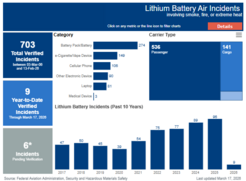
Note: These are lithium battery related events involving smoke, fire, or extreme heat that the FAA is aware of and should not be considered a complete listing of all such incidents. The methods of collecting and recording these incidents and the data involved has changed over the life span of this chart as the FAA’s Office of Hazardous Materials Safety has evolved. The incident summaries included here are intended to be brief and objective. They do not represent all information the FAA has collected, nor do they include all investigative or enforcement action taken.
This chart was last updated on March 17, 2026.
|
|
|

|
Date
|
Document
|
Subject
|
|
03/18/2026
|
N JO 7110.801
|
Interim Helicopter Separation Procedures
|
|
03/02/2026
|
N 8100.20
|
Organization Designation Authorization (ODA) Holder Ethics Training for Unit Members (UM) and Administrators
|
|
02/23/2026
|
N 8900.769
|
Documenting the Authorization and Surveillance of a Simulator Component Inoperative Guide Program
|
|
01/27/2026
|
InFO 26005
|
North Atlantic (NAT): Failure to Promptly/Correctly Load Controller-Pilot Data Link Communications (CPDLC) Route Uplinks
|
|
01/26/2026
|
InFO 26004
|
Runway Data Publication Sources & Use of Runway Length Data to Prevent Overruns
|
|
01/23/2026
|
AC 136-5
|
Enhanced Flight Following Center (EFFC) for Commercial Air Tour Operators
|
You can find all prior ACs, SAFOs, InFos, Orders & Notices, and other Dynamic Regulatory System (DRS) material by clicking on the buttons below.
|
|
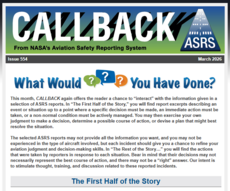
Aviation Safety Reporting System (ASRS) 'CALLBACK' Newsletter Highlights
Risk Management and Mitigation
This month, CALLBACK presents reported incidents in which pilot responses to risk were critical. Consider each narrative. Search for hazards, threats, and errors; then evaluate risk, the mitigating actions, and outcomes. You will, no doubt, recognize some timeless examples of risk that was managed well or may have been managed better.
Read the full newsletter from ASRS here.
|
|
|
|
TSA's Top 10 Best Catches of 2025.
Just plane bad...choices are what get highlighted in TSA's Top 10 Best Catches every year. Here is a run-down of what the TSA has decided are some of the worst packing decisions from 2025.
Watch more TSA's Top 10 Catches
|
|
HAZMAT- Mailing Household Items
Americans across the United States use the U.S. Mail daily and rely upon the Postal Service to ship numerous types of items for personal and business purposes. However, what people may not know is that certain items and substances should never enter the mail system. These materials are not only considered hazardous but are also illegal to send through the mail. Prohibited, restricted, and non-mailable items include anything containing liquid mercury, fireworks, live ammunition, strike-anywhere matches, explosive or flammable devices, and corrosive or acidic substances and materials, as well as several others.
Other items that appear safe because they are used during everyday activities around the house also pose a significant risk during transportation and are considered hazardous materials. Some common items that you might not think of include flammable aerosol products (spray disinfectants, spray paints, and hairspray), lithium batteries, safety matches, perfume, and cosmetic products such as nail polish and nail polish remover. Although some of these materials are allowed to travel through the mail, there are strict quantity limits, packaging, and marking requirements. Additionally, some items are not allowable in airmail but may be sent with ground delivery only.
Learn more at the USPIS's website.
|
|
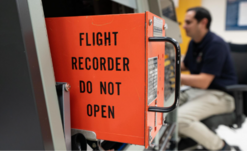
Investigators must understand flight crews’ actions before an incident to conduct thorough investigations and develop effective safety recommendations. Cockpit voice recorders (CVRs) capture real-time insight into crew decision-making, workload, coordination, and situational awareness, providing information often unavailable from other sources.
For years, this critical safety tool faced a significant limitation: most CVRs retained only the last 2 hours of audio. In many cases, the system overwrote important recordings before investigators accessed them, and that risk still affects much of today’s operating fleet.
In February 2026, the Federal Aviation Administration (FAA) issued a final rule requiring newly manufactured aircraft with a CVR to retain the last 25 hours of audio, in line with NTSB Safety Recommendation A-18-030. This change is significant for future aircraft, but it does not apply to the thousands of airplanes already in service, which will continue under the two-hour standard unless retrofitted.
Why It Matters
Under the previous two-hour standard, the system recorded CVR audio on a continuous loop. If more than two hours passed between an event and powering down the aircraft, the system could erase critical evidence.
This problem became acute when crews recognized incidents late, during extended ground operations, multiple flight legs, or when aircraft remained powered after landing. By the time investigators assessed the event, they sometimes found key cockpit audio no longer available.
The NTSB has repeatedly emphasized that CVRs are among the most valuable tools in accident investigation. They provide real-time insight into:
- Crew coordination and communication
- Interactions with air traffic control
- Workload and fatigue indicators
- Responses to system alerts and abnormal situations
More complete information leads to more accurate findings and stronger safety recommendations.
Read the FAA CVR Final Rule.
Read more NTSB Safety Recommendations.
|
|
|
|
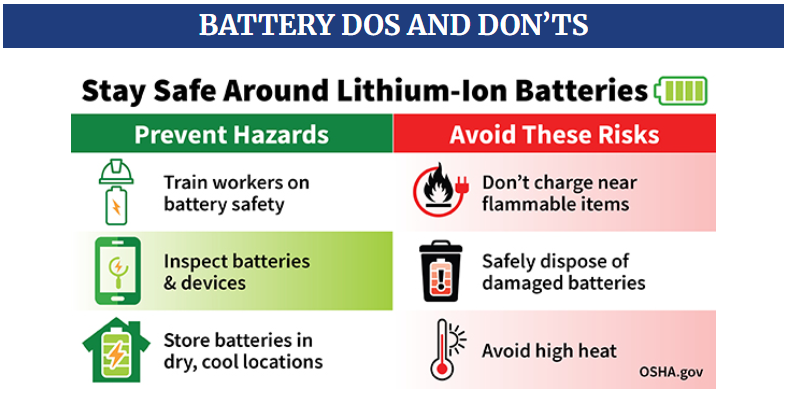
OSHA is publishing it's twice monthly QuickTakes newsletter featuring compliance assistance, training and other workplace safety and health resources. OSHA's February 27, 2026, issue included "Battery Do's and Don'ts" detailing how to stay safe around Lithium-Ion Batteries.
Read OSHA's QuickTakes latest newsletter.
|
|
ICAO Statement on the Safety and Security of Aviation Operations
ICAO has strongly called on Member States to respect the principles and provisions of the 1944 Convention on International Civil Aviation. Civil aviation must be preserved for the promotion of global peace and prosperity, with safety and security always ensured as the fundamental priority. ICAO Member States have the responsibility to ensure the safety and security of air transport operations, facilities and passengers, and the Convention requires them to cooperate.
The ICAO framework protects passengers and crew by requiring airspace closures when safety is threatened.
ICAO supports Member States by working with all stakeholders to identify and implement contingency measures that minimize disruptions to international air services, with no compromise on safety. When airspace is affected by conflict and international air traffic flows are disrupted, we activate and lead regional and inter-regional coordination mechanisms to support Member States as they implement contingency arrangements for their Flight Information Regions (FIR), in accordance with Annex 11 — Air Traffic Services of the Convention.
ICAO convenes affected and adjacent Member States, air traffic services providers, airspace users, and other relevant stakeholders through contingency coordination forums to ensure information sharing, alignment of procedures, and the continued safe and orderly flow of international air traffic.
As reaffirmed in last year’s unanimous adoption of ICAO Assembly Resolution A42-4: Addressing risks to civil aviation arising from conflict zones, the assessment of safety in conflict zones is an exclusive responsibility of Member States and their air traffic services providers and airlines in accordance with applicable ICAO provisions and guidance.
We support the effective implementation of these responsibilities by facilitating the sharing of information, of expertise and promoting coordinated risk mitigation efforts. We’re continuously working with Member States and all industry stakeholders involved to improve guidance on how to ensure the safety and security of civil aviation operation near and over conflict zones.
In line with the responsibilities mandated in the Convention, ICAO does not comment on matters concerning specific Member States.
|
|
|
|
|