U.S. Federal Aviation Administration sent this bulletin at 03/18/2026 04:33 PM EDT
Week of March 16, 2026
Flying in For the Festivities
The National Cherry Blossom Festival is March 20-April 12. If you’re flying into Reagan Washington National Airport to join in on the cherry blossom fun, be sure to look out your window for a peek at the cherry blossoms! Travelers with a seat on the left should get a glimpse if landing to the south. A quick look might also be possible for anyone on the right side of their northerly departing aircraft.
For any general aviation pilots flying into our smaller surrounding airports, take a look at our From the Flight Deck video series for what to expect as you fly in.
Remember that Washington, D.C., including the Tidal Basin, is under a Temporary Flight Restriction and is a No Drone Zone.
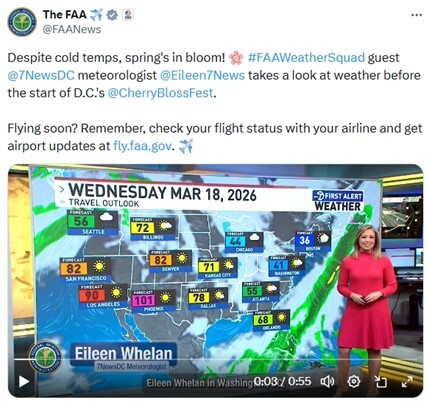
Eileen Whelan with ABC7 in Washington, D.C. is kicking off the National Cherry Blossom Festival for us this week. Eileen is forecasting the return of warmer weather this weekend to compliment the festivities. Blooms are in stage 3 right now with peak bloom expected next weekend. The western side of the country is still enjoying lots of sunshine and high temperatures.
Aviation Weather Cameras
Aviation weather cameras are a key resource to help pilots fly safely. They provide pilots with near-real-time images of weather conditions at departure and destination airports as well as along flight routes. Thanks to the Brand New Air Traffic Control System initiative, we’re expanding our network that already consists of nearly 300 weather cameras. Take a look at current conditions all over the country by visiting our weather camera webpage. You can learn more about how these cameras have been keeping pilots safe for decades by reading our latest blog.
ICYMI
U.S. Transportation Secretary Sean P. Duffy and FAA Administrator Bryan Bedford announced a new measure to enhance safety in areas where helicopters often cross both arrival and departure paths near busy airports. The general notice (GENOT) suspends the use of visual separation between airplanes and helicopters and mandates that air traffic controllers use radar to actively manage these aircraft to keep them safely separated. Read more about this upgraded safety protocol in our latest press release.