FAA Office of Hazardous Materials Safety Hazmat Highlights - February 2026
U.S. Federal Aviation Administration sent this bulletin at 02/27/2026 11:49 AM EST
FEBRUARY 2026
“Hazmat Highlights” is the FAA’s Office of Hazardous Materials Safety monthly newsletter with public updates from government sources related to the safe transportation of hazardous materials by air.
Before Packing for a Flight, Read the Fine Print
Passenger notifications provide critical information on safe packing.
Hazardous materials are more common in everyday products than you might think, and incidents involving spills, smoke and fires on aircraft due to hazmat are on the rise. That's why it's critical for passengers to know the rules. We're here to help. Check out our blog for some samples of the hazard warnings you might see when looking at your airline's packing restrictions, what items you can't bring on board and which items must be in your carry-on luggage. Always remember-Pack Safe! ✈️ Read the latest PackSafe information on what you can and can’t bring aboard an aircraft.
Share the Message
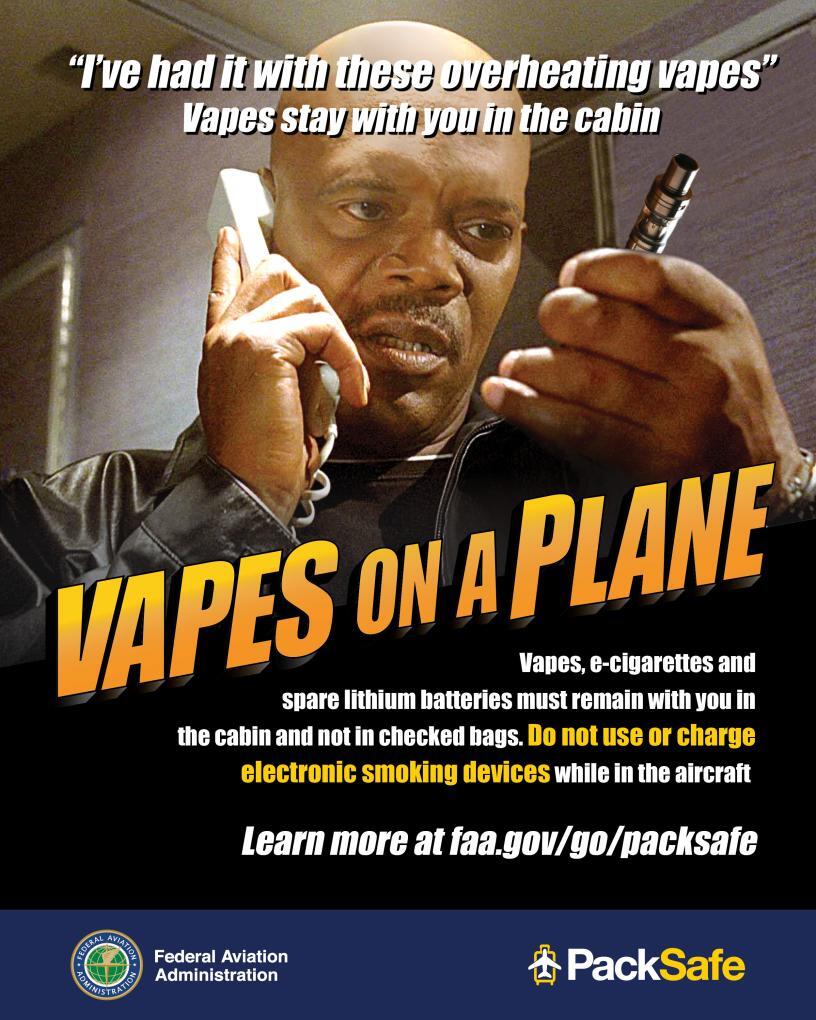
Electronic smoking devices, like vapes and e-cigarettes, contain lithium batteries and are considered dangerous goods due to their risk of smoke, fire, and extreme heat. The FAA has printable flyers that could help prevent a hazardous materials incident and may also be posted on social media. Consider posting or sharing one of these flyers within your business, personal, or social circles.
The Federal Aviation Administration (FAA) Office of Hazardous Materials Safety's oversight responsibilities extend beyond the airport. We oversee entities that introduce dangerous goods into commerce through transportation by aircraft. Regulated entities include, but are not limited to, manufactures, freight forwarders, e-commerce entities, businesses, online retailers that sell dangerous goods, and aircraft repair and maintenance stations.
Under Title 49 of the United States Code ("the Statute"), any person who intends to provide air transportation service as an air carrier must first obtain two separate authorizations from the Department of Transportation: "safety" authority in the form of an Air Carrier Certificate and Operations Specifications from the FAA.
Air carrier operations cannot commence until a certificate is issued. Included in this process, is the permission to carry dangerous goods or a prohibition on carrying dangerous goods. This must be completed prior to accepting dangerous goods for transport.
The FAA Office of Hazardous Materials Safety (AXH) works in conjunction with the Office of Aviation Safety (AVS) and Flight Standards Service (AFS) in certification and oversight of Title 14 of the Code of Federal Regulations Part certificate holders and operators. Below you will find the most common types of operations AXH oversees. If you require a more detailed description, please refer to 14 CFR and the applicable part number.
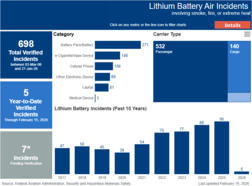
Note: These are lithium battery related events involving smoke, fire, or extreme heat that the FAA is aware of and should not be considered a complete listing of all such incidents. The methods of collecting and recording these incidents and the data involved has changed over the life span of this chart as the FAA’s Office of Hazardous Materials Safety has evolved. The incident summaries included here are intended to be brief and objective. They do not represent all information the FAA has collected, nor do they include all investigative or enforcement action taken.
Title 14 CFR Part 141 Chief Instructor & Assistant Chief Instructor Qualifications for an Approved 14 CFR Part 141 Appendix K Special Preparation Course for the ATP CTP
Mr. Frank Lopez Council on Safe Transportation of Hazardous Articles 101 Ridge St. Suite I Glenn Falls, NY 12801
Reference No. 24-0051
Dear Mr. Lopez,
This letter is in response to your June 6, 2024, email requesting clarification of the Hazardous Materials Regulations (HMR; 49 CFR Parts 171-180) applicable to the responsibility to obtain a Competent Authority Approval (CAA) for the transportation of hazardous materials. In your email, you provide several examples of provisions found in the International Civil Aviation Organization Technical Instructions for the Safe Transport of Dangerous Goods by Air (ICAO TI) that require approval from the "State of Origin" and "State of the Operator," such as Special Provisions (SP) A88 and A99.
We have paraphrased and answered your questions as follows:
Q1: Is it the shipper's (i.e., offeror's) or air carrier’s (i.e., operator's) responsibility to obtain an approval for the State of Origin and the State of the Operator, as required in ICAO TI Special Provisions A88 and A99?
A1: The HMR apply to the offering, acceptance, and transportation of hazardous materials to, from, or within the United States, and to any aircraft of United States' registry anywhere in global air commerce. When ICAO TI SP A88 and A99 stipulate authorization from both the "State of Origin" and the "State of the Operator," as the competent authority for the United States, PHMSA issues a single competent authority approval (CAA) based on authority provided within the HMR. Typically, the approval is granted to the offeror requesting as part of the pre-transportation functions, outlined in 49 CFR § 171.1(b). The operator's capability to handle specific material is evaluated during the approval process, in coordination with the Federal Aviation Administration (FAA).
Q2: Is the only approval an operator is required to seek, or provide in accordance with ICAO TI Special Provisions A88 and A99, the operator's agreement to accept a dangerous goods shipment under a CAA?
A2: Yes. Generally, it is the responsibility of the offeror (i.e., shipper) to seek a CAA—including under ICAO TI Special Provisions A88 and A99. However, in some circumstances the air operator seeks this approval, either through a contractual arrangement with the offeror, or because the operator itself is the offeror of the hazardous materials (e.g., COMAT). In these circumstances, the operator is the responsible party for obtaining a CAA.
Independent of the HMR, operators should refer to the FAA provisions under 14 CFR §§ 121.135(b)(25) and 135.23(p) concerning operator manual requirements for accepting and transporting dangerous goods shipments.
I hope this information is helpful. Please contact us if we can be of further assistance.
Sincerely,
Alexander Wolcott Acting Chief, Regulatory Review and Reinvention Branch Standards and Rulemaking Division
Hazardous Materials: 67th Session of the UN Sub-Committee of Experts on the Transport of Dangerous Goods
From November 24 to December 3, 2025, the U.S delegation, including representatives from PHMSA, FAA, and the U.S. Coast Guard, attended the 67th session of the United Nations Sub-Committee of Experts on the Transport of Dangerous Goods. This group creates the UN Model Regulations, which set worldwide safety standards for moving hazardous materials by all types of transportation. These standards affect more than 2.3 million shipments every day in the United States.
This was the second of four meetings for the 2025–2026 cycle. During the session, the committee reviewed 86 proposals to update the UN Model Regulations. The topics discussed included increasing the amount of flammable gas allowed in non-refillable cylinders, setting exceptions for certain seedcake shipments with safe oil and moisture levels, and developing a new hazard-based classification system for lithium batteries.
Significant progress was made on these and other important issues. PHMSA looks forward to continuing to work with stakeholders as these efforts move forward throughout the rest of the biennium.
Recommendations That Got Results in the Spotlight Archive
Making One of the Most Hazardous Jobs in Aviation Less Risky
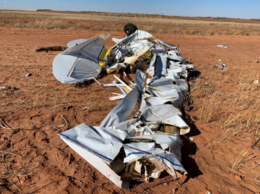
From April through October, thousands of agricultural pilots take to the skies to safeguard the nation’s crops, often flying just feet above the ground in one of aviation’s most hazardous jobs. Recognizing the risks, the NTSB has spent years working to improve safety in this critical sector.
On average, about 54 agriculture aircraft crashes occur in the U.S. each year, with roughly 22 percent resulting in fatalities, according to the National Agricultural Aviation Association (NAAA) ag aviation accident data summary. With only an estimated 3,400 agriculture pilots in the country, these numbers represent a significant threat to this small, but vital aviation community.
Aviation Safety Reporting System (ASRS) 'CALLBACK' Newsletter Highlights
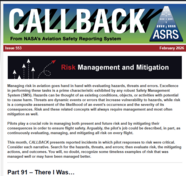
Risk Management and Mitigation
This month, CALLBACK presents reported incidents in which pilot responses to risk were critical. Consider each narrative. Search for hazards, threats, and errors; then evaluate risk, the mitigating actions, and outcomes. You will, no doubt, recognize some timeless examples of risk that was managed well or may have been managed better.
Be prepared for your next flight. Learn about the checkpoint screening process and policies.
TSA incorporates unpredictable security measures, both seen and unseen, to accomplish their transportation security mission. Security measures begin long before you arrive at the airport. TSA works closely with the intelligence and law enforcement communities to share information. Additional security measures are in place from the time you get to the airport until you get to your destination.
Americans across the United States use the U.S. Mail daily and rely upon the Postal Service to ship numerous types of items for personal and business purposes, including lithium batteries. However, what people may not know is that shipping lithium batteries is a tricky business and requires much attention to be paid to the shipping regulations and recommendations. For domestic mailings only, small consumer-type primary lithium cells or batteries (lithium metal or lithium alloy) like those used to power cameras and flashlights are mailable domestically under certain conditions.
Lithium Batteries in Electronic Devices
If you're mailing pre-owned, damaged, or defective electronic devices containing or packaged with lithium batteries, you must send them via ground transportation; they are prohibited in air transportation.
These devices must be marked on the outer packaging with the text. "Restricted Electronic Device" and "Surface Transportation Only."
OSHA has announced that it will be celebrating the moments in life that bring us together during the Workers Memorial Events occurring Monday April 20-Friday April 24, 2026. Additional announcements of the schedule of events will be released soon.