|
JANUARY 2026
“Hazmat Highlights” is the FAA’s Office of Hazardous Materials Safety monthly newsletter with public updates from government sources related to the safe transportation of hazardous materials by air.
|
|
|
If your lithium battery-powered device overheats, smokes, or catches fire on your flight, alert the crew immediately. They are trained to properly respond and extinguish the fire. ✈️ Get more tips at https://www.faa.gov/hazmat/packsafe. Click the image below to watch the full video.
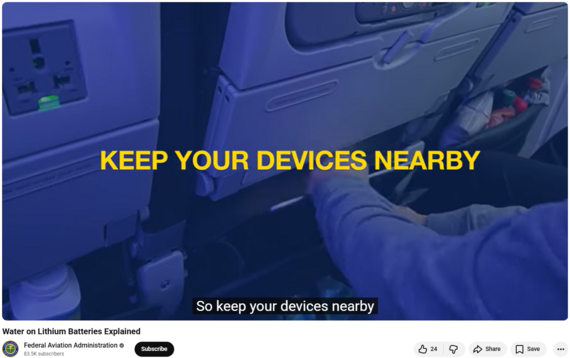 Visit the FAA on YouTube.
|
|
Mandatory and Voluntary Incident Reporting
Incident Reporting Saves Lives! It is critically important that all injuries and accidents, including near misses, are reported so that the causes can be determined and the risk eliminated. Reporting hazards helps prevent additional injuries and increases safety. Making an Incident Report isn't difficult, and we are here to help.
Click here to learn about the types of Incident Reports and when you should report.
|
|
Lithium Battery Air Incidents
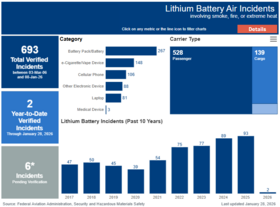
Note: These are lithium battery related events involving smoke, fire, or extreme heat that the FAA is aware of and should not be considered a complete listing of all such incidents. The methods of collecting and recording these incidents and the data involved has changed over the life span of this chart as the FAA’s Office of Hazardous Materials Safety has evolved. The incident summaries included here are intended to be brief and objective. They do not represent all information the FAA has collected, nor do they include all investigative or enforcement action taken.
This chart was last updated on January 28, 2026.
|
|
|

|
Date
|
Document
|
Subject
|
|
01/07/2026
|
N 8900.760
|
REAL ID and Identification Requirements When Applying For or Exercising the Privileges of a Certificate, Rating, or Authorization
|
|
01/08/2026
|
SAFO 26001
|
Airspace Management Considerations for Space Launch Activities
|
|
01/09/2026
|
InFO 26001
|
Revision 2 of the Maintenance Implementation Procedures (MIP) between the Federal Aviation Administration (FAA) and Transport Canada Civil Aviation (TCCA)
|
|
01/13/2026
|
InFO 26002
|
Impaired or Intoxicated Passengers Aboard Title 14 of the Code of Federal Regulations (14 CFR) Part 91 or Part 135 flights
|
|
01/22/2026
|
InFO 26003
|
Spatial Disorientation (SD) Training for Pilots
|
You can find all prior ACs, SAFOs, InFos, Orders & Notices, and other Dynamic Regulatory System (DRS) material by clicking on the buttons below.
|
|
Audit Initiated of FAA’s Oversight of the Infrastructure Investment and Jobs Act Airport Infrastructure Grant Program
To address the Nation’s aging aviation infrastructure, the Infrastructure Investment and Jobs Act (IIJA) provides $14.5 billion in funding through the Airport Infrastructure Grant (AIG) program over fiscal years 2022 to 2026. However, because the Federal Aviation Administration’s (FAA) need for investment in the Nation’s aging aviation infrastructure exceeds available funding, it is critical AIG program recipients efficiently use available funds. Accordingly, the audit objective will be to assess if FAA's implementation of its oversight procedures provides reasonable assurance that AIG program participants properly expend funds.
Click here to read the full report.
|
|
 Hazardous Materials: Advancing Regulations to Support Highly Automated Transportation Systems (HM-266)
On December 4, 2025, PHMSA published in the Federal Register an advance notice of proposed rulemaking (ANPRM) titled, “Hazardous Materials: Modernizing Regulations to Facilitate Transportation of Hazardous Materials Using Highly Automated Transportation Systems” (HM-266).
This ANPRM seeks to obtain stakeholder input on potential revisions to the Hazardous Materials Regulations (HMR) to facilitate the safe transportation of hazardous materials using highly automated transportation systems. The comment period for this ANPRM closes on March 4, 2026.
Your feedback matters: comment by March 4, 2026. The ANPRM may be viewed at: Federal Register :: Hazardous Materials: Modernizing Regulations To Facilitate Transportation of Hazardous Materials Using Highly Automated Transportation Systems
Request for Comments for the 2028 Emergency Response Guidebook
PHMSA is announcing the open period for comments on the 2028 Emergency Response Guidebook (ERG). To pursue our objective of continually improving the ERG, PHMSA is open for comments related to new methodologies and considerations for future editions of the ERG.
Please submit any recommendations to improve the 2028 ERG to ERGComments@dot.gov. Comments must be submitted by January 1, 2027, for consideration.
Read the latest from PHMSA's newsroom by clicking here.
|
|
On-Scene Hazards of Ballistic Parachute Recovery Systems
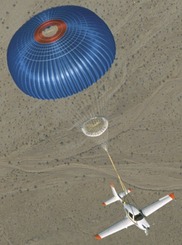
The problem
Ballistic parachute recovery systems (BPRS) are rocket-powered parachutes installed on some airplanes as an optional safety device. If an in-flight emergency occurs, pilots can deploy the BPRS (by activating the rocket that extracts the parachute) to aid the airplane’s gradual descent, reducing the potential for serious injuries to occupants. While these systems can save lives when activated and deployed in flight, they pose a hazard to first responders at an accident site if the rocket did not activate before or during ground impact.
|
|
|
Aviation Safety Reporting System (ASRS) 'CALLBACK' Newsletter Highlights
New Year's Resolutions
This month, CALLBACK presents recent, reported incidents from aviation personnel and disciplines wherein reporters have made deliberate, distinct resolutions to change for better the way they may accomplish a specific task or goal. Many are stated directly. Others are implied or may be gleaned, deduced, or inferred. Appreciate each of the reporters’ New Year’s Resolutions, as well as your own.
Read the full newsletter from ASRS here.
|
|
|
|
What happens if TSA determines I am traveling with an item that is deemed hazardous material?
If hazardous materials are found in a passenger’s checked baggage, those items are brought to the attention of the airline with which the passenger is booked. Once the airline determines whether the item is permitted or prohibited, TSA officers accept the airline’s determination.
Click here for TSA's responses to frequently asked questions.
|
|
HAZMAT- Hazardous Materials
Americans across the United States use the U.S. Mail daily and rely upon the Postal Service to ship numerous types of items for personal and business purposes. However, what people may not know is that certain items and substances should never enter the mail system. These materials are not only considered hazardous but are also illegal to send through the mail. Prohibited, restricted, and non-mailable items include anything containing liquid mercury, fireworks, live ammunition, strike-anywhere matches, explosive or flammable devices, and corrosive or acidic substances and materials, as well as several others.
Click here to read the full article about shipping possible hazardous materials, including ammunition, firearms, fireworks, mercury, household items, lithium batteries.
To learn more about the USPS guidelines on hazardous, prohibited, and restricted mailings visit: https://www.usps.com/ship/shipping-restrictions.htm.
|
|
EASA and DJI Collaborate to Improve Awareness of Safe and Legal Drone Operations
A key requirement of the European Drone Rules is for drone operators to obtain up-to-date information on restrictions that might be in place where they intend to fly (known as “geo-awareness”) and for drone pilots to comply with this information during each flight.
Across Europe, National Aviation Authorities (NAAs) publish official UAS Geographical Zones (UGZ) as part of EASA’s harmonised geo-awareness framework. They are accessible on https://www.easa.europa.eu/en/domains/civil-drones/naa. This EASA webpage serves as a central access point for users, providing links to the official UGZ maps published on the websites of all EASA Member States’ NAAs.
The European Union Aviation Safety Agency (EASA) has worked with DJI, the global leader by volume in the drones’ market, to support the transition to the new regulatory framework for drones and to promote greater awareness of safe drone flying among operators and pilots.
Read the full EASA article here.
|
|
|
|
|