|
NOVEMBER 2025
“Hazmat Highlights” is the FAA’s Office of Hazardous Materials Safety monthly newsletter with public updates from government sources related to the safe transportation of hazardous materials by air.
|
|
DOT & FAA Announce Termination of FAA Emergency Order, Return to Normal Operations
U.S. Transportation Secretary Sean P. Duffy and Federal Aviation Administration (FAA) Administrator Bryan Bedford today announced that the agency’s flight reduction emergency order will be terminated on Monday, November 17, at 6 a.m. This means normal operations can resume across the National Airspace System (NAS).
The FAA safety team recommended the termination of the order following their detailed reviews of safety trends and the steady decline of staffing-trigger events in air traffic control facilities.
Click here to read the full article.
|
|
PackSafe - Fuels Webpage Update
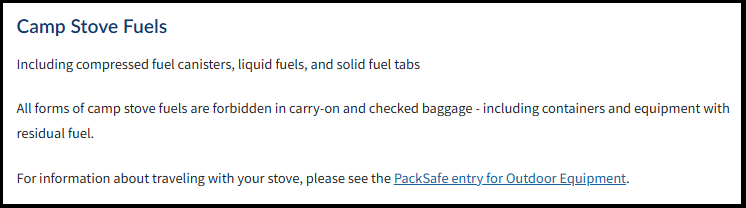
FAA's PackSafe - Fuels webpage has been updated to include Camp Stove Fuels.
Click on the box below for more details.
|
|
Notice of Guidance: Transporting Hazardous Materials by Unmanned Aircraft Systems (UAS)
|
|
Lithium Battery Air Incidents
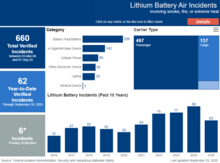
Note: These are lithium battery related events involving smoke, fire, or extreme heat that the FAA is aware of and should not be considered a complete listing of all such incidents. The methods of collecting and recording these incidents and the data involved has changed over the life span of this chart as the FAA’s Office of Hazardous Materials Safety has evolved. The incident summaries included here are intended to be brief and objective. They do not represent all information the FAA has collected, nor do they include all investigative or enforcement action taken.
This chart was last updated on September 29, 2025.
|
|
|

|
Date
|
Document
|
Subject
|
|
09/16/2025
|
SAFO 25003
|
Addressing Risk Associated with Passenger Non-Compliance and Retention of Carry-On
Baggage and Personal Items During Emergency Evacuations
|
You can find all prior ACs, SAFOs, InFos, Orders & Notices, and other Dynamic Regulatory System (DRS) material by clicking on the buttons below.
|
|
Audit Reports
FAA Can Improve Its Guidance and Documentation Practices to More Effectively Administer the International Aviation Safety Assessment Program
Our Objective(s)
To evaluate the Federal Aviation Administration’s (FAA) (1) policies and procedures for the International Aviation Safety Assessment (IASA) program and (2) ability to monitor foreign civil aviation authorities (CAAs) for potential safety concerns.
Why This Audit
In 2022, FAA announced changes intended to better mitigate international civil aviation risks, strengthen international relationships with CAAs, and improve effectiveness in executing the IASA process. While the changes were suspended in 2024, a new set of revisions was proposed. It remains uncertain how the Agency’s proposed changes will impact the program’s ability to evaluate and monitor foreign CAAs’ compliance with ICAO standards.
Click here to read the findings and recommendations.
Click here to read the full report.
|
|
 Have you Checked the Box for your next Outdoor Adventure?
There is nothing like enjoying the crisp fall air while doing your favorite outdoor activities, but did you know that some of the supplies you bring camping, hiking, or hunting are considered hazardous materials?
Help keep hazardous material incidents once in a blue moon by checking out the Check the Box Outdoors Brochure.
Are you the Grill Master ready to impress the neighborhood with your outdoor cooking skills? Not if your propane cylinder isn’t.
Check out PHMSA’s new “Is your Cylinder Safe to Fill?” resource guide. The propane cylinder safety poster assists fillers with inspecting cylinders for serviceability before filling, based on Hazardous Materials Regulations cylinder requalification standards.
It reflects the October 30, 2020, final rule, which authorized 12-year initial and subsequent requalification periods for volumetric expansion testing and a 12-year initial requalification period for proof pressure testing.
PHMSA develops compliance assistance materials that make it easier to understand and comply with the HMR. Electronic versions of these resources are available at: https://www.phmsa.dot.gov/training/hazmat/publications.
PHMSA's Newsroom
Read the latest from PHMSA's newsroom by clicking here.
|
|
NTSB Issues Urgent Recommendation on Learjet Landing Gear
Main landing gear could separate on landing
The National Transportation Safety Board issued an urgent recommendation to ensure main landing gear are correctly attached on certain Bombardier Learjet airplanes.
The urgent recommendation to the Federal Aviation Administration would require operators of 10 Learjet models -- affecting 1,883 airplanes currently in service -- to comply with manufacturer service bulletins on landing gear maintenance. A second recommendation to the FAA would require Bombardier to revise procedures to include a post-maintenance visual check of the position of the aft landing gear trunnion pin and retaining bolt. In the absence of a required verification step, a mechanic could inadvertently install the retaining bolt without it passing through the trunnion pin, leaving the gear insecurely attached to the airframe. The misassembly is not readily detectable during routine maintenance or preflight inspections.
Read the full recommendation here.
|
|
Aviation Safety Reporting System (ASRS) 'CALLBACK' Newsletter Highlights
The High Stakes of Runway Incursions
This month, CALLBACK presents reports of runway incursions that may or may not have been “expected.” Examine each incident to identify the threats and errors (TEM)2 present in each; then consider how they might have been trapped.
Read the full newsletter from ASRS here.
|
Did you miss October's CALLBACK: What Would You Have Done?
October's CALLBACK offered the reader a chance to “interact” with the information given in a selection of ASRS reports. In “The First Half of the Story,” you will find report excerpts describing an event or situation up to a point where a specific decision must be made, an immediate action must be taken, or a non-normal condition must be actively managed. You may then exercise your own judgment to make a decision, determine a possible course of action, or devise a plan that might best resolve the situation.
Read the October newsletter from ASRS here.
|
|
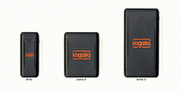
RECALL: Zyntony Recalls Kogalla Power Banks
Date: October 2, 2025
Hazard: The recalled power banks’ lithium-ion batteries can overheat and ignite, even when not in use, posing fire and burn hazards.
Read more about this recall.
|

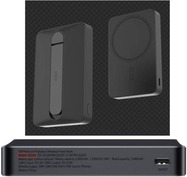
RECALL: Belkin Recalls Portable Power Banks and Wireless Charging Stands
Date: November 13, 2025
Hazard: The lithium-ion battery in the power banks and charging stands can overheat, posing fire and burn hazards to consumers.
Read more about this recall.
|
 |
|
RECALL: ESR HaloLock Wireless Power Banks Recall Expanded to Include Additional Model
Date: October 9, 2025
Hazard: The lithium-ion battery in the recalled power banks can overheat and ignite, posing fire and burn hazards to consumers.
Read more about this recall.
|
Click here to view recent recalls by the Consumer Product Safety Commission.
|
|
Air Transport for All: Hundreds of new air service agreements accelerate progress towards ICAO’s 2050 Vision

Montréal, Canada and Punta Cana, Dominican Republic, 17 November 2025 – ICAO Member States have now reported reaching 440 new and updated bilateral and multilateral agreements at the International Civil Aviation Organization Air Services Negotiation Event 2025 (ICAN 2025).
These agreements are expected to support the implementation of the outcomes of the 42nd ICAO Assembly, which last month adopted a new suite of Resolutions supporting the ICAO 2050 Vision. The Resolutions provided the foundation and direction for this year’s negotiations, ensuring that new agreements reflect the Organization’s updated global priorities.
Read the full article here.
|
|
|
|
|
|