|
JUNE 2025
“Hazmat Highlights” is the FAA’s Office of Hazardous Materials Safety monthly newsletter with public updates from government sources related to the safe transportation of hazardous materials by air.
|
|
FAA, International Partners Collaborate on Advanced Air Mobility
The Federal Aviation Administration and four other regulators are collaborating on advanced air mobility (AAM) certification to enable a safe and efficient rollout of these aircraft across the countries.
“It’s an incredibly exciting time to be in aviation as we work to integrate new technologies safely into the NAS,” said FAA Acting Administrator Chris Rocheleau. “Enabling the integration of new entrants is a priority and we’re committed to doing whatever we can to foster innovation while also staying true to our safety mission.”
Read the full article about the AAM collaboration here.
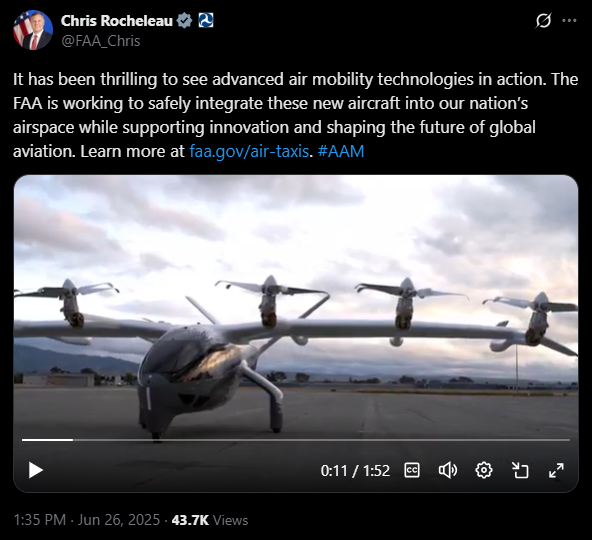
Watch FAA's Acting Administrator Chris Rocheleau's video about AAM technologies on X.
|
|
Did you Know?
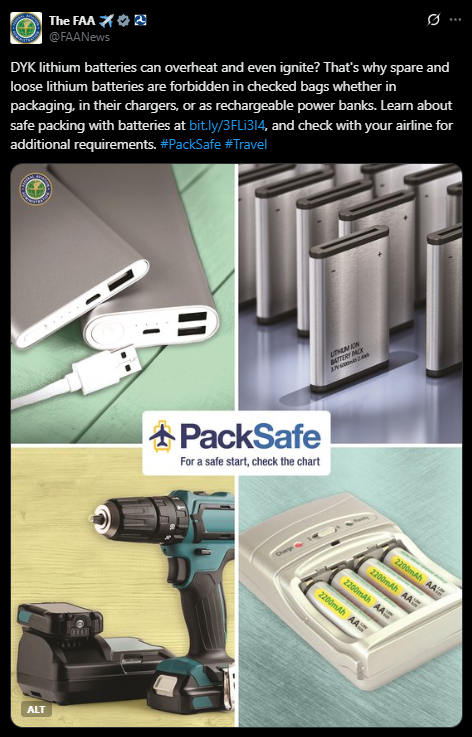
Did you know lithium batteries can overheat and even ignite? That's why spare and loose lithium batteries are forbidden in checked bags whether in packaging, in their chargers, or as rechargeable power banks. Learn about safe packing with batteries at faa.gov/hazmat/packsafe/airline-passengers-and-batteries, and check with your airline for additional requirements.
Click here to visit the FAA on X.
Vapes: Second Leading Cause of Incidents
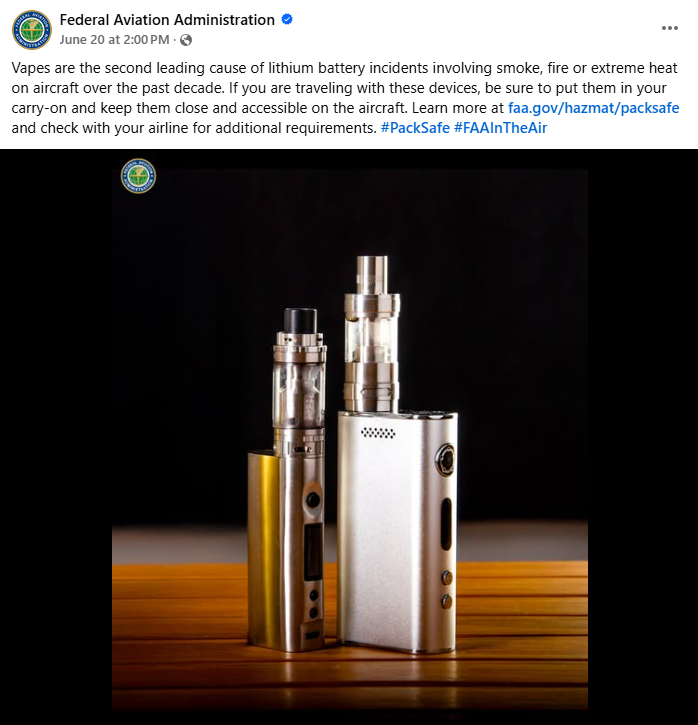
Vapes are the second leading cause of lithium battery incidents involving smoke, fire or extreme heat on aircraft over the past decade. If you are traveling with these devices, be sure to put them in your carry-on and keep them close and accessible on the aircraft. Learn more at faa.gov/hazmat/packsafe and check with your airline for additional requirements.
 Click here to visit the FAA on Facebook.
|
|
Remember: Fireworks Don't Fly!
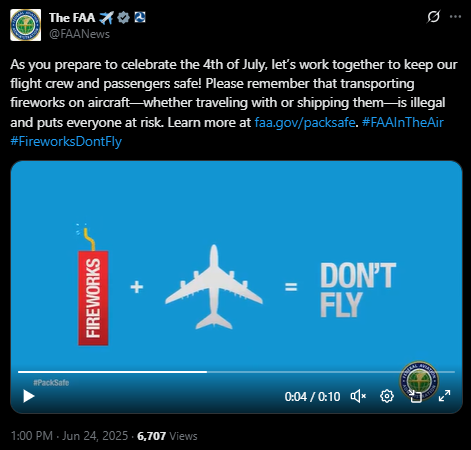
As you prepare to celebrate the 4th of July, let’s work together to keep our flight crew and passengers safe! Please remember that transporting fireworks on aircraft—whether traveling with or shipping them—is illegal and puts everyone at risk. Learn more at faa.gov/packsafe.
Click here to visit the FAA on X.
|
|
Lithium Battery Air Incidents Involving Smoke, Fire or Extreme Heat
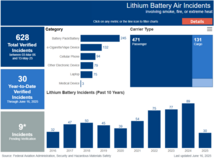
Note: These are lithium battery related events involving smoke, fire, or extreme heat that the FAA is aware of and should not be considered a complete listing of all such incidents. The methods of collecting and recording these incidents and the data involved has changed over the life span of this chart as the FAA’s Office of Hazardous Materials Safety has evolved. The incident summaries included here are intended to be brief and objective. They do not represent all information the FAA has collected, nor do they include all investigative or enforcement action taken.
This chart was last updated on June 16, 2025.
|
|
|

You can find all prior ACs, SAFOs, InFos, Orders & Notices, and other Dynamic Regulatory System (DRS) material by clicking on the buttons below.
|
|
 Hazardous Materials Registration
The 2025–2026 registration year begins officially on July 1st and ends on June 30th of the following year. The updated 2025 registration brochure is available. To download or print this brochure, visit our website.
The tips below are intended to help you prepare for the upcoming 2025 registration year.
- Online registration is the quickest and most effective way to obtain your Hazardous Materials Registration Certificate! To register online, enter through the PHMSA Portal at: https://portal.phmsa.dot.gov.
- When renewing your registrations, please use your HM Company ID to avoid errors in typing business name and company address. If you don't know your HM Company ID, please contact our registration help desk for assistance by email register@dot.gov or phone. The registration help desk can be reached at the following numbers:
- (202) 934-1630 for businesses beginning with the letters A–M
- (202) 934-1631 for businesses beginning with the letters N–Z
- Registrants should also contact the registration help desk for assistance with any of the following:
- Confirming the status of registrations submitted by mail or ACH (registrants should allow up to 14 days for processing);
- Assistance with locating previously-submitted registrations;
- Assistance with financial payment issues, such as disputes, refunds, or other concerns.
Please submit only business contact information. Please note that the contact information you submit during the registration process, including names, addresses, phone numbers, and email addresses, may be disclosed in response to requests under the Freedom of Information Act (FOIA), 5 U.S.C. § 552.
For more information, visit: https://www.phmsa.dot.gov/registration/registration-overview
Note: While PHMSA initiated the rulemaking process to adjust the registration fee structure, following the Infrastructure Investment and Jobs Act of 2021, there will be no changes for the 2025–2026 registration year.
For additional information and access to the dockets or comments received, go to https://www.regulations.gov or DOT's Docket Operations Office. The docket number for this rulemaking activity is PHMSA-2022-0033 (HM-208J). So far, PHMSA has published an Advanced Notice of Proposed Rulemaking (ANPRM) , a Notice of Proposed Rulemaking (NPRM), and held a Public Meeting to solicit public input on possible changes.
PHMSA's Newsroom
Read the latest from PHMSA's newsroom by clicking here.
|
|
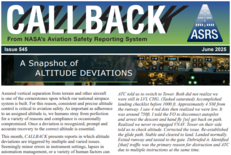
Aviation Safety Reporting System (ASRS) 'CALLBACK' Newsletter Highlights
A Snapshot of Altitude Deviations
This month, CALLBACK presents reports in which altitude deviations are triggered by multiple and varied issues. Seemingly minor errors in instrument settings, lapses in automation management, or a variety of human factors can have serious consequences, including terrain warnings, go-arounds, and ATC interventions.
Read the full newsletter from ASRS here.
|
|
|
|
|
|