|
MAY 2025
“Hazmat Highlights” is the FAA’s Office of Hazardous Materials Safety monthly newsletter with public updates from government sources related to the safe transportation of hazardous materials by air.
|
|
Air Carrier Roundtable Readout
Representatives from the Federal Aviation Administration, airline industry and labor organizations met Monday to share safety best practices and discuss how to make the world’s busiest air transportation system even safer.
“Commercial airline travel remains the safest form of transportation in world history,” said Acting FAA Administrator Chris Rocheleau. “But the last three months drove home that we need to do more, we need to be better, and we need to do it together.”
During the roundtable at the FAA’s headquarters building in Washington, D.C., participants discussed how airlines use their Safety Management Systems (SMS) to monitor and manage risk associated with airspace complexities; potential uses of artificial intelligence to identify hazards and predict risks; and how SMS and safety culture complement each other in managing risk.
Read more about the Air Carrier Roundtable Readout here.
|
|
EASA Publishes New Recommendations on Managing Risks of Lithium Batteries
COLOGNE, May 28, 2025 — The European Union Aviation Safety Agency (EASA) published a new Safety Information Bulletin (SIB) highlighting the risks to safe air travel which can posed by lithium batteries. The SIB was issued in response to an increased number of safety events involving lithium batteries carried by passengers on board commercial passenger aircraft.
Read the EASA full article here.
|
|
You're Hearing More About Lithium Batteries
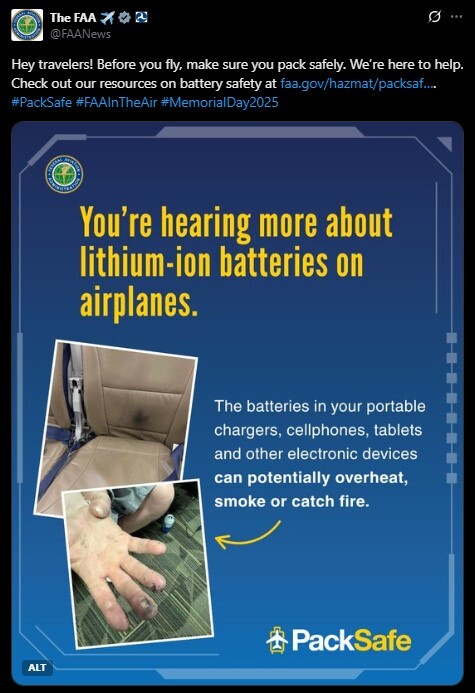
Hey travelers! Before you fly, make sure you pack safely. We’re here to help. Check out our resources on battery safety at www.faa.gov/hazmat/packsafe.
Click here to visit the FAA on X.
Review our PackSafe - Power Banks and Spare Lithium Batteries Page
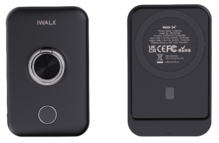
Power Banks, cell phone battery charging cases, rechargeable and non-rechargeable lithium batteries, cell phone batteries, laptop batteries, power banks, external batteries, portable rechargers
Lithium batteries are required to undergo safety testing, all lithium ion batteries are capable of overheating and undergoing a process called thermal runaway. Thermal runaway can occur without warning as a result of various factors, including if the battery is damaged, overheated, exposed to water, overcharged, or improperly packed. Thermal runaway can also occur on its own due to manufacturing defects.
Flight crews are trained to recognize and respond to lithium battery fires in the cabin. Passengers should notify flight crew immediately if their lithium battery or device is overheating, expanding, smoking or burning.
Spare (uninstalled) lithium ion and lithium metal batteries, including power banks and cell phone battery charging cases, must be carried in carry-on baggage only.
Read more about traveling with lithium powered devices here.
|
|
Lithium Battery Air Incidents Involving Smoke, Fire or Extreme Heat
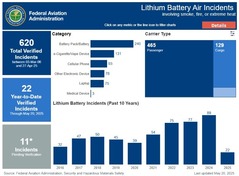
Note: These are lithium battery related events involving smoke, fire, or extreme heat that the FAA is aware of and should not be considered a complete listing of all such incidents. The methods of collecting and recording these incidents and the data involved has changed over the life span of this chart as the FAA’s Office of Hazardous Materials Safety has evolved. The incident summaries included here are intended to be brief and objective. They do not represent all information the FAA has collected, nor do they include all investigative or enforcement action taken.
This chart was last updated on May 23, 2025.
|
|
|

|
Date
|
Document
|
Subject
|
|
05/15/2025
|
AC 150/5200-34B
|
Construction or Establishment of Landfills Near Public Airports
|
|
05/09/2025
|
InFO 25005
|
Transportation of Human Organs in the Cabin of an Aircraft used in Title 14 of the Code of Federal Regulations (14 CFR) Part 121 Operations
|
You can find all prior ACs, SAFOs, InFos, Orders & Notices, and other Dynamic Regulatory System (DRS) material by clicking on the buttons below.
|
|
Audit Initiated of FAA’s Aviation Safety Workforce
Mandated by the FAA Reauthorization Act of 2024
FAA employs a sufficiently staffed and well-trained aviation safety workforce—including air traffic controllers, maintenance technicians, safety inspectors, and other aviation safety professionals—to ensure the safety and efficiency of the National Airspace System. Section 429 of the FAA Reauthorization Act of 2024 requires DOT-OIG to conduct an audit of any FAA workforce plans completed in the preceding 5 fiscal years for occupations the Agency relies on to accomplish its aviation safety mission. The Act also outlines requirements, including but not limited to, DOT-OIG analyzing applicable assessments of critical competencies and skills gaps among FAA’s safety-critical positions. In addition, DOT-OIG is to determine whether existing workforce development programs are producing intended results and if cooperative training programs provide FAA employees with opportunities to enhance their expertise, knowledge, skills, and abilities with aerospace companies while avoiding any conflicts of interest. Accordingly, the objective of this audit will be to determine whether FAA has developed workforce plans for its safety critical workforce in accordance with Section 429 of the FAA Reauthorization Act of 2024.
Read the full announcement here.
|
|
 Request for Proposal: Risk Assessment for HAZMAT Packages in an Unmanned Aircraft Systems (UAS) Environment
The RD&T program published a Request for Proposal titled “Risk Assessment for HAZMAT Packages in an Unmanned Aircraft Systems (UAS) Environment.” The RFP seeks out expertise, capabilities, and experience to evaluate the safety performance of existing dangerous goods packaging requirements in an unmanned aerial systems (UAS) environment. The work will account for operational conditions specific to the carriage of dangerous goods via UAS, the corresponding hazards, the safety performance of existing packaging standards, and will identify appropriate risk mitigation measures. It will also identify potential hazards associated with malfunctions of UAS package containment systems at various cruise altitudes, up to 400 feet above ground level (AGL), which could drop items during transit, inadvertently.
More information on how to submit a proposal can be found at the link below or interested parties can search and find the information from the SAM.gov home page, by selecting "Contract Opportunities" and searching by the RFP number 693JK325R0002.
Click here to read the RFP.
PHMSA's Newsroom
Read the latest from PHMSA's newsroom by clicking here.
|
|
Aviation Safety Reporting System (ASRS) 'CALLBACK' Newsletter Highlights
A Maintenance Legacy
This month, CALLBACK offers selected incidents that demonstrate significant impact, positive or negative, that AMTs can have on all flights. AMTs work tirelessly to mitigate or eliminate real and potential threats. Explore the narratives as you identify the issues and the actions taken by the AMTs involved.
Read the full newsletter from ASRS here.
|
|
|
|
|
|