COVID-19 - News updates for all West Sussex Care and Support Providers
02 June 2020
Welcome to today's newsletter, which includes the following:
Please continue to let us know if there is anything else you would find helpful to include in the newsletters and we'll do our best to add them. Contact us at contracts@westsussex.gov.uk.
A significant boost to PPE supplies that should help meet demand in the health and social care sectors has been announced by government.
It has signed deals with more than 100 new suppliers from around the world as well as ramping up domestic production to help meet demand for PPE. Follow this link to the announcement.
Following a pilot with a number of care providers the Clipper service is now launching. This phase of the roll-out will see small residential social care services (care homes with 24 beds or fewer), small domiciliary care providers (99 clients or fewer) and GPs invited to register on the portal. There is currently no charge for PPE at the point of order through the portal, as the portal is acting as an emergency top-up route. Health and care providers should continue to use their business as usual routes first. For more information please see this PPE Portal update document.
Until the Clipper service is fully functioning the route for accessing emergency supplies of the national stocks of PPE remains in place. As a reminder, care providers need to source in the first instance through their usual supply channels, if unable to source or the estimated delivery date means that stocks of PPE would have run out or be extremely low, please follow: How to access PPE – residential and domiciliary care providers
Note: the national Local Resilience Forum stock, that the council holds for distribution, now includes hand sanitiser. In addition, there is a small number of gowns for issue to providers undertaking Aerosol Generating Procedures (AGP). These will be provided under the same arrangements as described above in ‘How to access PPE’.
The Relatives & Residents Association (R&RA) and the National Care Forum (NCF) have created a joint statement setting out shared expectations and good practice on the importance of clear, open and regular communications during the COVID-19 pandemic. The statement is endorsed by the Care Provider Alliance, the Care Quality Commission and Skills for Care. To hear from the Executives of R&RA and NCF and access the statement click here.
The government’s new Coronavirus Community Support Fund opened for applications on Friday 22nd May.
This new funding stream makes available £200m in government funding that will be aimed primarily at small to medium organisations in England.
The fund has two key objectives:
- To increase community support to vulnerable people affected by the COVID-19 crisis, through the work of civil society organisations.
- To reduce temporary closures of essential charities and social enterprises, ensuring services for vulnerable people impacted by COVID-19 have the financial resources to operate, and so reduce the burden on public services.
Grants will allow organisations to meet service costs, where they are experiencing increased demand and/or short-term income disruption. Grants will also allow organisations to refocus services to address more immediate beneficiary needs in light of COVID-19.
Learn about applying for emergency COVID-19 funding in England here.
Domiciliary care services are being asked to ensure the safety of their staff and customers during these unprecedented times. This guidance puts together information from the government, skills for care and CQC to help you protect staff and customers.
PPE
It is important to ensure you have adequate levels of PPE for staff, if you are unable to get PPE from your usual supplier you can contact West Sussex County Council for support. Contact details as well as a list of suppliers are within the "How to access PPE – residential and domiciliary care providers" section of our Coronavirus (COVID-19) page.
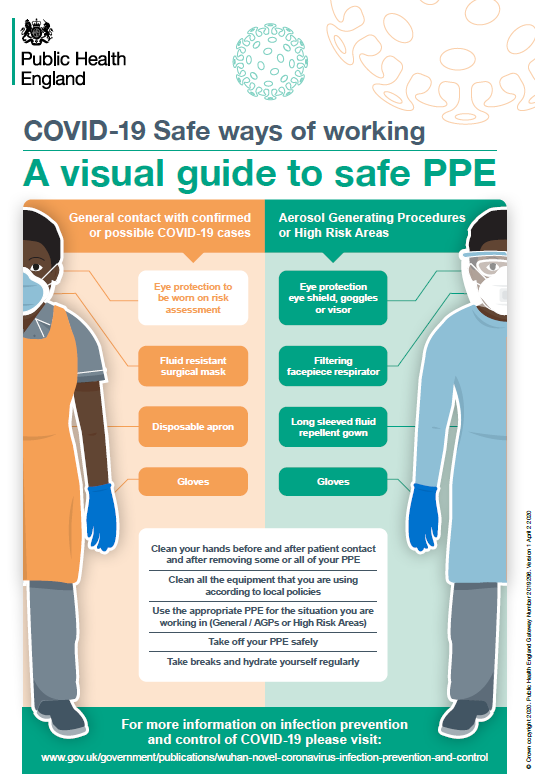
It is just as important your staff are aware how to correctly wear PPE and ensure they know when PPE is needed. Within this link is a poster, which could be distributed to your staff as a reminder on how to wear PPE correctly. Information and videos on putting on and removing PPE have also been published by Public Health England on the Gov.uk website here.
Staff should be aware the specific PPE they need to wear in different scenarios. This should be part of your regular communications with your team.
Customers
To help reduce the risk of exposure to COVID-19, you can divide your customers into care groups and allocate groups of staff to work with them. The recommendation is to divide customers into those shielding, those at risk, and everyone else. Having a specific team of staff for each of these groups can help reduce the spread of COVID-19 and promote the safety of your staff and customers.
It is also worth reviewing if visits can be limited during times when regular staff are unavailable. While this may not be possible for customers whose personal tasks need to be assisted with at specific times, reducing non-essential visits can help reduce the risk of exposure.
Any reallocating of tasks or reductions in visits must be done with agreement of partnership agencies and commissioners. Due consideration needs to be given to any unpaid carers and, importantly, to those receiving care to ensure there is still a personalised approach to their care.
Small to medium size organizations may not have the workforce to be able to categorize customers and staff, however it may be possible to visit customers who are shielding and at risk before people from other categories, which can reduce risk of exposure.
If any customers develop COVID-19 symptoms they should be supported to call 111. Home-care workers should also report suspected cases to their manager who will work with community partners, commissioners and the customer to review their care plan.
Reducing contact between staff
Another way to limit exposure and risk of spreading COVID-19 is by working and supporting staff remotely. Meetings should be conducted by phone or online meeting services such as Skype, Zoom or Microsoft Teams wherever possible.
Staff coming into offices to collect PPE or to hand-in timesheets should be staggered so there is not a high number of people in the same location at once.
Any staff who have symptoms of COVID-19 should immediately self-isolate and are eligible for testing through the self-referral portal.
It is important to regularly check in with staff and see if they have developed any symptoms.
Wellbeing of care staff
It is important to promote and maintain the wellbeing of your staff. The government has put together a wellbeing information pack you can share with your staff.
Keeping your staff motivated can be a challenge; see this link for a webinar recording hosted by Skills for Care on how to keep staff motivated in these challenging times.
The Care Workforce COVID-19 app has been launched to help staff in the care sector to get information and advice, receive regular updates on any changes, access resources on health and wellbeing and share best practice with other care staff across the country. Click this link to register for access to the app.
For further information on promoting wellbeing please visit West Sussex's website devoted to this here.
Links to further information and guidance on Gov.uk site
Gov.uk general Coronavirus (COVID-19) guidance and support hub
Guidance - Coronavirus (COVID-19): provision of home care
Policy paper - Coronavirus (COVID-19): adult social care action plan
Guidance - COVID-19: how to work safely in domiciliary care in England
With thanks again,
Contracts and Performance Team
|