
Throughout the COVID-19 pandemic it has been our ongoing commitment at Healthcare Inspectorate Wales (HIW) to check that people in Wales are receiving good quality healthcare, which is provided safely and effectively, in line with the Health and Care Standards.
The UK was the first country in the world to approve a vaccine against COVID-19, and the first to have three approved vaccines available. The Welsh Government published its national Vaccination Strategy for Wales[1] in January 2021, which set out the plans for the COVID-19 vaccination roll out across Wales to the priority groups set out by the Joint Committee on Vaccination and Immunisation (JCVI). The vaccination programme is of significant strategic importance in the response to the pandemic and is the biggest mass vaccination programme in the history of the NHS. Health boards have undertaken an extraordinary amount of work in planning and preparing for the delivery across their regions.
By February 2021, around 45 mass vaccination centres were either operational or ready to open. Theatres, leisure centres and even bowling centres were repurposed into mass vaccination centres, delivering a healthcare service in highly unusual surroundings and circumstances.
At the time of writing, more than half the population of Wales has had a first dose of the vaccine. Wales has regularly been ahead of the other UK nations in terms of percentage of population vaccinated, and is only behind Israel and UAE. This is a significant achievement that shows the scale and pace of the work undertaken by health boards, and the considerable efforts of staff in the community delivering vaccinations to help protect the people of Wales.
Throughout March 2021, HIW undertook a series of focused inspections, which included visits to mass vaccination centres, to examine the arrangements put in place across Wales, and check how the risks to people’s health, safety and well-being are managed. The temporary nature of the sites, and the high volume of people being treated, raises potential risks in a number of areas.
Overall, we found that appropriate arrangements had been put in place by health boards to oversee the safe implementation of their vaccination programmes, despite the unique environments and the speed at which they have been mobilised and staffed. We saw positive examples of the safe management of COVID-19 vaccines, good infection prevention and control measures and safe care being provided to patients by dedicated and hard-working staff.
However, we did require some improvements to be made during our visits in order to maintain patient safety, including increased audit activity, better compliance with fire safety and evacuation procedures and more regular checking of resuscitation equipment. Where we found these issues, without exception, the health boards were prompt and effective at resolving the risks we identified.
The purpose of this Quality Insight Bulletin is to support improvement in the delivery of the vaccination programme by sharing our findings from the assurance work we have undertaken. The focus is on good practice and learning, so that health boards can take note and adapt accordingly through this unprecedented and challenging time.
Back to top
|

At the start of 2021 we began developing the tools and methodology needed to undertake our assurance work. Health boards and mass vaccination centres were selected for our focused inspections after analysing evidence and intelligence available to us, and workbooks were created in line with professional standards and national guidance. Our focused inspection approach included a review of governance structures and systems, discussions with senior managers responsible for the delivery of the vaccination programmes, followed by limited onsite activity. This approach best respected the current pressures faced by NHS staff to deliver this important programme, as well as the safety of the public and HIW staff.
We visited eight mass vaccination centres across four health boards in March 2021. The dates and centres we visited were:
-
Cardiff and Vale University Health Board
- 1 March 2021 - Splott Mass Vaccination Centre, Cardiff
- 2 March 2021 - Holm View Mass Vaccination Centre, Barry
-
Cwm Taf Morgannwg University Health Board
- 3 March 2021 - Ravens Court, Bridgend
- 4 March 2021 - Cynon Valley Indoor Bowls Centre, Mountain Ash
-
Hywel Dda University Health Board
- 8 March 2021 - Halliwell Mass Vaccination Centre, Carmarthen
- 9 March 2021 - Cardigan Mass Vaccination Centre, Cardigan
-
Betsi Cadwaladwr University Health Board
- 11 March 2021 - Ysbyty Enfys Bangor, Bangor
- 12 March 2021 - Ysbyty Enfys Glannau Dyfrdwy, Deeside.
Our focused inspections explored the following seven areas of the Health and Care Standards (2015):
- Dignity and comfort
- Infection Prevention and Control
- Medicines management
- Recognition and escalation of acutely unwell patients
- Environment
- Record keeping and management of medical records
- Governance.
The views of patients and staff, as always, are critical to our work, and we invited them to complete online surveys about their experiences. People were invited to provide their feedback about any of the mass vaccination centres across Wales, not just the centres we visited. We received over 500 responses from people who had received their vaccination, and 89 responses from staff working within the centres. We have also engaged with the Community Health Councils (CHCs) across Wales, who have recently been seeking feedback from people across Wales about their experience of receiving vaccinations. We are working closely with the CHCs to understand the results of their survey, and we are grateful for their assistance in sharing their findings with us.
Following the completion of our focused inspections we published our findings in a series of individual health board reports, which are available on our website. This Quality Insight Bulletin gives an overview of our findings on a national level, and initially looks at the three main stages of the vaccination process: the arrangements prior to a patient receiving their vaccination, the administering of the vaccination, and the procedures post vaccination. The final section describes our findings in relation to the governance and management of the workforce.
|

The majority of people who completed a HIW survey said that they received very good/ good communication from the health board prior to their appointment. However, we received feedback about issues getting through on the phone line to speak to a member of staff. One person commented:
“The whole process at the vaccination centre was efficient and professional, the people on the phone line booking service were fantastic and very helpful. Getting through was a nightmare though”
It was evident that a great deal of planning and preparation had been invested by each health board to provide suitable temporary environments to deliver their vaccination programmes. The mass vaccination centres we visited were generally spacious, visibly clean, appropriately lit and well ventilated. We only encountered one maintenance issue during our visits; in one centre the temporary flooring had started to deteriorate in places, and repairs were needed to make it safe and fit for purpose.
We are aware of anecdotal evidence of delays experienced by people waiting for their vaccinations at some mass vaccination centres across Wales. However, during our visits to the eight centres, the flow of people throughout the day was timely, and people were not queuing for long. It was clear that volunteer staff have played a significant role in the successful delivery of the vaccination programme. We saw volunteers undertaking tasks such as directing people where to park, and assessing people for symptoms of COVID-19 before allowing entry to centres. We noted this as good practice.
People were reminded of the requirement to wear a mask, unless they were exempt from doing so. Bottles of hand sanitiser were available at the entrances and at various places throughout the centres to encourage good hand hygiene. We saw that the centres had been adapted to allow for safe social distancing at all times.
|

People were kept informed about what to do once entering the centres, such as where to give their details to administration staff and where to wait for their vaccination. We observed volunteers and clinical staff working at each of the centres speaking to people in an approachable, friendly and respectful manner. The majority of people who completed a HIW survey told us that they had a very good/good experience of checking in at their vaccination centre.
The main issues we identified at this stage of the process were in relation to the procedures in place to ensure the safety of people and staff in the event of an emergency at the centres. We were assured by health boards that each venue used as a mass vaccination centre was fully compliant with all health and safety policies and procedures before opening. However, we found a combination of security, fire regulation compliance and emergency evacuation issues at three of the four health boards we visited. We observed that the exit doors to a centre were left unattended at times throughout the day, which left a risk that unauthorised people could access the building. Fire risk assessments had not always been updated to list mitigations in place when relaxing some fire regulations, such as the propping open of internal fire doors to allow for adequate ventilation. We also found that there were no evacuation plans in place at some of the centres we visited, which meant that staff were unaware of the procedures in place to safely evacuate the premises in the event of an emergency.
The temporary nature of these sites, the volume of people accessing them and the inherent security risks around the potential for vaccines to be tampered with or stolen, all combine to increase the need for safe, robust arrangements to be in place.
Back to top
|

During our tours of the mass vaccination centres we looked at the arrangements for the safe storage and management of the COVID-19 vaccines. We saw vaccines were being stored in locked fridges that were mainly located in rooms away from the vaccination areas. Physical security of the fridges varied across health boards. We saw in one health board that security staff were guarding the rooms that the vaccines were being stored in, while in another health board, fridges were left unobserved at times. Temperature readings of fridges were being recorded by staff across all centres and uploaded onto the electronic Welsh Immunisation System (WIS) to check they remained within the safe range.
At the time of our visits, the majority of centres were delivering second doses of the Pfizer-BioNTech vaccine to patients. We saw that in some health boards, the vaccine was diluted, drawn up and administered by the same person, with appropriate checks in place. In other health boards, this process was carried out by separate people, which was in line with the guidance in the National protocol for COVID-19 mRNA vaccine BNT162b2 (Pfizer/BioNTech). However, in one health board we could not see a clear procedure in place for transferring the vaccine to the vaccinator in a safe way that allowed for appropriate checks of vaccine particulars, batch number and expiry date. Health boards must ensure that their processes for vaccine delivery are in line with the relevant national protocol.
We were assured that infection prevention and control (IPC) measures were being followed in the centres we visited to help reduce the risk of infection and keep people and staff safe. We observed clinical staff wearing masks, sanitising their hands and cleaning their vaccination stations and chairs in between appointments. We were told by all health boards that clinical staff must complete IPC training before beginning their role as a vaccinator at each centre. The majority of people who completed a HIW survey agreed that infection control measures were followed well where appropriate, for example in the practice of social distancing, the use of sanitisers and the use of face masks.
The proximity of hand washing facilities for staff was dependent on the layouts of the sites being used. In one health board we saw that sinks had been installed in the vaccination areas which we noted as best practice. In other health boards, staff were required to use the sinks in the toilets. These toilets were often shared with the public, and we noted staff had to physically open doors to get back to their vaccination station. The door handles are multiple touch points, which increases the risk of transmission of infection. Health boards must ensure effective hand hygiene practices can be facilitated at the mass vaccination centres.
|

We considered how the environment of the centres we visited allowed for dignity and privacy to be maintained for people receiving their vaccinations. In most centres we saw that vaccination stations were surrounded by screens to provide privacy to people and help protect their confidentiality, which we noted as best practice. However, in some centres, privacy screens were not being used and vaccination stations were close together. We received comments about the issue of privacy from people and staff who completed our survey:
“No curtains were drawn and I had to take off my shirt in front of a lot of other patients”
“Some centres are better for privacy than others. Patients seem happy but I do not think that one of the sites provides enough privacy”
“It would be nice if all pods were to have a curtain for privacy/dignity”
Health boards should consider whether the modesty, personal space and confidentiality of people is being fully respected when receiving their vaccinations.
A clinical peer reviewer accompanied our healthcare inspectors during our visits to the centres to provide clinical knowledge and ensure good practice was being demonstrated. They obtained permission from a sample of people and staff to observe the care provided at the vaccination station. On the whole we were assured that people received appropriate clinical assessments to ensure they were suitable for the vaccination. However, in one health board we observed that clinical assessments undertaken by some vaccinators who were not professionally registered[2] were not as in depth as clinical assessments undertaken by professionally registered vaccinators (e.g. nurses). Health boards should ensure through initial training and ongoing supervision that unregistered vaccinators are competent in undertaking the clinical assessment stage of the vaccination process.
We found that people were being provided with the right information to give informed consent prior to receiving their vaccination. As the majority of centres we visited were administering second doses, we saw people arriving for their appointment with a card that had recorded the name and date of their first vaccine. We were told by each health board that when people receive their first vaccination they are provided with information leaflets that inform them of possible side effects and when to seek help if required.
Almost all people who completed a HIW survey felt happy with the way things were explained to them during their appointment and said that aftercare instructions and advice about adverse reactions was explained to them. One person said:
“Really good service on both occasions. Everything explained clearly”
We saw that details about each vaccination administered by clinical staff were being electronically recorded onto WIS, such as the medical history of patients and information about the vaccine given. This was either being done by the vaccinator, or in some cases, by administration staff. In some centres we observed administration staff sitting with vaccinators and people at the vaccination station when recording this information. In those situations we reminded health boards that people should be introduced to the administration staff member and asked if they consented for this person to be present during their vaccination. Health boards should also review the training provided to administration staff to ensure they feel competent in using WIS; some staff that completed a HIW survey told us:
“I felt confident enough to be able to manage the organisation of the list and getting people though the system, however the initial training on WIS could have been better”
“I had very minimal training on the WIS system. I was shown ONCE what to do and then I was left to sit in front of a patient and a nurse and to take details. It was never checked that I was doing things correctly, I have had to pick up tips/ask how to do things myself to get to grips with WIS”
Back to top
[2] Vaccinators that are not professionally registered must, and those returning to immunisation after a prolonged interval (more than 12 months), should, complete the COVID-19 vaccinator competency assessment tool for formal evaluation and sign-off of their clinical competency.
|

We saw that people receiving the Pfizer-BioNTech vaccine were required to wait for 15 minutes following their vaccination in line with the national protocol. We found the waiting areas set up at centres administering the Pfizer-BioNTech vaccine allowed for social distancing and, on the whole, staff were in place to monitor people for adverse reactions. However, in one centre we visited we noted that people were not being observed by a member of staff during their 15 minute wait. This was resolved during our visit and health boards must ensure that people are observed at all times following their vaccination to ensure treatment can be administered immediately should the need arise.
Separate areas had been set up in the centres to provide treatment and privacy for people feeling unwell. We saw that trolleys were available in most centres to ensure people could be moved away from the waiting area.
We saw that emergency resuscitation equipment and adrenaline[3] were available within the centres to provide treatment in the event of an anaphylactic reaction or cardiac arrest following a vaccination. Each centre had equipment in line with guidance set out by the Resuscitation Council UK for management of anaphylaxis in vaccination settings. We noted that some centres had extra equipment available and we were told that this would only be used by staff trained in Intermediate Life Support[4]. All clinical staff working at the centres are required to undertake training in basic life support.
We found that the resuscitation equipment was not being regularly checked in two of the health boards we visited. This meant we could not be assured that equipment was in good condition, within expiry dates and safe to use. Health boards must ensure that processes are in place to regularly check all equipment required for a patient emergency.
We observed good systems in place at some centres to ensure chairs were disinfected and cleaned after people left the waiting area. In one health board people were given a card and told to leave it on the seat upon leaving so staff knew it needed to be cleaned before another person could sit on it. However, in one health board, people were asked to wipe clean their own chair before, and after, sitting down. We were not assured that people would suitably disinfect their chairs, which carried a risk of transmission of infection. We consider it best practice for staff to ensure chairs are wiped down after people leave the waiting area.
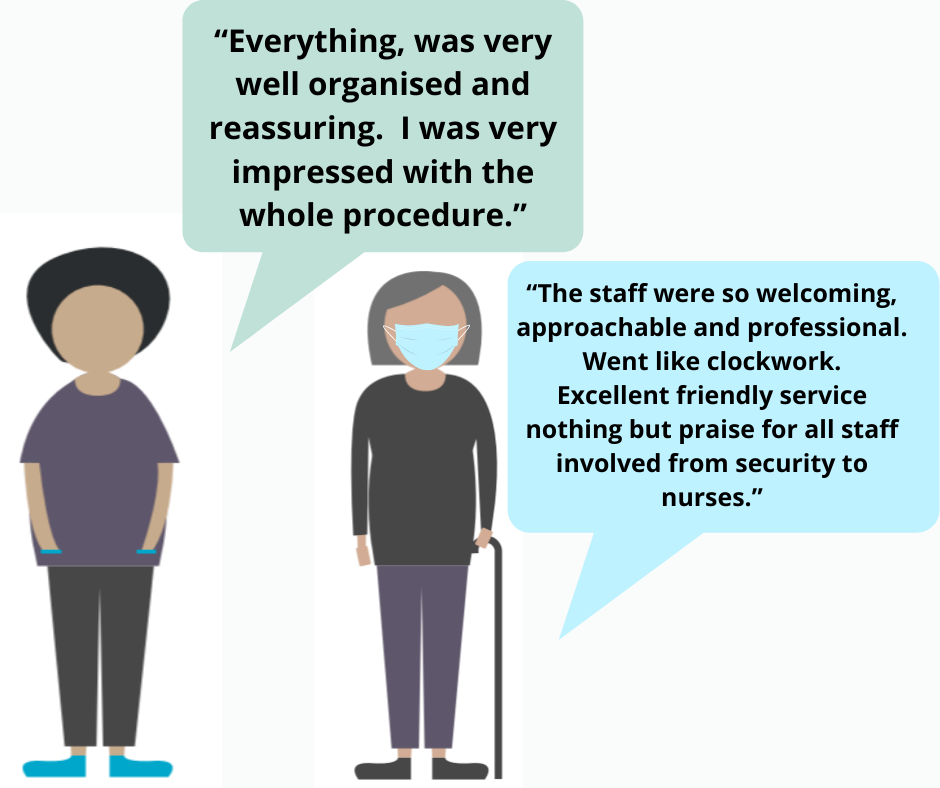
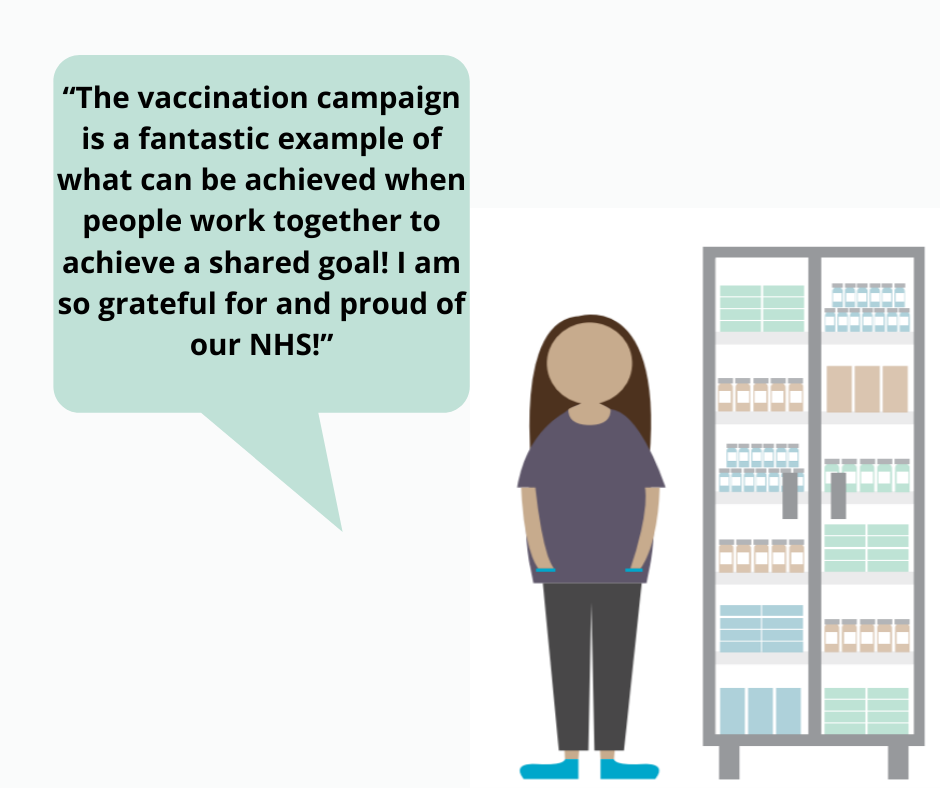
Overall, with only a few exceptions, people who completed a HIW survey reported that they had a positive experience in relation to their vaccination, with most people stating their service was excellent. Comments we received included:
|
[3] Adrenaline is a medicine used for the treatment of serious shock produced by a severe allergic reaction or collapse.
[4] An Intermediate Life Support course provides a variety of skills, from managing a deteriorating patient, identifying causes and treating cardiac arrest, to improving abilities as both a team member and leader.
Back to top

As part of our assurance work we requested a range of evidence from each health board in relation to the governance of their vaccination programmes. We found that clear structures were in place to oversee the delivery of each vaccination programme. However, in one health board, staff appeared to be unaware of who the senior managers were that had responsibility for delivering their programme. We encourage regular contact between the senior managers and staff at each of the centres to improve communication and reporting of any quality and safety issues.
We were provided with standard operating procedures that set out the arrangements put in place to deliver the vaccination programme locally at the mass vaccination centres. However, in some cases we found that the standard operating procedures differed from the processes we saw in place at the centres. Staff awareness of standard operating procedures also varied. Health boards must ensure that standard operating procedures accurately describe the agreed processes in place for each centre, and that staff are aware of the procedures for the centres at which they work.
We looked at the Patient Group Direction (PGD) documents in place at each health board that set out the procedures for the safe administration of the vaccines. In some health boards we noted that not all staff administering the vaccines had signed the latest version of the PGD. The purpose of the signature is to provide assurance that staff are aware of, and are following, the most up-to-date guidance and best practice. Health boards must ensure systems are in place to monitor whether staff have read and signed the latest versions of the relevant PGD to maintain safe and effective practice at all times.
We found variance in the volume of audit activity being undertaken at the centres we visited. Two health boards had implemented regular checks in relation to areas such as infection prevention and control and the environment of the centres to monitor compliance with agreed procedures. However, no audit activity was being undertaken in the remaining two health boards. Health boards need to ensure that they have systems in place to assure themselves that processes and systems are being adhered to fully in the centres. The absence of such arrangements could increase the risk to patient safety. In terms of good practice, we saw in one centre that a UV light box[5] was available to highlight any staff hand hygiene issues.
Staff who completed a HIW survey provided positive feedback on almost all parts of the process. The majority of staff felt that they were able to meet the demands on their time at work and that there were enough staff to allow them to do their job properly. Staff also felt safe working in the vaccination centres and said that their working pattern allowed for a work life balance. Some staff provided the following feedback in their response:
“Multi agency approach essential to the smooth running of each MVC, local authority, primary care, third sector all incredibly valuable. Volunteers are awesome! The appreciation from all the individuals attending makes all the stress worthwhile!”
“Given that the vaccination roll out was done at full speed, I think the work has been remarkable. Safety of citizens is paramount at all times, the team work astonishing. Fine tuning is ongoing, there are ways to improve and all are open to developing this”
Staff we spoke to at one centre reported that management and communication of staff rotas could be improved. We also received a similar comment from a member of staff who completed a HIW survey:
“From a patient safety perspective the centre has been great but administratively the organisation has been almost shambolic. We do not get rotas for admin staff, when we do they are wrong or are changed last minute. We are also continually overstaffed, sometimes by more than 50% - we have had to change our shift times as we aren't aware of how many staff are on until the actual day of the shift”
Health boards should check the organisation and management of staff rotas at their centres to ensure timely communication and transparency for staff working at each centre.
Back to top
[5] A UV Light Box highlights defects with hand washing and scrubbing techniques to raise awareness of potential hand hygiene issues.
|
Following our focused inspections we wrote to all health boards in Wales to provide rapid feedback on the issues identified that required urgent remedial action. We provided this summary in order to ensure that action could be taken across Wales where similar operating practices were in place. We asked all health boards to ensure that these findings were shared internally and in particular within quality and safety governance structures. Similarly, we would expect all health boards to review, reflect and learn from the findings set out in this quality insight bulletin, making improvements where needed.
We will continue to use our internal governance procedures to consider available intelligence, risk assessments and emerging issues to evaluate whether further assurance work is needed in relation to mass vaccination centres as part of our future programme of work.
Back to top
We welcome feedback, so please get in touch if you have any comments on our work.
Back to top
|