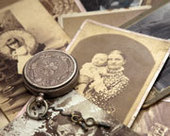
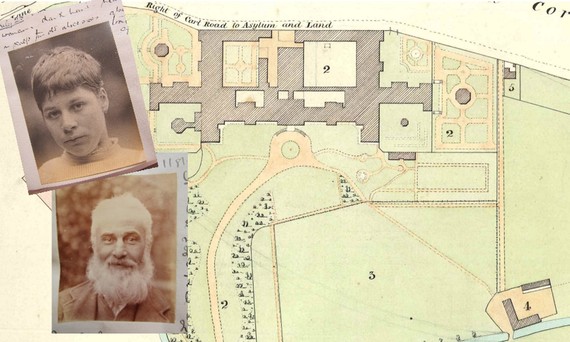
 Plan of St George's, Stafford. 19th case notes often included photographs of patients.
Wellcome Trust Research
Resources Grant
We are delighted to announce
that the Archive Service has been awarded a grant by the Wellcome Trust for a
2-year cataloguing and engagement project.
Our project ‘A Case
for the Ordinary: The Patient Experience of Mental Health Care in
Staffordshire’ will focus on the patient case records from the 3 former County
Asylums, later renamed St George’s (Stafford), St Edward’s (Cheddleton) and St
Matthew’s (Burntwood). Patient case records are not open for access until they
are 100 years old but we will make the earlier records available for research.
In addition we will be producing a database of information extracted from the
case notes with advice from academics in the fields of medical and social
history research, which will be the major research resource produced by the
project. Throughout the 2 years we will create a touring exhibition and offer a
series of talks at venues across the County about the history of mental health
care in Staffordshire. If you would like to know more about the project, which
will begin later this year, please contact Rebecca Jackson.
The project was timed to coincide with the 200th anniversary
of St George’s (and coincidentally the 70th anniversary of the NHS).
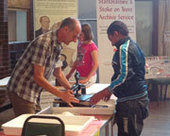
We took an exhibition about St George’s to an NHS 70th anniversary
event at the hospital in July.
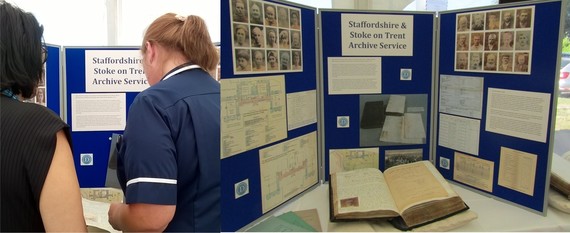 Nurses looking at the St George's Exhibition
 Burton Hospital collections
Amongst the large collections
recently relocated from Lichfield to Staffordshire Record Office is a large
collection for the Burton Hospitals and Institution. Patient records less than
100 years have an access restriction, but we can start to make available
records that are reaching 100 years, or permission can be obtained by the
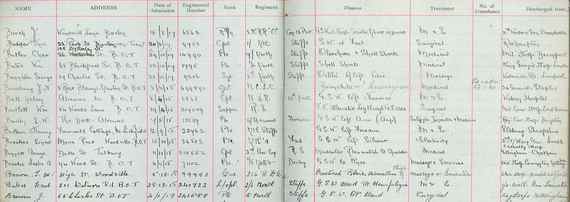
closest direct descendant. Included is this register of former soldiers who
were treated as out-patients following discharge at the end of WWI from 1917.
The volume gives name, address,
date of admission, regimental number, rank, regiment, disease (or condition),
treatment, and from where discharged. These are local men who have returned
home after discharge, some of whom have been discharged from another hospital,
mainly military or general hospitals in the UK but a few directly from France.
There are a wide range of conditions recorded including gun shot or shrapnel
wounds, fractures and other injuries or amputations, ulcers and other skin
complaints, rheumatism and lumbago, bronchitis and other breathing complaints,
fevers, stomach complaints, damage to eyes, nerve damage, neurasthenia,
myalgia, shell shock. An index has been made of all the names. There is also a
register of soldier in-patients 1918-1919, mainly from other areas (BD90).
Included in the collection is also a baptism register starting in 1911 for
Burton Workhouse, later for Belvedere Hospital (workhouse infirmary), and
continuing to 1959 as Andressey Hospital. These are contained in
collection LD475. Please remember to give advance notice to access these
records.

Treasures of the
Dead – What can probate do for your family research?
An often overlooked resource: a wealth of information can be
found in the final wishes of the deceased. The lost or hidden family
connections that you thought would never be found; the lands, trades and
possessions of ancestors lost in the mists of time.
But what are probate documents? Probate refers to the
official documents that were lodged with the courts allowing the deceased
person’s assets to be properly and legally dealt with. What might they include?
Wills were written or dictated by the individual themselves, giving you a
glimpse into their world before their death; who and what was important to
them; sometimes written in their own hand and signed with their signature. Administrations
were applied for, often by a family member, to administer the estate of the
deceased when they have died intestate (without leaving a will). Inventories
can be attached to wills or administrations and list the valuables, lands and
possessions of the deceased. These can help to build up a picture of their
social and economic status or to understand the tools of their trade.
You may be aware that we hold a large collection of original
probate, dating from 1521 -1858, but did you know that you can find Lichfield
Diocesan Consistory Court probate online at Find My Past? As a diocesan
collection you can hunt your ancestors not only into Staffordshire but also
into parts of Warwickshire, Derbyshire and Shropshire. Free access to Find My
Past is available in Staffordshire Libraries and Archives.
For some interesting examples keep an eye on twitter and
Facebook over the coming weeks. If you find your own interesting examples and
would like to share them please forward them to henrietta.martinez@staffordshire.gov.uk
In next month’s newsletter find out what happens
when things don’t quite go to plan with probate.
 Buy the Book!
We have been moving things around in the reading room at Staffordshire
Record Office to make way for our book sale, there are lots of local history books about Staffordshire and some real bargains
to be had, so if you are passing do pop in to see what we have on offer!
Our aim is to keep you updated with the latest developments and events. If you do not wish to receive this newsletter please use the 'unsubscribe' button at the bottom of this page.

|