Our Special Educational Needs and/or Disabilities (SEND) Meet and Chat drop-ins are open to anyone in Shropshire supporting a child with SEND — whether you're a parent carer, family member, or professional.
Join us for an informal drop-in session where you can ask questions, get advice, and explore the support available to you within Shropshire. Speak to a range of professionals who can help with:
- Education, health, and Care Plans (EHCPs)
- School support and advocacy
- Health and Wellbeing for children with SEND
- Social care and family support
- Mental health and emotional wellbeing
- Advice for navigating SEND challenges
Each session will have different professionals available, so come along, have a chat, and find the help you need!
Come along to ask questions, get practical advice, and connect with professionals who understand your journey. You do not need to have an official diagnosis to access these sessions
Information to help families in Shropshire - Shropshire Together Community Directory
|

We want every child in Shropshire with special educational needs and disabilities (SEND) to be healthy, happy and safe. They should have the same opportunities as other children.
We aim to provide good local support so that children can start their local primary school without needing an education, health and care plan (EHCP). The early years StepIntoSchool fund helps children with complex needs move from nurseries or childminders to primary school. It also helps children with complex needs who haven't been to nursery or a childminder when they begin primary school.
The StepIntoSchool Funding parent carer guide can be found on the SEND Local Offer -
Early years StepIntoSchool parent carer guide.
|

What is SWANN?
The Shropshire Wellbeing and Navigation Network (SWANN) is a support service for adults aged 18 and over who live in Shropshire.
It can help people get support early, before problems become more serious. A young adult, family member or unpaid carer can make a direct referral.
SWANN can connect you with different types of support, including:
- support after leaving hospital
- mental health and emotional wellbeing support
- meeting people and social activities
- befriending
- learning everyday living skills
- help with using computers and technology
- building confidence and independence
- finding local groups and services.
Read more: https://newsroom.shropshire.gov.uk/2026/09/shropshire-swann-self-referral-wellbeing-support/
|
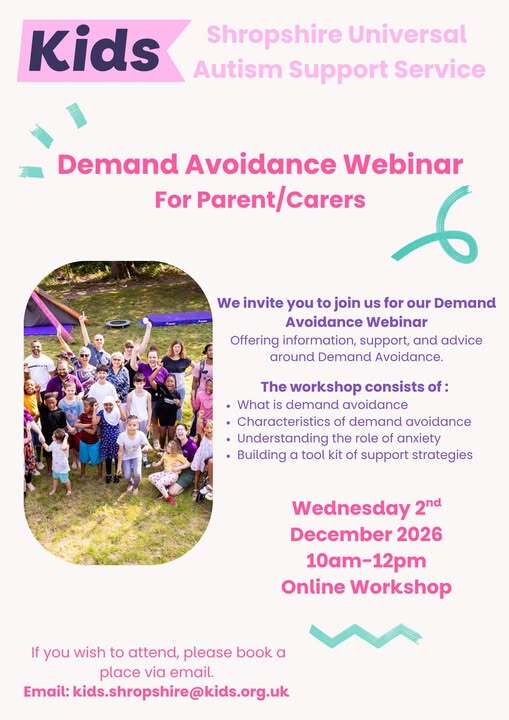
Shropshire's universally available autism support service - KIDS is hosting a webinar looking at Demand Avoidance on Wednesday 2nd December. To book a place please email Kids.Shropshire@Kids.org.uk
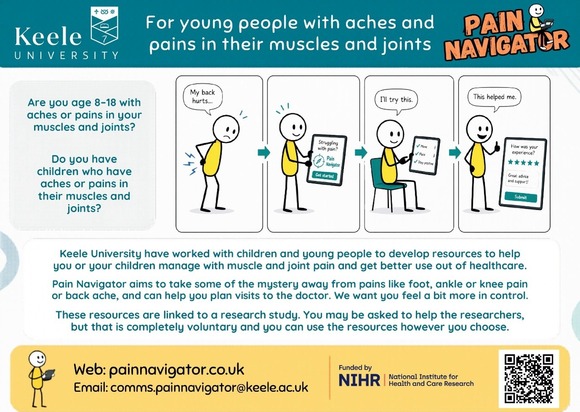
Keele University has been working with children and young people to develop resources to help parent carers and children and young people manage with muscle and joint pain. Find out more on this link Understand pain and feel more in control | Pain Navigator

It’s fair to say that all parents from time to time need some help and support with issues that impact on family life. There is help and support available in Shropshire through our Early Help coffee and chat drop ins – some of which are also stay and play sessions.
You can get free Information, advice and support on all aspects of family life, at our Family Drop-Ins. You can chat, have a cuppa and see how we can help you with:
- Family life
- Parenting support
- Domestic abuse support
- Money worries
- Housing support
- Special Educational Needs and Disabilities (SEND)
- and much more
To find your local drop in please visit the Shropshire Family Information Service Directory.
|

A large proportion of schools in Shropshire provide support for children’s social and emotional development through ELSA interventions. Emotional Literacy Support Assistants (ELSAs) have received specialist training, most often through the Shropshire Educational Psychology Service, and attend ongoing supervision with an Educational Psychologist to support the quality of their work.
ELSA interventions are intended to help children overcome barriers to learning that may be linked to their emotional wellbeing, confidence, relationships or ability to manage day-to-day challenges. ELSA support is not counselling or therapy. It is a structured, school-based intervention designed to help children develop specific social and emotional skills that can be practised and used in everyday life. For instance, ELSA support may help children to:
- recognise, understand and manage their emotions;
- develop confidence and self-esteem;
- develop social and friendship skills;
- cope with worries or feelings of anxiety;
- manage strong emotions, including anger and frustration;
- improve relationships with peers;
- develop skills for managing conflict and solving problems; and
- cope with experiences of loss, separation or bereavement.
How ELSA Support Works
A child who may benefit from ELSA support is identified within school and a referral is made to the school’s ELSA through the SENCo and/or Head Teacher, as appropriate. The child's strengths, needs and current experiences are considered, and a clear area of social or emotional development is identified as the focus for support.
ELSA interventions are usually time-limited and typically last around 6 to 8 weeks. Each intervention has a clear and achievable outcome so that support remains focused and purposeful. During this time, the ELSA delivers planned activities and discussions designed to help the child develop specific skills, strategies or understanding linked to their identified area of need.
Working Together with Parents and Carers
Working in partnership with parents and carers is recommended. Parents and carers know their child best and can provide valuable insights into their child's strengths, interests, experiences, motivations and the things that help them feel safe, supported and successful. Where appropriate, schools will share information about why ELSA support is being offered and what the intervention is hoping to achieve. Parents and carers may be able to contribute information that helps the ELSA gain a fuller understanding of the child's experiences and needs. There are also opportunities for parents and carers to reinforce new skills at home through everyday interactions.
At the end of an intervention, parents' and carers' perspectives can help schools understand whether changes have been noticed beyond the ELSA sessions themselves. This contributes to a shared understanding of the child's progress and helps inform decisions about any future support that may be helpful.
Can Parents Ask for ELSA Support?
If parents or carers have concerns about their child's social or emotional wellbeing, they are encouraged to discuss these with the SENCo or another appropriate member of school staff. Schools have a range of approaches to supporting children’s social and emotional development, and ELSA support is one of many possible forms of help. Where ELSA support is available, the school will consider the child’s individual strengths and needs and decide whether this is the most appropriate support at that time. Schools also need to consider the needs of other pupils and the time available within the ELSA service. As a result, some schools may need to prioritise support for certain children or operate a waiting list. The decision about which children receive ELSA support therefore rests with the school.
ELSA Support and EHCPs
Where ELSA support contributes towards needs or outcomes identified within an EHCP, it should still take the form of focused, time-limited interventions with clearly identified targets. A child may therefore receive a number of separate blocks of ELSA support over time, each addressing a different area of need or stage of development. A break between interventions is often appropriate. This gives children opportunities to practise, apply and generalise the skills they have developed before beginning another block of support. When there are multiple areas of need, these are usually prioritised and addressed one at a time rather than through several ELSA interventions running simultaneously.
When delivered at the right time and for the right reason, ELSA interventions can help children develop greater emotional understanding, confidence, resilience and independence, supporting them to feel more successful both in school and beyond
|

Moving to a new school, college or stage of education can be a big change for children and young people with SEND. There can be lots for families to think about, and it is not always clear what should happen or when.
PaCC has created a new Transitions in Education Guide to help Parent and Family Carers understand the process and plan ahead.
The guide includes information about choosing a school or college, important transition deadlines, EHCPs, open days, preparing for a move, transport, post-16 education and support for higher education. It also includes practical ideas to help make transitions easier for children and young people.
Good transition planning is about more than changing education settings. It should consider your child or young person’s social, emotional and physical needs, as well as the support they need to feel safe and confident.
Take a look at the guide, save it for later and share it with other SEND families who may find it useful.
Read more: PaCC Transition Guide
|
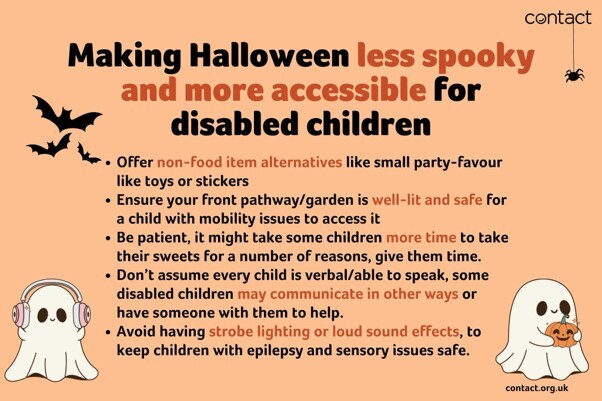
It's that time of year again! Our friends at Contact have shared some tips on we can make our homes a little less spooky (if that's more your thing) and much more accessible for disabled children.
- Offer non-food item alternatives like small party-favour like toys or stickers
- Ensure your front pathway/garden is well-lit and safe for a child with mobility issues to access it
- Be patient, it might take some children more time to take their sweets for a number of reasons, give them time.
- Don’t assume every child is verbal/able to speak, some disabled children may communicate in other ways or have someone with them to help.
- Avoid having strobe lighting or loud sound effects, to keep children with epilepsy and sensory issues safe.


Our Family Information Service provides information on things to do over the school holidays, so keep checking this link to share with families – they've already added over 100 things to do
Things to do during October half term
For any families whose children are registered with All In Short Breaks they can visit this website to see what is available - All In Short Breaks
|

Find out more about our Youth Advisors – a group of young people aged 16 to 25 from across Shropshire who want to make a positive difference. They share their views, ideas and lived experiences to help shape decisions and improve the services and support that affect young people across the county.
Youth Advisors provide a valuable young person’s perspective, helping decision-makers understand what matters to young people and how services could work better for them. Hear directly from some of the Youth Advisors about why they chose to get involved, what they hope to achieve and why it is important that young people have a meaningful voice in decisions about their lives and communities.
Watch the video to meet some of Shropshire’s Youth Advisors and hear, in their own words, what being involved means to them. Click this link to watch the video.
If you know of any young people who would be interested in becoming a Youth Advisors look out for the next expression of interest which will be launched during National Youth Work week at the beginning of November – keep an eye on the Local Offer social media accounts or email youthvoice@shropshire.gov.uk
|


We all know how important a good night’s sleep is for your child’s growth and development. When children sleep well, it helps them do better at school, react more quickly, build stronger memories, and learn and solve problems more effectively. It can also help them stay healthier, feel less irritable, and manage their behaviour more positively.
There are many different factors that can affect your child’s sleep, and it can sometimes feel hard to know where to start. Join us to learn more, share experiences, and pick up helpful tips to support your child in getting the rest they need.
Upcoming Session (once a week over 5 weeks, excl. half terms and bank holidays)
12th November 2026 from 9.30 to 11.30am Virtually via MS Teams
The SEND groups are suitable for parents/carers of children who have special educational needs and disabilities, no formal diagnosis is needed to attend our groups.
What We’ll Talk About
- Benefits of good sleep for our health and emotional wellbeing
- Sleep and bedtime routines for the whole family
- Sleep diaries
- Nutrition and food and their impact on healthy sleep and bedtime routines
- Meet other parents/carers to share and discuss experiences
“It’s been eye opening to see how many different things can affect children’s sleep. I have learnt so much and now have new ideas to try out.”
“I feel more confident in bedtime routines, and less alone in the fact my child struggles with sleep”
Want to Join Us? Email: parenting.team@shropshire.gov.uk or Call: 01743 250950
|


As parent carers of children and young people with SEND, your perspective is important to us.
We are conducting a survey to gather your thoughts on how information can be made more accessible and user-friendly for families like yours.
Your feedback will play a central role in guiding a comprehensive review of our SEND Local Offer website (https://next.shropshire.gov.uk/the-send-local-offer/) Your views will ensure the SEND Local Offer continues to develop to meet your needs and those of others in the SEND community.
By sharing your experiences and suggestions, you will help us create an information resource that is truly tailored to support you.
Have your say on Improving SEND information in Shropshire.
|


We are pleased to welcome a supported intern to the SEND Local Offer team.
A supported internship gives a young person with SEND the opportunity to gain valuable workplace experience, develop practical skills and build confidence with tailored support.
This appointment is important because it helps create a more inclusive workplace, supports a young person to take positive steps towards paid employment and enables our team to learn from their skills, ideas and lived experience. Welcome to the team Jack! We'll share more in the next edition.
|
|
Following agreement at our AGM, PaCC has officially become a Charitable Incorporated Organisation (CIO). Our registered name is now Parent Carer Community Shropshire (Charity No. 1217025), but we’ll continue to be known as PaCC Shropshire.
While you may notice some changes to our logo, website and social media over the coming months, who we are and what we do isn’t changing.
We’ll continue to champion the voices and lived experiences of Shropshire SEND families and work to improve experiences for children and young people with SEND aged 0–25 and their families. This change gives PaCC a stronger foundation to grow and continue supporting the Shropshire SEND community into the future.
Read more: Parent Carer Community CIO Announcement - PACC Shropshire
|

More Support While Waiting for Assessment. Families whose children are awaiting a neurodevelopmental assessment continue to receive support while they wait. The Midlands Partnership University NHS Foundation Trust (MPFT) team is now making more than 300 contacts every month with families on the waiting list. The aim is to ensure families can access information, advice and support based on their child's needs without having to wait for an assessment or diagnosis. More signposting here.
New Online Groups for Young People. Kids Universal Autism Support has launched two new online groups for young people:
- An Emotionally-Based School Avoidance (EBSA) group.
- A Youth Group for young people aged 14-19.
The groups have been extremely popular, highlighting the value of opportunities for young people to connect with others, share experiences and build confidence in a supportive environment. Find out more here.
Monthly Information Sessions for Parent Carers. The Parent Carer Community (PaCC) continues to run free online information sessions for families. Each session focuses on a different topic related to neurodiversity and provides an opportunity to learn more, ask questions and connect with services and other parent carers. Families regularly report that these sessions are helpful, informative and supportive. More information here.
New Group for Autistic Parents. Shropshire Autism Hub has launched a new Autistic Parents Group. The group provides a welcoming space for autistic parents to meet others, share experiences and shape the activities and topics they would like the group to focus on. As the group is led by the interests of those attending, it can respond to what autistic parents say is most important to them. Find out more here.
Continued Support for Secondary Schools. Every secondary school in Shropshire has been offered a free session each half-term with a Neurodiversity Practitioner (NDP) from the Educational Psychology Service. These sessions support schools to strengthen inclusive practice and enhance support for neurodivergent learners, helping to build understanding and confidence across staff teams.
Positive Feedback from the Understanding Attention Deficit Hyperactivity Disorder (ADHD) Roadshow. The Understanding ADHD training was delivered in multiple locations across Shropshire during 2025-26 and received very positive feedback from attendees. As a result of its success, this training will now be offered free of charge to all schools in Shropshire.
|

We know the Education, Health and Care Plan (EHCP) process can sometimes feel difficult to navigate. We are making changes to improve the support, information and communication families receive.
What is changing?
We have reorganised the EHCP Team to increase capacity and improve consistency. New EHCP and Annual Review templates are also now in use, following feedback from families. They are designed to make plans clearer and easier to understand.
Who is in the team?
Annie Williams is the EHCP Team Manager. The team is organised by age and stage of education, with dedicated teams for Early Years and Key Stage 1, Key Stage 2, Key Stages 3 and 4, post-16, and specialist cases. Each team includes experienced officers who work together to support children, young people and families. You can find the right officer for your child or young person in the Case Officer allocations list: https://next.shropshire.gov.uk/media/biwcivax/case-officer-allocations-all-key-stages-september-2026.pdf. If you are unsure who to contact, email EHCPTeam@shropshire.gov.uk or call 01743 254267.
Reducing delays
We are sorry that some families have waited longer than expected for assessments, plans or Annual Review updates. Our dedicated recovery team is working through delayed cases. Recruitment challenges mean this may take longer than we first planned. We will continue to prioritise cases and keep families updated. Your Case Officer may sometimes change so another member of the team can continue the work and complete important actions. We understand that a change of officer may be difficult. We only make this change when needed to help prevent further delays, and we appreciate your patience.
Moving to a new stage of education
If your child or young person is moving to a new stage of education, their Annual Review will help us plan their next placement. We must issue the final updated EHCP by 15 February for most school transfers and by 31 March for post-16 transfers.
You can help by asking your child or young person’s school SENDCO when their phase transfer Annual Review will take place. We have asked schools to send the review paperwork to us by 31 October. This gives us time to consider the information, identify a suitable setting and work towards the legal deadline.
Touch point meetings
Families can ask for an optional touch point meeting with their Case Officer. When the draft EHCP is issued, families will have at least 15 days to share their views and request a Touch Point meeting. This is an opportunity to meet the officer, talk through the process and ask questions, discussing the draft plan and the advice gathered. To arrange a meeting, please contact your Case Officer to book a suitable time.
Contact and useful links
Email is usually the quickest way to contact the EHCP Team. If you know your child or young person’s Case Officer, please email them directly. If you do not know who the Case Officer is, email EHCPTeam@shropshire.gov.uk or call 01743 254267 on Monday to Wednesday, 8.45am to 5pm, or Friday, 8.45am to 4pm. The phone line is closed on Thursdays so officers can focus on progressing cases. The team aims to reply within five working days, although this may take up to eight working days during busy periods.
When emailing as a parent carer, adding PARENT to the subject line will help the team identify your message.
Independent support for families Shropshire SENDIASS: free, impartial and confidential information, advice and support about SEND for children, young people, parents and carers. https://www.shropshiresendiass.com/ PACC Shropshire: the independent parent carer forum, offering information, community support and opportunities for families to help shape local SEND services. https://www.paccshropshire.org.uk/
|

The SEND and Inclusion Partnership Board brings together leaders from education, health, social care and parent carer organisations. Its job is to help make SEND services in Shropshire work better for children, young people and families.
The Board looks at the big picture. It checks whether plans are making a real difference, helps remove barriers, and asks partners to work together so that children and young people with SEND can be healthy, happy, safe and able to achieve their potential.
The Board also keeps a close eye on improvement work, including the SEND and Alternative Provision Strategy, the SEND action plan and the Accelerated Progress Plan. It receives updates from the Quality Assurance Group, which checks progress and quality across SEND workstreams.
Who is on the Board?
Board members include senior leaders from Shropshire Council and the NHS Integrated Care Board, alongside representatives for parent carers, SEND information and advice, education settings, health services and social care. Some members are core members, which means they help lead and make decisions. Others are associate members, who bring specialist knowledge, advice and views from their area of work.
-
Co-chairs help lead the Board and make sure partners stay focused on improving outcomes.
-
Parent carer and SEND advice representatives help bring the views and experiences of families into discussions.
-
Children and young people’s voice is included so that decisions are shaped by lived experience.
-
Health, education and social care leaders help make sure services work together and take shared responsibility.
-
Data and quality assurance representatives help the Board understand what is working well and what needs to improve.
-
Education, health and social care associate members provide advice from schools, colleges, health providers and care services.
What does this mean for families?
The Board is not there to look at individual cases. Its role is to improve the SEND system as a whole, so that support is clearer, more joined up and easier for families to understand and access.
Families can help by continuing to share their experiences through parent carer engagement, surveys, SEND events and the Shropshire Parent and Carer Council. Feedback from families helps leaders understand what is working and where change is still needed.
If you need help with an individual SEND question, you can contact Shropshire SEND Information, Advice and Support Service or visit the SEND Local Offer for information about services, support and next steps.
|


You may have heard about the government’s planned SEND reforms and be wondering what they could mean you and your family.
The reforms aim to change how children and young people with SEND are supported, so that help is available earlier, services work better together and families have a clearer, more consistent experience.
We have recently updated our page dedicated to the SEND reforms, click to see it here. As we went to press we learned that Shropshire Council's SEND Reform Plan had been approved by the Department for Education. We will update the website in the next month and tell you more in our next enewsletter
|
|