|
This week's headlines and highlights |
|
Welcome to the UKRI bulletin, featuring the latest news, funding announcements and stories about research and innovation in action. |
|
THIS WEEK'S TOP STORY: Mathematicians discover how to stop sloshing |
|

Applied mathematicians at the University of Surrey are identifying ways to reduce how much liquids slosh around inside tanks. Baffles slow down the movement of fluid by diverting its flow – the EPSRC-funded researchers found that two or three porous baffles dividing a tank calm sloshing better than a single separator, but the returns diminish as more baffles are added. The findings could help mathematicians and engineers design better tankers to transport liquids on land or at sea and also be used in tuned liquid dampers, which reduce the sway of skyscrapers in earthquakes and high winds.
|
|
 |
|
A network of seven NERC facilities that host environmental analytical facilities and field equipment and expertise has received an investment of £70 million. The facilities are led by the British Geological Survey, National Centre for Earth Observation and National Centre for Atmospheric Science and the funding will enable UK researchers to continue to access the equipment that underpins environmental science.
|
|
|
 |
|
Researchers at The Open University (OU) have been awarded £7 million from Research England to create a new centre for protecting women against violence online. The new centre, based in Milton Keynes, will develop research to inform law, policy, technology development and practice to prevent and reduce harms suffered by women and girls online. |
|
|
 |
|
Botanical gardens can cool urban air by 5°C during heatwaves, according to research led by the University of Surrey. Parks and wetlands have a similar effect. The study analysed how green spaces and waterways cool down cities and towns and found that botanical gardens, wetlands, rain gardens and green walls cooled the air considerably. The research was supported by EPSRC, NERC and AHRC.
|
|
|
 |
|
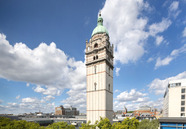
An alternative protein research centre, aimed at advancing the development of fermentation-based foods has received £12 million of funding from UKRI. The initiative will identify innovative fermentation methods to create ingredients that mimic the flavour and texture of animal products. Led by Imperial College London, the Microbial Food Hub will explore techniques including biomass fermentation and traditional fermentation. IMAGE CREDIT: Imperial College London
|
|
|
 |
|
A study led by researchers at the University of Stirling has uncovered the crucial roles of bacteria living on plastic debris. The NERC-funded research also identifies bacteria that could assist in plastic biodegradation, offering new insights for tackling plastic pollution. Plastic pollution is a worldwide problem, with up to two million tonnes estimated to enter oceans every year. |
|
|
THE ONE TO WATCH: From gamer to cloud systems engineer |
|
Growing up, Jacob Ward was always interested in computers – starting from gaming and then modifying the old PCs he could find in the attic. Today he’s part of a team that keeps thousands of servers running for a cloud infrastructure, so that scientists have the computer resources they need without having to maintain their own systems. Through this, he’s helping support important research including the Euclid Telescope, a deep space mission looking at the expansion of the universe. In this video, learn more about his fascinating work and how he got here.
|
|
More UKRI research and innovation in action |
|
 |
|
A study shows that UK solar parks can provide vital resources to help stem the decline in the nation’s bees and butterflies. The new NERC-funded research by scientists at Lancaster University and the University of Reading recorded around 1,400 pollinators across more than 30 species, including nearly 900 butterflies, more than 170 hoverflies, more than 160 bumble bees, moths and honeybees.
|
|
|
 |
|
IMAGE CREDIT: University College London
|
|
|
 |
|
A long-running experiment shows that it is possible to maintain or increase yields of wheat over nearly 200 years with either inorganic fertilisers or organic manure. The Broadbalk field experiment at BBSRC-funded Rothamsted Research has also found that changes in management have been needed to ensure that soil acidity, weeds and diseases are controlled. |
|
|
AND FINALLY IN THE NEWS: Helping the fight against malaria |
|
After decades of research, the first malaria vaccine RTS, S was approved in 2021, and trials have already shown that when combined with antimalarial drugs it reduced severe malaria cases and deaths by nearly two thirds. A second vaccine developed by the University of Oxford has also just been approved, with similar effectiveness, and it’s cheaper so we can manufacture it at an even bigger scale. This milestone is a huge achievement as malaria vaccines are particularly hard to develop because malaria is caused by a parasite which is much more complicated genetically than bacteria or viruses.
|
|
|
|