|
This week's headlines and highlights |
|
Welcome to the UKRI bulletin, featuring the latest news, funding announcements and stories about research and innovation in action. |
|
THIS WEEK'S TOP STORY: Electric rail freight solution to tackle parcel distribution |
|

A fully-electrified rail service will replace diesel on high-speed delivery routes, supported by First of a Kind (FOAK) funding to drive net zero rail opportunities.
Rail logistics expert Varamis Rail has partnered with parcel distribution and logistics companies to deliver a transformative parcel conveyance service using repurposed passenger stock, helping to support the growth of electric rail freight transport in the UK. A diversification from road transport to include other forms such as rail can create significant benefits and support UK low emissions targets.
FOAK is a Small Business Research Initiative (SBRI) competition funded by the Department for Transport and delivered in partnership with Innovate UK.
|
|
 |
|
Social media algorithms amplify extreme content, such as misogynistic posts, normalising harmful ideologies for young people, finds a report by the University of Kent, UCL and the Association of School and College Leaders. The AHRC-funded research found a fourfold increase in the level of misogynistic content in the ‘For You’ page of TikTok accounts over just five days on the platform. |
 |
|
An AI-powered four-legged robot has been developed to help visually impaired people move more independently through museums, shopping centres, hospitals and other public places. University of Glasgow EPSRC-funded researchers have partnered with industry and two leading charities to develop the RoboGuide, to help blind and partially sighted people. IMAGE: University of Glasgow.
|
 |
|
An international competition where cybathletes race against each other using their brainwaves alone has been won by a team led by the University of Bath. The technology was invented by the EPSRC-funded scientists who research and develop headsets that can act as interfaces between the human brain and computers. IMAGE CREDIT: NeuroCONCISE team
|
|
|
THE ONE TO WATCH : UKRI Future Leaders Fellowships Impact Awards winners |
|
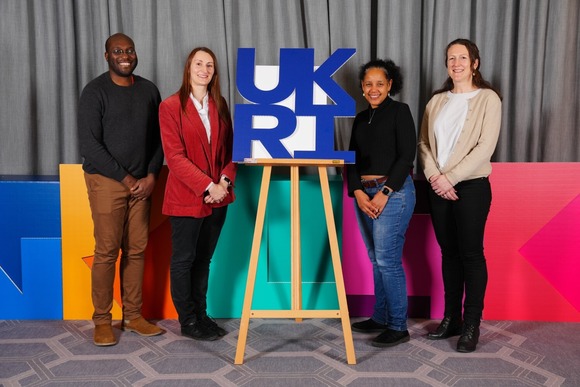
The Future Leaders Fellowships (FLF) inaugural awards were celebrated at UKRI’s annual FLF conference in Manchester, shining a spotlight on the next wave of world-class leaders in academia and business.
These future leaders are tackling ambitious programmes or multidisciplinary questions, and new or emerging research and innovation areas and partnerships.
The first FLF Impact Awards received over 60 entries across four categories: advancing culture, leadership, public engagement, and research and innovation.
|
|
More UKRI research and innovation in action |
|
 |
|
Scientists have shown that storing your eggs on the worktop rather than in the fridge – and how you cook them – matters to preserving vitamin D. Researchers at Newcastle University analysed eggs cooked in different ways to determine how the concentration of vitamin D was affected. The study is part of an Innovate UK funded research. |
|
|
 |
|
Four partnerships that will drive sustainable and inclusive economic growth and reduce regional disparities in the UK have been awarded nearly £20 million in UKRI funding. The Local Policy Innovation Partnerships (LPIPs) will bring together devolved governments, local authorities, local businesses and local communities to help research and innovation address local challenges.
|
|
|
 |
|
Hundreds of UK spin-outs, established with taxpayer-funded bioscience research, have contributed billions to the economy and created thousands of jobs. Cambridge Policy Consultants Ltd reviewed the economic impact of 457 spin-out companies established after years of BBSRC support and found the spin-outs have contributed £5.2 billion to the economy.
|
 |
|
Scientists have found that the West Antarctic Ice Sheet shrank suddenly and dramatically at the end of the Last Ice Age around 8,000 years ago. The University of Cambridge and NERC-funded British Antarctic Survey (BAS) study shows that in one location the ice sheet thinned by 450 metres in under 200 years – the first evidence anywhere in Antarctica for such a fast loss of ice. IMAGE CREDIT: University of Cambridge/BAS.
|
 |
|
A new £100 million fund will unlock the potential of engineering biology. Six new UKRI Engineering Biology Mission Hubs and 22 Mission Awards are being funded to transform solutions in areas like vaccine, textile and food production. Engineering biology has enormous potential to address global challenges, drive economic growth, and increase national security, resilience and preparedness. |
|
|
AND FINALLY: Smell the roses ... |
|
Stopping to smell the roses is a bit of a letdown these days. This is because most roses sold in our shops are bred for beauty and durability, rather than smell. The trade-off being that the genes needed for that famous rose smell have been lost over time. But scientists identified a gene that produces the enzyme RhNUDX1, responsible for scent in roses. If we can breed this back into varieties– or even add it through gene editing – things could come up smelling of roses.
|
|
|
|