|
This week's headlines and highlights |
|
Welcome to the UKRI bulletin, featuring the latest news, funding announcements and stories about research and innovation in action. |
|
THIS WEEK'S TOP STORY: Study uncovers potential origins of life in ancient hot springs |
|

The NERC-funded Newcastle University research team found that mixing hydrogen, bicarbonate, and iron-rich magnetite under conditions mimicking hot springs results in the formation of a spectrum of organic molecules, notably including fatty acids.
The findings potentially reveal how some key molecules needed to produce life are made from inorganic chemicals, which is essential to understanding how life formed on Earth billions of years ago.
|
|
ONE TO WATCH : Research England E3 fund investing in projects across England |
|
Research England is investing £156 million in projects across England including rural and coastal health research, mathematics for artificial intelligence, digital innovations in health and social care, and blended realities. Research England’s Expanding Excellence in England (E3) Fund will support 18 universities to expand their small but outstanding research units, helping these units increase their research skills and build research capacity and quality to benefit local economies, society, and cultures. Watch the film that explains the E3 fund and showcases three units that received the first round of funding. |
|
More UKRI research and innovation in action |
|
 |
|
A trial is helping patients with severe depression show substantial improvements in the severity of their depression, anxiety and thinking by using MRI neuronavigated Transcranial Magnetic Simulation (TMS). The BRIGhTMIND trial was led by experts at the University of Nottingham and funded by MRC and the National Institute for Health and Care Research. |
 |
|
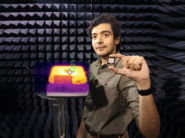
Wireless temperature sensors could be cheaper and more sustainable thanks to the development of a new method of measuring temperature through a soft and flexible ‘smart skin’ sensor. The new temperature sensor was developed by a team led by ESPRC-funded researchers from the University of Glasgow and is capable of reading temperatures from 30°C to more than 200°C. |
 |
|
A robotics harvesting service may soon be available to UK raspberry growers thanks to a £515k grant from DEFRA and Innovate UK. Fieldwork Robotics, developers of selective, adaptive and modular harvesting robots, has been awarded the grant to accelerate its £1.1 million BerryBot Project which is focused on increasing the performance and robustness of Fieldwork Robotics’ raspberry harvesting robot, Alpha. |
|
|
 |
|
Researchers have discovered the oldest black hole ever observed, dating from the dawn of the universe, and found that it is ‘eating’ its host galaxy to death. The international team, led by the University of Cambridge and funded by STFC, used the James Webb Space Telescope to detect the black hole, which dates from more than 13 billion years ago. |
|
|
 |
|
Extreme weather influences mortgage payments according to research from an ESRC-funded international collaboration. The research found that when cyclones and floods hit populated areas, people’s ability to pay their mortgage differs depending on the type and intensity of the extreme weather. The more powerful the cyclone, the greater the chance that borrowers will miss or delay mortgage payments. |
|
|
AND FINALLY: Plant-based meat alternatives could be improved with one ingredient |
|
|
Plant-based meat alternatives could be improved with one ingredient.
When asked why they are not keen on plant-based alternatives to meat, people often point to the dry taste. Step forward scientists who have made big strides in transforming plant proteins to provide a juicy texture. The team from the School of Food Science and Nutrition at the University of Leeds achieved this by adding just water to create plant protein microgels in a process called microgeletion, transforming plant proteins without having to use any added chemicals or agents.
|
|
|
|