|
This week's headlines and highlights |
|
Welcome to the UKRI bulletin, featuring the latest news, funding announcements and stories about research and innovation in action. |
|
THIS WEEK'S TOP STORY: Ancient DNA reveals why MS and Alzheimer's rates in Europe are so high |
|
 34,000 year-old DNA has shown why multiple sclerosis and Alzheimer’s rates in Europe are so high.
Analysis of bones and teeth from almost 5,000 humans also explains how the MS gene once protected ancient farmers and why Northern Europeans today are taller than Southern Europeans.
The ‘astounding’ results have been revealed in four trailblazing papers published in Nature, linked from here, and provide new biological understanding of debilitating disorders.
The University of Cambridge and University of Oxford research used MRC-funded UK Biobank data.
Image:SayoStudio
|
|
 |
|
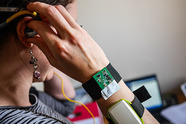
A wristband could revolutionise Parkinson's treatment. The technology allows mobility-related activities to be monitored in patients at home, to determine how effective a new drug or treatment is. Currently, to gather this evidence which is needed to take a new drug to market, each patient must travel to hospital to be observed. The technology from the University of Bristol has received EPSRC funding. Image: SPHERE-IRC |
 |
|
Researchers have identified risk factors for young-onset dementia, challenging the notion that genetics are the sole cause of the condition. The University of Exeter study used MRC-funded UK Biobank data to identify 15 risk factors similar to those for late-onset dementia. The findings indicate that it may be possible to reduce the risk of young-onset dementia by targeting health and lifestyle factors. |
|
|
ON THE BLOG : How the impact of quantum can be as big as AI |
|
|
The potential of quantum technology is no less dramatic than AI.
Kedar Pandya, Executive Director of Cross-Council Programmes, EPSRC, explains in our latest Voices blog, that while quantum technologies don’t get the same exposure as AI and aren’t as understandable to the average person, the impact is just as big.
We are starting to see real-world applications in quantum technologies which are expected to solve major challenges across many sectors.
|
|
More UKRI research and innovation in action |
|
 |
|
Analysis from nearly 1,500 supernovae has produced one of the most robust measurements of the constraints of the Universe's expansion to date. Findings from the Dark Energy Survey (DES) collaboration – an international group of researchers with UK support from STFC and six UK universities – offers new support for the standard model of a universe with an accelerated expansion. |
 |
|
New generation of environmental scientists. Four new centres for doctoral training will boost UK expertise in flood management, wetland restoration, sustainable mineral resources and freshwater quality. The NERC-funded centres will support the next generation of PhD students as they build careers in research, business and public service. Each centre will receive £2.6 million. |
|
|
AND FINALLY: The pros and cons of being a UK butterfly |
|
|
A new study shows UK butterflies are not as good at regulating their body temperature as their Spanish cousins but Spanish butterflies are more at risk of extinction caused by rising global temperatures.
NERC-supported research from the University of Cambridge looked at butterfly populations in Catalonia in northern Spain. They found both UK and Spanish butterflies use heat-avoiding behaviour when temperatures rise, but Spanish butterflies may not be able to adapt quickly enough to survive global temperature rises.
UK butterflies may initially benefit but rely on finding warm microclimates. Habitat loss, therefore, is an equally important threat to butterflies. Image: University of Cambridge.
|
|
|
|