|
UKRI Headlines and Highlights |
|
Welcome to the UKRI bulletin, featuring the latest news, funding announcements and stories about research and innovation in action. |
|
The covid pandemic disproportionately affected children in BAME families by exacerbating inequalities according to a new study.
Research from UCL, Goldsmiths and Royal Holloway found that black and ethnic minority communities experienced greater anxiety over work, education, and disproportionate attention from police during the pandemic.
The £2.5 million project details an investigation exploring the impact of the pandemic on people of Black, Asian and Minority Ethnic backgrounds. (BAME).
The Co-PoWeR report reviewed the impact of efforts to stop the virus spreading on family life, education, and parenting.
It found that the disproportionate impacts of the disease were exacerbated by pre-existing racial and structural inequalities.
The work forms part of a larger Economic and Social Research Council (ESRC) and UK Research and Innovation (UKRI) funded project. Read more.
|
|
 |
|
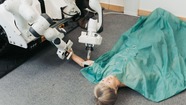
Robots go where doctors can’t – New robot medics will be able to check a person’s heart rate, blood pressure and give injections in high-risk areas like in war zones and humanitarian disasters.
University of Sheffield researchers developed the technology at the Innovate UK-established Advanced Manufacturing Research Centre. Find out more and watch the video.
Image credit: University of Sheffield AMRC
|
|
|
 |
|
In a study led by the University of Surrey and funded by BBSRC, researchers found that chickens treated with a novel metal-derived complex, had much lower bacterial shedding in their faeces 24 hours later.
|
|
|
 |
|
Scientists from the University of Exeter examined “tooth rake marks” on whales’ skin and found males had fewer marks if a mother who had stopped breeding was present. The study was supported by NERC.
An adult male with travelling with its post-reproductive mother. Image information Credit David Ellifrit / Center for Whale Research
|
|
|
 |
|
World first carbon footprint tool - By 2025, there will be an estimated 180 zettabytes of data created from things like phones and emails.
Image: Glenn Carstens-Peters on Unsplash
|
|
|
THE FILM TO WATCH: 101 jobs that change the world |
|
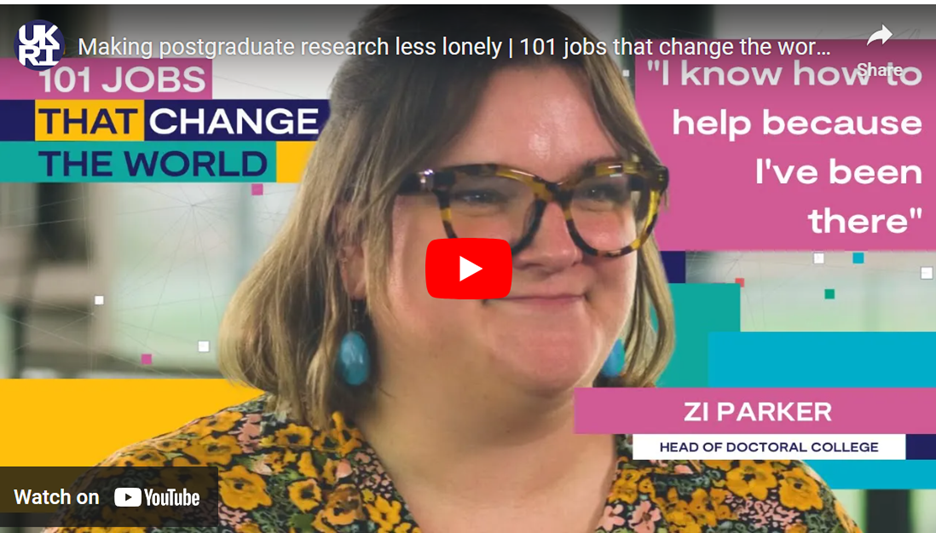
During her postgraduate research programme, Zi Parker struggled with loneliness and found it wasn’t for her. Now, as the Head of Doctoral College at Queen Mary University London, she helps postgraduate researchers get the support that she needed when she was doing her PhD.
Find out how Zi works hard with her team to make sure that postgraduate researchers know they’re not alone and that they feel part of a community.
The video is part of our 101 Jobs series that aims to highlight some of the many roles that contribute to the success of the research and innovation system
Find out more
|
|
UK Research and Innovation in Action |
|
 |
|
Hydrogen-electric airline drivetrain completes first tests
Innovate UK-funded ZeroAvia has completed the initial flight testing of the ZA600 hydrogen-electric powertrain with the prototype engine meeting the highest anticipated performance threshold. The 10th flight in the initial series was completed in July 2023 – the next stage of testing and demonstration will be the first cross-country flights.
|
|
|
 |
|
Extraordinary archaeological discoveries from a frozen 16th century Alaskan village can now be viewed online for the first time. The Nunalleq Digital Museum and Catalogue features some 6,000 objects found over a decade, including dolls, ceremonial dance masks, jewellery, cooking utensils and sewing tools. Funding from the Arts and Humanities Research Council.
|
|
|
 |
|
A potent anti-cancer therapy has been created using Nobel prize-winning ‘click chemistry’, where molecules click together like LEGO bricks. The new study by UCL and Stanford University researchers, published in Nature Chemistry, opens up new possibilities for how cutting-edge cancer immunotherapies might be built in future. Funding from UKRI.
|
|
|
 |
|
Infants who nap a lot have smaller vocabularies and poorer cognitive skills, according to new research from the University of East Anglia. The study found that some children are more efficient at consolidating information during sleep, so they nap less frequently. Funding from ESRC.
|
|
|
 |
|
MRC- and EPSRC-funded scientists have created a biomedical compound to block proteins produced in the body when a patient has cancer, and which causes its spread to other parts of the body. The work was carried out by researchers from the Chemistry and Biochemistry Departments at the University of Liverpool and Nanjing Medical School in China.
|
|
|
 |
|
Scientists have developed mycocrete, a paste made with the root network of fungus called mycelium, as a building material. Injecting this into a knitted textile framework creates a composite material which is stronger and more versatile than previous biomaterials made of fungi and could be used to construct lightweight buildings with low environmental impact. Funding from Research England.
Image: mycocrete, credit: Hub for Biotechnology in the Built Environment
|
|
|
 |
|
Fertility in England and Wales fell to its lowest recorded level between 2010-20 – for women across all educational groups – according to a new study that used data from the ESRC-funded Understanding Society study. The total fertility rate fell from 1.94 in 2010 to 1.55 in 2021, according to birth registration data from the Office of National Statistics.
|
|
|
 |
|
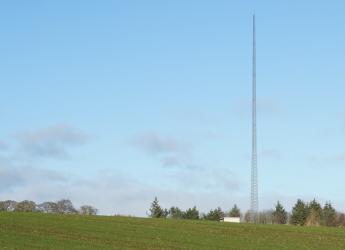
There are plans to build the UK’s first purpose-built tall tower for directly measuring greenhouse gases at the NERC-funded James Hutton Institute’s Balruddery Farm in Angus near Dundee. The 100-metre-tall tower will enable the UK to monitor and so mitigate climate change by allowing scientists to measure the composition of greenhouse gases directly.
|
|
|
THE BIGGER PICTURE: New astronomy detection in the first billion years of the Universe |
|
|
James Webb Space Telescope advances our understanding of galaxies
New research that used data from the James Webb Space Telescope shows that crucial building blocks of planets and stars could form much earlier in the life cycle of galaxies than previously thought.
An international team of astronomers has for the first time detected the presence of carbon-rich dust grains in the first billion years of the Universe.
These small diamond-like particles found between the stars are essential for the formation and evolution of galaxies such as the Milky Way.
The team is supported in part by UKRI and the Science and Technology Facilities Council (STFC).
Image credit: European Space Agency
Find out more
|
|
|
|