|
UKRI Headlines and Highlights |
|
Welcome to the weekly UKRI bulletin, your one-stop shop for news, funding announcements and stories about research and innovation in action. |
|
RESEARCH INFRASTRUCTURE: £72 million upgrade |
|
|
UKRI is investing £72 million in new infrastructure projects.
The funding will provide world-class facilities and equipment to help maintain the UK’s position as a science superpower in line with the ambitions set out in the government’s Science and Technology Framework.
The funding includes:
- £23 million for 11 individual wind tunnels, an experimental database and upgrades to facilities across the UK’s National Wind Tunnel Facility network
- A new £34 million digital infrastructure for sharing and reuse of biological and biomedical science data
- £6.8 million to scope a second-generation instrumentation suite for the European Southern Observatory’s Extremely Large Telescope
- An £8 million investment in the conceptual design of new technologies for next-generation gravitational wave infrastructure
Find out more.
|
|
RESEARCH INFRASTRUCTURE: ISIS Neutron and Muon Source to receive major upgrades |
|
|
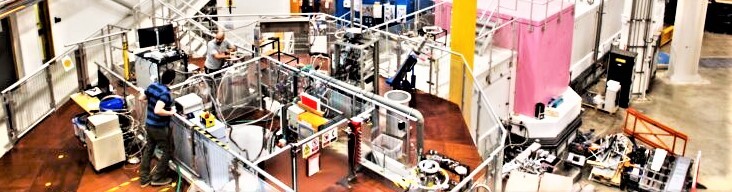
STFC has launched Endeavour: a £90 million programme of improvements and instruments to supercharge the ISIS Neutron and Muon Source (ISIS), one of the UK’s large-scale national laboratories.
Located at the STFC Rutherford Appleton Laboratory in Oxfordshire, ISIS generates powerful beams of subatomic particles called neutrons and muons.
These beams are directed at different materials, and scientific instruments are used to analyse the interactions of neutrons and muons with these materials to provide insights into their structure.
Experiments undertaken at ISIS cover a huge range of science and applied research – from understanding the chemicals needed to develop new medicines to stress-testing aircraft components.
Majority funded by the UKRI Infrastructure Fund, Endeavour will help STFC facilitate new research that will play a key role in helping us to protect against threats such as global health crises and climate change.
Find out more.
|
|
HEALTHCARE TECHNOLOGIES: AI breast screening software can detect abnormalities missed by current screening procedures |
|
|
Breast screening technology developed using Artificial Intelligence (AI) can detect abnormalities that would have been missed using current screening procedures.
From research to delivery in clinical settings, the ground-breaking work undertaken by the University of Aberdeen, NHS Grampian and Kheiron Medical Technologies included the analysis of 220,000 mammograms from more than 55,000 people to determine how well an AI tool could detect breast cancers.
The analysis found that the AI software, named 'Mia', which was developed with funding from Innovate UK, was successful at identifying potentially missed cancers, known as 'interval' cancers, which are detected between screening visits.
The team found that Mia would have suggested recalling 34.1% of the women who went on to develop cancer in between screenings.
Find out more.
|
|
|
BLUE-SKY THINKING:
Moonshots for the UK – transforming tomorrow together
|
|
|
Help us to identify ambitious research and innovation priorities for the UK.
What are the major global challenges that will drive the future of research and innovation for the next few decades? Where is the UK best placed to lead ground-breaking innovation that will have truly significant impact?
With the help of our communities, UKRI and the Department for Science, Innovation and Technology (DSIT) are looking to identify bold, ambitious, and transformative ideas for moonshots across the research and innovation landscape.
The first stage of this process is for community members to submit their idea for a moonshot. Moonshots should be submitted before 10 July 2023.
Find out more.
|
|
THE BIGGER PICTURE: Researchers take a key step towards creating synthetic 'smart cells' by building cell ‘skeletons’ with strands of DNA |
|
|
Cells, about a thousandth of a millimetre in size, are the fundamental units of all life.
They contain 'skeletons' made of proteins that fulfil a number of functions, such as providing structural support, helping the cell move around, and transporting materials within the cell.
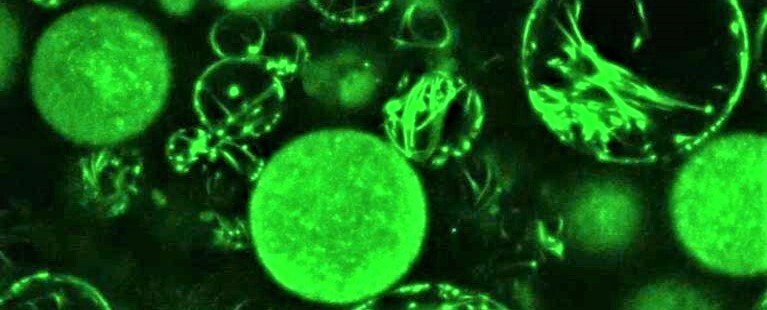
Now, the tiny tubes and thread-like structures that give cells their shape and help determine their function have been artificially re-created using strands of DNA in a study led by UCL researchers.
The research represents a key step towards synthetic 'smart cells' that could be used to sense diseases, deliver drugs or repair damaged cells inside the body.
The research was supported by the Rosetrees Trust and MRC.
Find out more.
|
|
GLASTONBURY: Be right there, right now, in the Science Futures area |
|
|
From climate change to robot surgeons, and from spiders to AI and deepfakes, festival-goers at this year’s Glastonbury Festival can learn and take inspiration from Science Futures – an entire area dedicated to science.
The University of Exeter is helping to organise and provide content for Science Futures, which was founded and is coordinated by Lancaster University’s Professor Emma Sayer (pictured), whose research in her day job is funded by NERC.
In addition to showcasing extraordinary science, Science Futures provides unique opportunities for people to hear from, and meet, researchers tackling critical problems and those behind cutting-edge innovations.
You can learn about what's occurring right there, right now, from Science Futures' supercharged Twitter feed.
Find out more.
|
|
THIS WEEK'S BIG NUMBER: 6% |
|
|
More than 6% of the UK population aged 16 and over – that is one in 15 – changed their reported sexual identity over a six-year period, according to new research led by Lancaster University.
Analysing data from the ESRC-funded United Kingdom Household Longitudinal Study, the researchers found that:
-
Of the 22,673 individuals who were each observed twice in 2011-2013 and 2017-2019, a significant minority of 6.6% changed their reported sexual orientation
-
Sexual identity mobility is higher among young people aged 16-24 (7.9%) and older adults aged 65 and over (7.4%), compared with those aged 25-64 (5.0-6.2%)
- Sexual identity mobility is 10.3% less likely among men (5.7%) than women (6.3%).
- Sexual identity mobility is three times more likely among non-white ethnic minority individuals (15.5%) than among white people (5.0%).
- Sexual identity mobility is more likely among the less educated
Find out more.
|
|
ENVIRONMENT: Saving moths may be just as important as saving the bees |
|
|
Night-time pollinators such as moths may visit just as many plants as bees, and should also be the focus of conservation and protection efforts, a new study from the University of Sheffield suggests.
The researchers found that moths under pressure from urbanisation may also be less resilient than bees, due to their more complex life cycle and more specific plant requirements
The study also revealed that despite this threat, moths play a crucial role in supporting urban plant communities, accounting for a third of all pollination in flowering plants, crops and trees.
The researchers suggest that when planning or redeveloping urban areas, supporting the introduction of plant species that are beneficial for moths, as well as bees, will become increasingly important for the health of urban ecosystems.
The study was funded by a Grantham Centre for Sustainable Futures PhD Studentship, EPSRC and NERC.
Find out more.
|
|
UKRI VOICES: UK-US research partnership is a match made in heaven |
|
|
The latest in our new series of personal insights into topical research and innovation themes from voices across UKRI is written by Chloë Somers, Director, UKRI North America Office.
She describes how helping researchers to work across national boundaries can build strong teams and lead to better proposals – and explains why the UK-US research partnership is a match made in heaven.
Find out more and subscribe.
|
|
ONLINE: There is widespread coverage across national and regional titles including Mail online, The Guardian and GB News of key findings from the ESRC-funded Institute for Fiscal Studies, which says that one million middle-income working-age adults are unable to meet unexpected expense costing one month’s income. |
|
ON THE AIRWAVES: This week's The Life Scientific, BBC Radio 4's science profile programme, focused on the life and work of renowned epigeniticist Professor Anne Ferguson-Smith, who has received funding from MRC throughout her career. |
|
ON TV: Anand Menon, Director of the ESRC-funded UK in a Changing Europe, was a panellist on this week's Question Time on BBC 1. This week's edition focused exclusively on Brexit, seven years on. |
|
UKRI TWITTER: Would you like to help shape the usage and development of the Global Talent visa (GTV)? We're seeking new members for the GTV External Advisory Board, which provides a forum for advice from across the research & innovation sector. Apply by 21 July. |
|
ON THE AIRWAVES: This week's edition of BBC Radio 4's flagship history programme, In Our Time, explored the life and work of British philosopher, Elizabeth Anscombe. The panel included Professor Rachael Wiseman, co-author of an award-winning book on Anscombe, which was funded by AHRC. |
|
MEANWHILE ON INSTAGRAM... |
|
|
Could understanding how live music affects our brains enable us to help people with Parkinson’s disease?
That’s the question researchers at the Royal Northern College of Music and the University of Manchester are trying to answer.
Using an electroencephalogram (pictured), they found more brain activity during live performance. This could be because live music is a shared experience and a sense of occasion.
Music’s ability to trigger intense feelings of nostalgia and stimulate memory has already been shown to benefit dementia sufferers, and has the potential to help those suffering with lifelong medical conditions such as Parkinson’s disease.
Find out more.
weareukri.
|
|
UKRI-supported research and innovation around the UK |
|
|
Windrush folk songs supporting mental health, and films on health and social inequality are among 10 new AHRC-funded projects exploring the future of health and social care. The investment supports research across the UK, from Kent in south-east England to the Highlands and Islands in Scotland, with researchers collaborating with communities to explore their lived experience of health and social care.
Trials to test the effectiveness of a six-monthly contraceptive injection for women are to start in Lothian and Ayrshire. If successful, the study will expand the range of contraceptive options available to women, giving them greater choice over how to control their fertility. The trial is led by the MRC Centre for Reproductive Health at the University of Edinburgh.
Innovate UK is investing £1 million in Northern Ireland’s Advanced Manufacturing Innovation Centre (AMIC) to enable it to start supporting local businesses. The funding will help build capabilities within AMIC in areas such as automated food manufacturing and digital twins. Digital manufacturing testbeds will also enable businesses to explore digital manufacturing technologies and apply them to address business challenges.
Reducing motorway speed may improve air quality – but more real-world studies are needed – according to new research at the University of Birmingham. The study was funded by NERC.
The prospect of a cure for a type of epilepsy could be one step closer following breakthrough research on materials which may help new types of probes to be safely implanted in the brain. The University of Glasgow project, funded by EPSRC and the EU, is part of a European-funded collaboration which aims to tackle epilepsy by treating and regenerating damaged brain tissue.
|
|
ONE MORE THING: Regular napping is linked to larger brain volume |
|
|
Daytime napping may help to preserve brain health by slowing the rate at which our brains shrink as we age, suggests a new study led by researchers at UCL and the University of the Republic in Uruguay.
The study analysed genetic data from people aged 40 to 69, using data from UK BioBank, which is co-funded by MRC.
They found a causal link between habitual napping and larger total brain volume – a marker of good brain health linked to a lower risk of dementia and other diseases.
Senior author Dr Victoria Garfield, from the MRC Unit for Lifelong Health & Ageing at UCL says: “Our findings suggest that, for some people, short daytime naps may be a part of the puzzle that could help preserve the health of the brain as we get older.”
The study was supported by Diabetes UK, the British Heart Foundation and the Diabetes Research and Wellness Foundation.
Find out more.
|
|
|
|
|