|
UKRI Headlines and Highlights |
|
Welcome to the weekly UKRI bulletin, featuring the latest news, funding announcements and stories about research and innovation in action. |
|
|
RESEARCH INFRASTRUCTURE:
£103 million investment in world-class labs
|
|
|
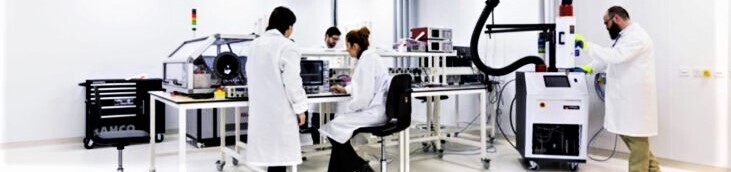
UKRI is investing £103 million to expand and upgrade the UK’s world-class research infrastructure, including digital infrastructure.
The investments will fuel scientific breakthroughs; drive economic growth and create jobs across the UK.
This crucial support is part of the package provided by government so that our research and innovation communities can carry on with their essential work notwithstanding the delay to association with Horizon Europe.
The investments include:
Find out more.
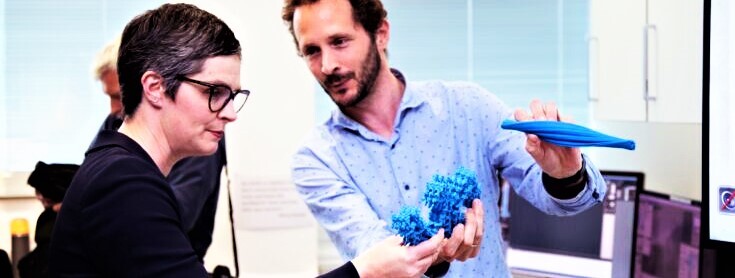
Photography: Chloe Smith, Secretary of State for Science, Innovation & Technology, at the MRC Laboratory of Molecular Biology.
|
|
UK BIOBANK: World’s largest whole-body scanning study begins exciting second stage to re-scan 60,000 UK volunteers |
|
|
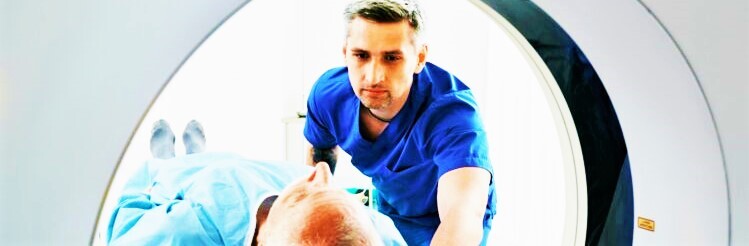
UK Biobank, a large-scale biomedical database containing in-depth genetic and health information from half a million UK participants, is embarking on a second stage to re-scan 60,000 volunteers in the world’s largest whole-body scanning study.
The scans will help scientists to accelerate research into the diagnosis, treatment, and prevention of our major diseases by seeing how people’s brains, hearts, abdomens and bones have aged.
Since 2014, the UK Biobank – a collaboration between MRC, Wellcome, British Heart Foundation and Dementias – has collected vast amounts of body-scanning data from MRI, ultrasound, X-ray and dual energy X-ray absorptiometry.
Now, 60,000 people, including the BBC’s Medical Editor Fergus Walsh, are returning to have their second scan so that scientists can see the changes that have taken place since their initial scans were taken 2-7 years previously.
These comparisons are vital for assessing diseases that tend to develop later in life, such as cardiovascular or neurodegenerative diseases.
Find out more.
|
|
UKRI 2023 Perception Survey: Your feedback will help us address issues; tailor our activities and measure progress |
|
|
This year UKRI turns five years old. To achieve our ambition to create an outstanding R&I system for the UK to which everyone can contribute and from which everyone benefits, it is important for us to understand how we are perceived and understood by our various communities.
We are undertaking a short quantitative survey to test opinion from across the research and innovation system about who we are, what we do and how well we do it.
We would be grateful if you could take a few minutes to complete the survey. Your feedback will help us address issues, tailor our activities and measure our progress as an organisation over the coming years.
The survey takes around 10 minutes to complete and is optimised for mobile and desktop devices.
It is being conducted by Trueology Ltd, an independent research agency, and all responses are anonymous.
The survey will be live until 16 June 2023.
Thank you in advance for your contributions.
Find out more and complete the UKRI perception survey.
|
|
|
What does mental illness sound like?
Popular audio representations of mental illness are often discordant or otherworldly, designed to evoke strong emotions like fear or anxiety.
Yet those with mental illness often describe other sounds which are meaningful to them and their experience, reflecting monotony, lack of connectedness, repetition, silence, control, and lack of control.
Radio 3’s Researcher in Residence, Professor Sally Marlow of King’s College London, whose research is funded by ESRC, asked composer/sound artist Gawain Hewitt to work with people with lived experience of mental illness to co-compose work to explore a spectrum of symptoms and changing feelings that words alone cannot do justice to.
Through a series of music-making workshops, the team found new ways to express their experiences using musical instruments, voices, apps, and everyday sounds in an ambitious attempt to break through the language barriers of mental health.
Find out more.
|
|
|
THE BIGGER PICTURE:
Behold: the largest cosmic explosion ever eyewitnessed
|
|
|
A team of astronomers led by the University of Southampton have uncovered the largest cosmic explosion ever witnessed, captured here in an artist's impression.
The explosion is more than 10 times brighter than any known supernova.
The researchers believe that the explosion is a result of a vast cloud of gas, possibly thousands of times larger than our sun, that has been violently disrupted by a supermassive black hole.
The explosion took place nearly eight billion light years away, when the universe was around six billion years old, and is still being detected by a network of telescopes.
The project is led by Dr Philip Wiseman, whose research is supported by STFC.
Find out more.
Artist's impression of a black hole accretion by John A. Paice
|
|
UKRI BLOG: Seizing the opportunity of a thriving UK semiconductor industry |
|
|
Today’s publication of the UK national semiconductor strategy is a solid foundation on which the UK can become a global science superpower.
In a new blog posting, Andrew Tyrer, Innovate UK's Industrial Strategy Challenge Director of Robotics and Martin McHugh, CEO of the Compound Semiconductor Applications Catapult (CSA) reflect on the strategy and discuss the opportunities it presents to grow the UK industry.
They also describe how Innovate UK and the CSA Catapult are leading initiatives to drive growth, create jobs and foster innovation to support the strategy.
Find out more.
|
|
|
MARINE ECOSYSTEMS:
Coastal lights trick coral reefs into spawning earlier than they should
|
|
|
The light pollution caused by coastal cities can trick coral reefs into spawning outside of the optimum times when they would normally reproduce, a new study has found.
Dr Thomas Davies from the University of Plymouth is senior author of the research study and also principal investigator of the wider NERC-funded project.
He says: “This study shows it is not just changes in the ocean that are impacting corals, but the continued development of coastal cities as we try and accommodate the growing global population.
"If we want to mitigate against the harm this is causing, we could perhaps look to delay the switching on of night-time lighting in coastal regions to ensure the natural dark period between sunset and moonrise that triggers spawning remains intact.
"That would potentially raise a number of economic and safety issues, but is something we potentially need to consider to ensure our coral reefs are given the best chance of survival.”
Find out more.
|
|
|
“There is an urgent need to mitigate greenhouse gas emissions from sheep. Recent figures show there are more than 1.2 billion sheep in the world, producing around 7 million tonnes of methane into the atmosphere." Dr Nicola Lambe, Scotland's Rural College
Dr Lambe is leading an Innovate UK-funded project to measure methane emissions from sheep.
In a UK first, she and her team are using specially designed trailer-mounted Portable Accumulation Chambers which can predict methane emissions in individual sheep from a variety of systems, including at pasture, as well as in multiple locations.
The team will then analyse the air samples they have collected for methane concentration, from which they will be able to identify which genetics, feed types and systems generate the highest (and the lowest) emission levels.
The researchers are working with a sheep breeding farm run by Rob and Jo Hodgkins, who will measure emissions from a group of Romney rams, and identify those that produce the least methane.
Find out more.
Photography: Mahyar Motebassem on UnSplash
|
|
ONLINE: The Daily Star reports that 'Britain is set to dominate the universe – by building factories in space'. It quotes the Innovate UK-supported Space Forge and Satellite Applications Catapult, which are among the 150 UK companies and organisations working in this area as the cost of sending hardware into orbit plummets. |
|
ONLINE: The Manchester Evening News and multiple regional titles report on a study by the MRC Unit for Lifelong Health & Ageing at UCL on the impact of homeworking on mental health. The article was first published in The Conversation. |
|
MEANWHILE, ON INSTAGRAM... The beautiful secrets of pollen |
|
|
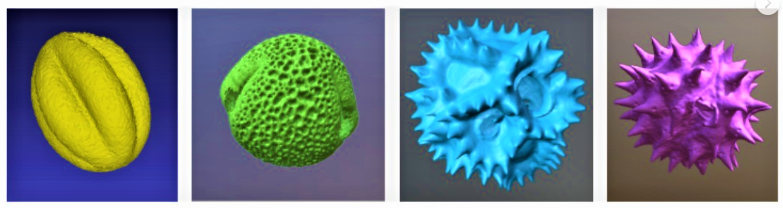
You’re looking at pollen grains magnified to hundreds of times their real size.
Pollen comes in loads of different shapes and sizes to help it get from one flower to another.
Scientists use these unique shapes to identify which plant pollen belongs to – and that can tell us some amazing things: from evidence at crime scenes to the reconstruction of ancient landscapes.
With funding from NERC, Dr Oliver Wilson, from the University of York, created these amazing 3D scans using a confocal laser scanning microscope.
He uses them to make 3D-printed models to inspire people to learn about plants, and shares the files so others can print their own.
weareukri
|
|
THIS WEEK'S BIG NUMBER: 2027 |
|
|
2027: Granted, this is more of a big date than a big number, but if you're a householder who has installed solar panels in your roof you'll be pleased to learn that you could break even on your investment as early as 2027, according to scientists at the University of Surrey.
The team say that in 2021 large-scale photovoltaic systems were cheaper than wholesale electricity, with prices at £51 per milliwatt hour versus £149 per milliwatt hour for smaller systems.
The team's findings are regardless of the size of the system, which includes individual homeowners.
The research was supported by Innovate UK and Equal Opportunities Foundation Hong Kong.
Find out more.
|
|
|
ONE MORE THING:
Bread made from cell pulse flour keeps you fuller for longer
|
|
|
Pulses such as chickpeas and beans can help support healthy weight maintenance and decrease the risk of heart disease, but their high-fibre benefits are generally considered to be reduced when they are processed in a flour mill.
Now, researchers from the Quadram Institute have found a way to make whole cell flours that preserve the dietary fibre structure of the whole pulses.
The scientists replaced regular wheat flour in bread with ‘cellular chickpea flour’. The results showed a reduction in blood glucose levels in people who ate it, who also reported that the new bread kept them fuller for longer.
The first-of-its-kind study is based on the design of a new pulse ingredient that is now being commercialised for food industry use as PulseON® by Pulseon Foods Ltd.
Find out more.
Photography: Nicholas Barbaros on Unsplash
|
|
|
|
|