|
This week's headlines and highlights |
|
Welcome to the UKRI bulletin, featuring the latest news, funding announcements and stories about research and innovation in action. |
|
HORIZON EUROPE: Guarantee fund awards £1 billion in grants |
|
SKIN CARE: Cutting-edge science behind No7's new anti-ageing product |
|
|
Scientists at Boots' skincare brand No7 and The University of Manchester have announced a breakthrough anti-ageing skincare product.
The discovery follows 16 years of research and innovation and was developed using cutting-edge British R&D spanning advanced robotics, mathematical modelling, bioinformatics, machine learning, cell biology and cosmetic science.
This led to the creation of a new ‘super peptide’ blend proven to bio-hack the skin’s natural repair process, signalling renewal of over 50 key proteins including collagen and fibrillin in skin cells.
No7 says it is its most promising anti-ageing product yet.
The research, which involved three universities, 37 studies and 4,200 consumer tests across the world, was supported by BBSRC, MRC and EPSRC.
The range, called Future Renew, is on sale online.
Find out more.
|
|
FUTURE MANUFACTURING: New hubs will help prepare for epidemics and transform food production |
|
|
EPSRC is investing £24 million in two manufacturing hubs to help prepare for epidemics and pandemics and to transform food production
The Future Vaccines Manufacturing Hub, co-led by UCL and the University of Oxford, aims to make the UK the global centre for vaccine discovery, development and manufacture.
It will save lives by enabling rapid roll-out of highly effective new vaccines for front-line use.
The Cellular Agriculture Manufacturing Hub, led by the University of Bath, aims to transform food production and to support the transition to an environmentally, economically, and socially sustainable model in which novel manufacturing systems complement traditional food production.
Find out more.
|
|
PUBLIC ENGAGEMENT: Networks to strengthen public’s role in research and innovation |
|
|
UKRI has awarded 25 grants in the first phase of its £3.6 million Community Research Networks programme.
The programme represents a shift in the way UKRI funds public engagement, and will empower communities to develop grassroots research agendas and build capability and expertise in community-led forms of research and innovation.
The collaborations comprise diverse organisations across the UK. They include social enterprises, local councils, museums, city farms and wildlife trusts, working to build a more open, inclusive and diverse research and innovation system.
Over the next six months, collaborations will work with local communities to develop detailed plans for a network in their area. They will be given the opportunity to bid for a share of £3 million later this year.
Find out more.
|
|
SUSTAINABLE MATERIALS: Manchester spin-out signs £1 billion deal to help tackle global sustainability challenges |
|
|
Graphene Innovations Manchester Ltd (GIM), a spin-out company from The University of Manchester's graphene ecosystem, has signed a £1 billion deal to help tackle global sustainability challenges.
Founded by Dr Vivek Koncherry, a research associate at the EPSRC Future Composites Manufacturing Research Hub, GIM has signed a Memorandum of Understanding with Quazar Investment Company to form a new company in the UAE.
The new venture will develop and produce premium, environmentally-friendly products using advanced 2D materials, including breakthrough graphene-enhanced concrete that does not need cement or water and can be made using recycled materials.
The programme will include a new Sustainable Materials Translational Research Centre. The facility will be a partnership with The University of Manchester’s Graphene Engineering Innovation Centre, the EPSRC-funded Henry Royce Institute, the Innovate UK-led High Value Manufacturing Catapult and Rochdale Development Agency.
Find out more.
|
|
THIS WEEK'S BIG NUMBER: 70% |
|
|
70% of Kenya’s vegetable exports are taken up by fine beans.
This makes the crop hugely important for the country's farmers, particularly as the agriculture sector contributes almost 30% to the national GDP.
What's more, 60% of fine bean exports from Kenya are produced by over 50,000 smallholders.
There is, however, a problem: rain, which splashes soil onto bean pods, causing them to become contaminated. During the rainy season this can be 100% of the crop.
Now, scientists from Cranfield University, working with AGS Ekology Ltd, Vegpro Kenya and Provenance Partners Ltd, have shown that spraying an environmentally friendly polymer onto soil surfaces can reduce ‘soiling’ of fine beans by almost 65%.
The reduced food waste could bring greater financial security for smallholder farmers as well as increase the resilience of the UK food supply chain.
The project is funded by Innovate UK.
Find out more.
|
|
UKRI-supported COVID-19 research and innovation |
|
ON THE AIRWAVES: This week's edition of BBC Radio Four's flagship history programme, In Our Time discussed the Battle of Crécy in 1346. The panel included Professor Anne Curry; Andrew Ayton and Erika Graham-Goering. Professor Curry and Mr Ayton's work is supported by AHRC. |
|
UKRI TWITTER: As new challenges emerge in food production, could multi-tasking autonomous robots help the future of farming? From reducing pesticide use to optimising yield with the power of data, take a look at what robots like Thorvald can do. weareukri. |
|
ONLINE: BBC News reports on an unprecedented analysis at the MRC-supported Francis Crick Institute of how cancers grow, revealing an "almost infinite" ability of tumours to evolve and survive. The story is also covered by the Financial Times, Yahoo News and many more regional outlets. |
|
ONLINE: The Herald reports that Royal Mail drone deliveries will tackle Scottish islands ferry service gaps. The project is funded by the Department for Transport’s Freight Innovation Fund and executed by the Innovate UK-led Connected Places Catapult. |
|
|
"Our verification software can deduce how much AI can learn from their interaction, whether they have enough knowledge that enables successful cooperation, and whether they have too much knowledge that will break privacy." Dr Solofomampionona Fortunat Rajaona, University of Surrey
Dr Rajaona and his team have developed software which can be used as part of a company’s online security protocol. It helps an organisation understand whether an AI interacting with the company has learned too much or even accessed sensitive data.
The research is particularly timely, given the huge surge of public and industry interest in generative AI models fuelled by advances in large language models such as ChatGPT.
The researchers say creation of tools that can verify the performance of generative AI is essential to underpin their safe and responsible deployment.
Developed with funding from EPSRC, the software won the best paper award at the 25th International Symposium on Formal Methods.
Find out more.
|
|
UKRI-supported research and innovation in action |
|
|
The community of microbes living in and on our bodies may be acting as a reservoir for antibiotic resistance, according to new research from the Earlham Institute and Quadram Institute in Norwich. The study is funded by BBSRC, NERC and the ERC.
People in Britain had less 'risky' sex in the year following the pandemic, finds a new study led by researchers at UCL and the University of Glasgow. The lower prevalence of people having condomless sex with multiple or new partners during the early stages of the pandemic was still evident one year after Britain’s first lockdown. The study was funded by Wellcome, supported by ESRC and NIHR, MRC and UCL.
A study by a University of Glasgow-led research centre has identified that a significant proportion of Romanian migrants have experienced an increase in xenophobia and racism following the Brexit vote of 2016. The research is funded by ESRC and AHRC.
Medherant, a company borne out of ground-breaking research at the University of Warwick supported by Innovate UK, has raised almost £3 million to develop a testosterone patch for people suffering from low libido and reduced zest for life due to the menopause.
Earlier this month, tick-borne encephalitis, a potentially fatal disease, was detected in England. The news coincided with the launch of a new research project exploring the impact the possible rewilding of the UK could have on the risk of catching Lyme disease, which is transmitted by ticks. The multi-institution study, which includes the universities of Salford, Greenwich and York, is funded by UKRI and DEFRA.
|
|
ONE MORE THING: Potatoes could be key to Martian construction projects |
|
|
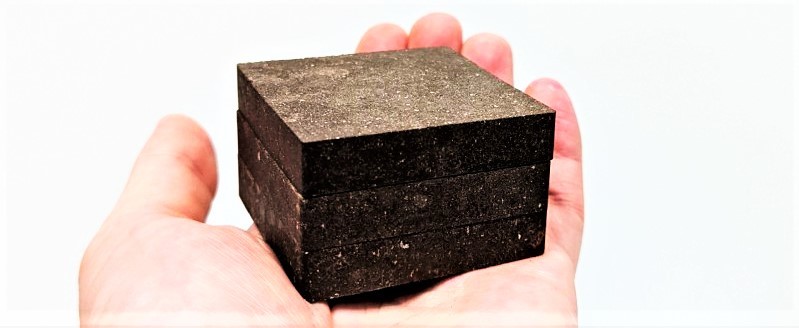
When future residents of Mars decide they need a new patio extension, the builders could find themselves using a new material made from extra-terrestrial dust, potato starch and salt.
Developed by University of Manchester scientists, the material is twice as strong as concrete and uses materials that will be easily available to astronauts as they set about constructing the first buildings on the planet.
The research team have shown that ordinary potato starch can act as a binder when mixed with simulated Mars dust to produce a concrete-like material.
This work improves on previous work from the team which used astronauts’ blood and urine as a binding agent – a process that required blood on an all-too regular basis.
The material was developed at the Future Biomanufacturing Research Hub, which is funded by EPSRC and BBSRC.
Find out more.
|
|
|
|
|