|
UKRI Headlines and Highlights |
|
Welcome to the weekly UKRI bulletin, featuring the latest news, funding announcements and stories about research and innovation in action. |
|
DIGITAL TECHNOLOGY: £75.6 million investment in the screen, performance and wider digital entertainment sectors |
|
|
AHRC is investing £75.6 million in the development of new technology to support the convergence of the gaming, screen, performance and wider digital entertainment sectors.
The investment will support the creation of a new creative facility comprising a central hub and experimental studio fitted with real-time digital technologies.
The CoSTAR hub will be enhanced by a network of regional labs across the UK and supported by a data, insight and foresight lab.
The ambition is that this investment will generate at least an additional £20 million private sector investment.
AHRC is now calling on researchers and creative industries professionals to apply to host the CoSTAR hub, which is funded primarily through UKRI's Infrastructure Fund.
Find out more.
|
|
|
HEALTHCARE:
Long-term antidepressant use may double the risk of heart disease
|
|
|
A study led by the University of Bristol has found that long-term antidepressant use may double the risk of heart disease.
The findings are from the most comprehensive epidemiological study to date to investigate the health consequences from using the medication over 10 years.
The researchers analysed data on 200,000 people drawn from UK Biobank.
Co-funded by MRC, UK Biobank is a large-scale biomedical database and research resource containing anonymised genetic, lifestyle and health information from half a million UK participants.
Find out more.
Photography by Christine Sandu on Unsplash
|
|
|
NEW SERIES – UKRI VOICES:
Week three: Finding the true value of investing in innovation
|
|
THE FILM TO WATCH: Supercomputer simulations have revealed an alternate explanation for the Moon’s origin |
|
|
Durham University scientists have used supercomputer simulations to reveal an alternate explanation for the Moon’s origin.
The researchers suggest the Moon may have been created as a satellite placed immediately into orbit following a giant impact between Earth and a Mars-sized body.
The simulations were carried out on the DiRAC Memory Intensive service hosted by Durham University on behalf of STFC's DiRAC High-Performance Computing facility.
Find out more and watch the film.
|
|
HEALTHCARE INNOVATION: Lab-grown pigmented skin will advance skin health research and could lead to new health products |
|
|
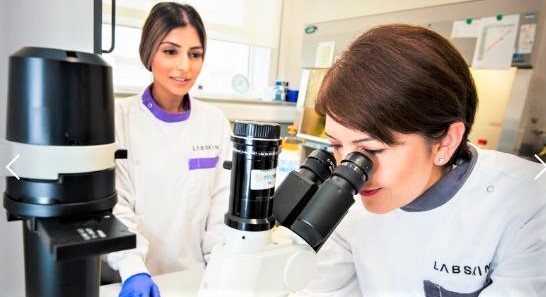
A university/industry partnership has led to the development of the first-ever commercially available lab-grown ‘pigmented’ skin-equivalent.
The team, from UK-based Labskin and the University of Bradford’s Centre of Skin Sciences, describe their achievement as a major breakthrough for research into skin health and the development of skincare products.
Known as ‘Labskin M’, the new pigmented skin model is the result of an Innovate UK Knowledge Transfer Project between Labskin and the university.
Find out more.
|
|
|
ENERGY RESEARCH:
First images of CO2 emissions from commercial aircraft engine revealed
|
|
|
University of Strathclyde researchers have released the first images of carbon dioxide emissions from commercial aircraft engines.
This new state-of-the-art technology, which uses a novel near-infrared light imaging technique, could help accelerate research into developing more environmentally friendly turbine combustion engines and aviation fuels.
The research was funded by EPSRC.
Find out more.
|
|
|
"Our study provides a bridge between water under pressure at the molecular level and the wonderful ability of organisms which thrive under high pressure in depths of the oceans." Professor Lorna Dougan, University of Leeds
Professor Dougan and her team have discovered how a chemical in the cells of marine organisms enables them to survive the high pressures found in the deep oceans.
The research was supported by EPSRC. The team also used the ISIS neutron and muon analytical facility at STFC's Rutherford Appleton Laboratory in Oxfordshire.
Find out more.
|
|
ON THE AIRWAVES: BBC Radio 5 Live’s Naga Munchetty Show featured an interview with Professor Lorraine Whitmarsh, Director of the ESRC-funded Centre for Climate Change and Social Transformations, on behaviour around climate change issues such as food, transport, and domestic energy (See This Week's Big Read below). Starts approx. 01.47.55. |
|
TWITTER: Minister for Science and Investment Security @NusGhani visited the @EPSRC-supported @ECIT QUB today to discuss world class #CyberSecurity research and developments. The Minister was also updated on our exciting digital innovation investments in collaboration with our #BRCityDeal partners |
|
IN PRINT: The Hampshire Chronicle reports that the University of Winchester and Solent University have developed a new set of best practice guidelines to improve the mental health of those working in heritage projects which, it notes, are based on UKRI-funded research. |
|
ONLINE: Arts Professional asks what widespread digital access could mean for UK arts organisations, and credits Innovate UK funding for the My Sound Cinema platform; the first online site for audio-described screenings of new and existing cinema releases. |
|
|
THIS WEEK'S BIG READ:
New report presents public perceptions on net zero lifestyle changes
|
|
|
Reducing carbon emissions in line with the Paris Agreement, and keeping warming to below 1.5 degrees, will require substantial changes to our lifestyles, from low-carbon technologies to changing our diets.
Now, a report by the ESRC-funded Centre for Climate Change & Social Transformations (CAST) presents public perceptions and preferences for changes to how we heat our homes, the food we eat, the products we buy and how we travel.
Find out more.
|
|
CLIMATE CHANGE AND THE ENVIRONMENT |
|
RESEARCH AND INNOVATION AROUND THE UK |
|
ONE MORE THING: Researchers are translating human-dog bonding to a robotic platform |
|
|
In a step towards the development of robots that interact meaningfully with humans, a new study – led by the University of Glasgow – highlights specific dog behaviours that dog owners perceive as important for bonding with their pets.
In a survey study of 153 dog owners, participants described a range of key behaviours, such as nudging the owner with a paw or looking back at the owner on walks, which appeared to suggest that the dog was being protective or checking in with the owner.
From these responses, the researchers identified seven core types of behaviour that owners felt were important, including attunement, communication, consistency, physical affection, positivity and enthusiasm, proximity, and shared activities.
The researchers suggest that incorporating these types of behaviour into robotic systems could aid development of robots that provide the same fulfilment and mental health benefits for people as bonding with a pet dog.
The research was supported by the EU and through an ESRC PhD studentship.
Find out more.
Photograph by Chen Mizrach on Unsplash
|
|
|
|
|