|
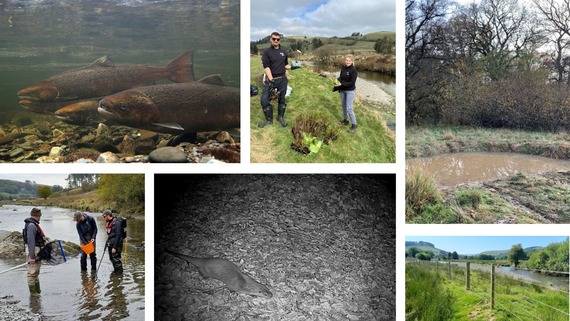 This edition of the newsletter brings you a winter-to-spring snapshot of what’s happening across the headwaters: new partnerships, fieldwork insights, voices from the farming community and an invitation for more landowners to get involved. Salmon are migrating upstream to spawn, tree planting is beginning in earnest, and our team is working closely with farmers and landowners to plan the next phase of restoration.
As always, each article has been written by members of the project team or by people working alongside us - sharing stories straight from the riverbanks, farmyards and forests of the upper Wye.
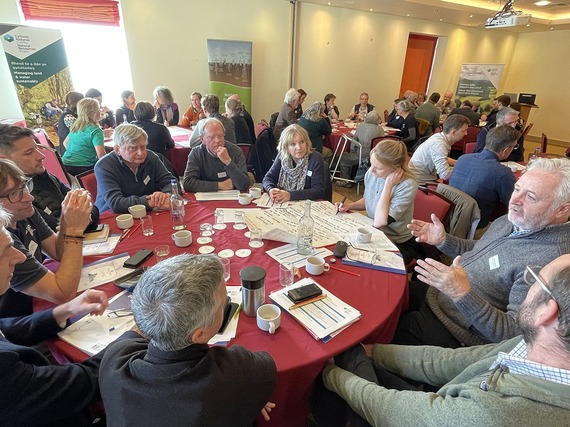 Photo: 2024 stakeholder event in Llandrindod, featuring local farmer Geraint sharing his insights
Restoring river health in the upper Wye catchment is only possible through strong collaboration with the people who know the land best. Farmers and land managers shape the landscape, influencing the water that flows through it, and their involvement is essential for restoring river health.
Our approach is built on co-design, trust and fully funded support. Every farm is different, so we tailor solutions to meet the needs of both the business and the river. This might include stock proof fencing to protect riverbanks, alternative drinking points, buffer strips, tree planting or targeted in-channel restoration.
Lasting change comes from voluntary action and shared responsibility. By understanding farmers’ motivations, challenges and priorities, we’re able to deliver practical measures that work on the ground - and that landowners feel confident adopting.
Rivers don’t recognise boundaries, so we have to work at a catchment scale. When multiple farms adopt similar river-friendly practices, the benefits multiply: less soil loss, fewer nutrients entering the water, healthier habitats and stronger farm resilience.
Looking ahead to 2026, we’re particularly keen to speak to farmers in the upper reaches of the Ithon and its tributaries including the Aran and Gwenlas - though we welcome conversations with landowners upstream of Glasbury.
If you’d like an advisory visit or want to explore the types of improvements that could be of benefit on your riverside farm, please get in touch. Together, we can shape a healthier river system and support productive, sustainable farm businesses.
|
|
|
Winter is one of the most important and dramatic times of year on the upper Wye. While trees stand bare and fields lie quiet, the river itself is alive with movement - because it is now that our native salmon and trout begin their annual spawning season.
Brown trout spend their entire lives in our rivers and will only breed when the water is cold, and gravel beds are clean. Salmon make a far longer journey: entering the river as early as spring, moving steadily upstream over many months, and finally spawning in winter in the same catchments where they were born. Atlantic Salmon are a designated species in the River Wye Special Area of Conservation.
For successful spawning, gravel must be free of silt; otherwise, oxygen cannot reach the buried eggs. Females dig hollows known as redds, lay their eggs and cover them over - an ancient process that has taken place in these headwaters for thousands of years. Once spawning is complete, adult salmon return to sea to feed, while juveniles remain in the river for up to two years before migrating out as smolts.
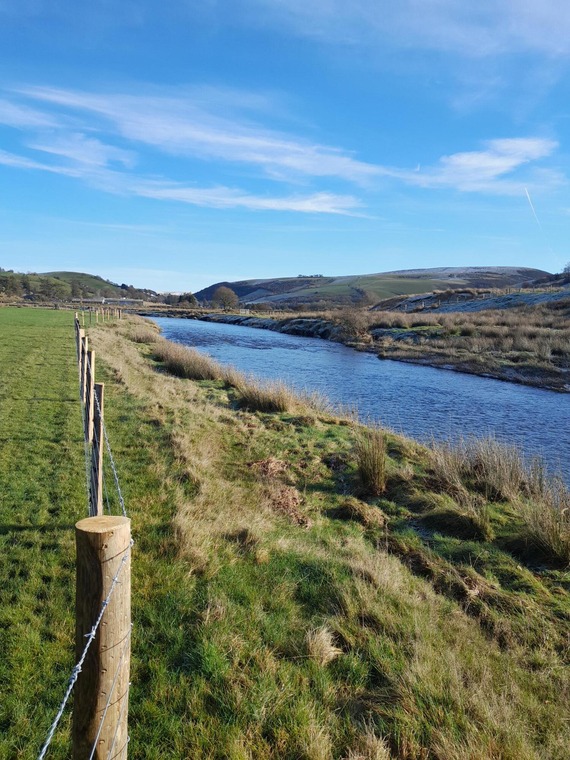 Photo: Upper Wye on a bright November morning. Despite ideal conditions, no salmon redds were found here during this particular site-visit – with works being carried out on this river habitat, we’re hoping our monitoring will show improvements over time
Our team is helping protect these vital spawning grounds by fencing riverbanks, reducing erosion and improving riverside habitat. These measures keep livestock from trampling redds, reduce sediment entering the river and smothering gravels and support the invertebrates that juvenile fish depend on.
None of this work would be possible without the farmers who live and work along the river corridor. Their cooperation is essential - and we’re extremely grateful for their support in safeguarding the future of salmon in the upper Wye.
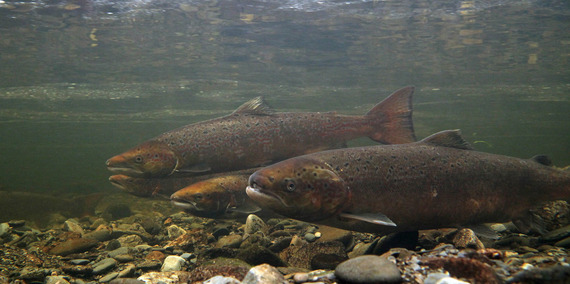 Photo: Native salmon migration in the upper Wye in previous years. Credit: Peter Lewis
|
|
|
We’re delighted to announce a new partnership between the Upper Wye Catchment Restoration Project and Coed Cadw, the Woodland Trust in Wales. Under this agreement, the Woodland Trust will supply up to 40,000 native saplings over the next three years, supporting a significant expansion of scattered riparian and hedgerow planting across the upper catchment.
These trees - including willow, alder, hazel, hawthorn, blackthorn, holly and oak - have been carefully selected for their suitability near watercourses and their value for wildlife. Together they will help stabilise riverbanks, provide shade to cool warming waters, intercept run-off and strengthen habitat corridors for a wide range of species.
Planting begins early this year, with 10,000 trees scheduled across several farms. Each site has been chosen to deliver multiple benefits: increasing shade, reducing erosion, protecting spawning habitat and helping the river adapt to the pressures of climate change.
We would like to thank the Woodland Trust for this fantastic opportunity to work together. We look forward to sharing updates throughout the planting season as these new trees take root in the upper Wye landscape.
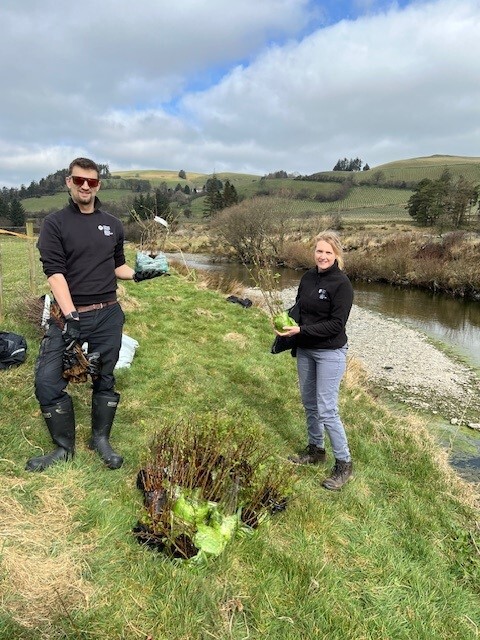 Photo: The project team tree planting on the upper Wye in early 2025
|
|
|
This winter, we’re shining a spotlight on how river restoration work can benefit farms via our Voices from the Catchment series. In spring 2025 the project delivered works on Tŷ Mawr Farm in the upper Wye Valley. We asked the farmer to share his experience of working with the Upper Wye Catchment Restoration Project...
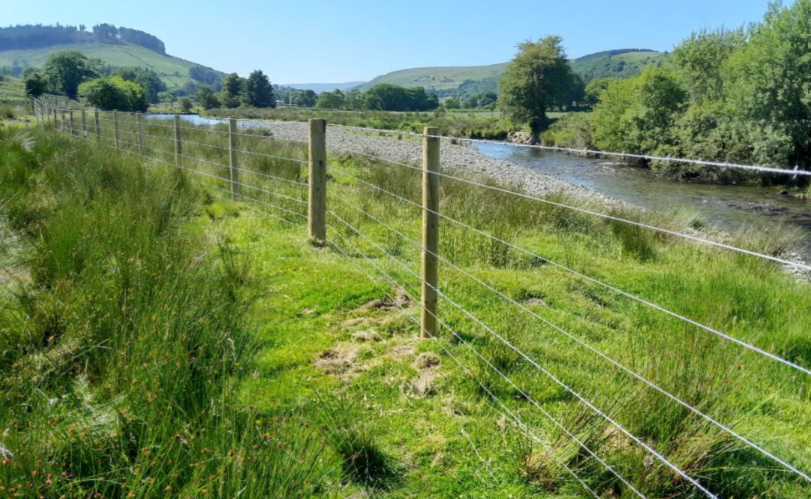 Photo: New buffer strips were installed by the project on Tŷ Mawr Farm
Can you tell us a bit about your farm?
We’re a beef and sheep farm in the upper Wye Valley.
What made you get involved with the project?
The river’s a big part of the farm and it’s good to see it being looked after. I was contacted by NRW about improvement works to the SSSI [the River Wye (Upper Wye) Site of Special Scientific Interest] and this led on to being involved with the project.
What work has taken place so far?
We’ve had buffer strips fenced, and water troughs installed for cattle that would otherwise be accessing the river to drink. We’ve also had trees planted to help with erosion.
Have you noticed any benefits for the farm or the river?
There are benefits to us in that the fields are now stock proof along the river, and without that there could have been a problem losing sheep to the river. It’s also saved gathering from down the banks and across the river when there is a risk of floods.
Any surprises along the way?
No surprises - everything has been handled professionally.
Why is working together important?
For us, working together has meant we can do the work - as farmers we want the river to be as healthy as possible, but the capital costs are more than we can gain from the improvements in the animal management side of things.
What would you say to other farmers thinking about getting involved?
It’s well worth having the meeting because you might get benefits you didn’t expect, and both NRW and the contractors were easy to discuss things with.
We’re glad we had the meeting, rather than saying no thank you.
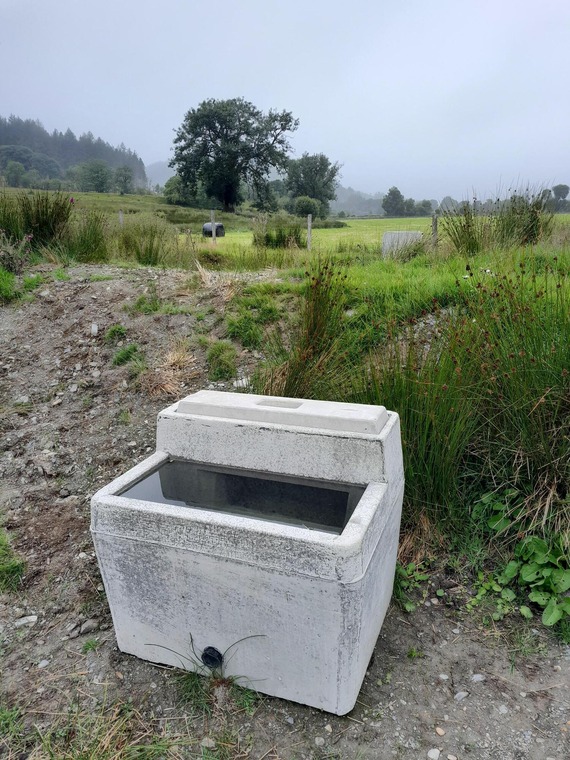 Photo: New troughs were also installed
|
|
|
The Upper Wye Programme takes a joined-up, evidence-based approach to river restoration. By working across multiple landholdings in one area, we aim to create continuous stretches of healthier river and habitat. Our decisions are guided by data, ensuring we focus on places where action will have the greatest impact.
So far, this approach has been trialled on the upper Wye near Llangurig, with strong support from local landowners. This has enabled an ambitious monitoring programme that is shaping our future work.
Key monitoring findings (2025)
- Electrofishing:
- 18 surveys across 8km revealed good fry numbers (under 1 year old) but very few parr (1-4 years old).
- Sites with wide buffer strips and natural boulders had the healthiest fish populations.
- Invertebrates:
- Spring and autumn data showed low diversity and abundance, which has serious implications for the food chain.
- Water quality:
- Four sondes recorded summer temperatures up to 25.3°C – dangerously high for salmonids (a sonde is a water monitoring instrument that measures temperature, pH, dissolved oxygen and conductivity).
What’s next
In 2026, we plan to carry out drone surveys to assess the presence of ranunculus/water crowfoot, a key species in the Wye Special Area of Conservation (SAC). We’re also keeping up to date with surveys being conducted by Friends of the River Wye.
On the ground, we’ve already completed work on two farms and two forests, with four more farm schemes in development and plans to engage with four additional landholdings imminently. By the end of 2026, our goal is to visit every riverside farm between the Wye’s source and Llangurig to learn more about land management practices and share advice on actions that can improve river health.
Data sits at the heart of this work. Mapping helps us identify pressures on the river, and monitoring tools measure the outcomes after restoration. This evidence builds trust with landowners, showing clearly how restoration benefits both the river and the farm.
Monitoring suggests that reintroducing boulders where they were previously removed could greatly benefit salmon parr. Early proposals include reintroducing boulders at 12 locations along 9km near Llangurig. This could become one of NRW’s most ambitious re-bouldering projects, setting an example for similar schemes across Wales and the UK.
Combined with slow-the-flow measures, river corridor improvements, and around 2,000 new trees planted so far, these efforts form the backbone of a landscape-scale restoration programme.
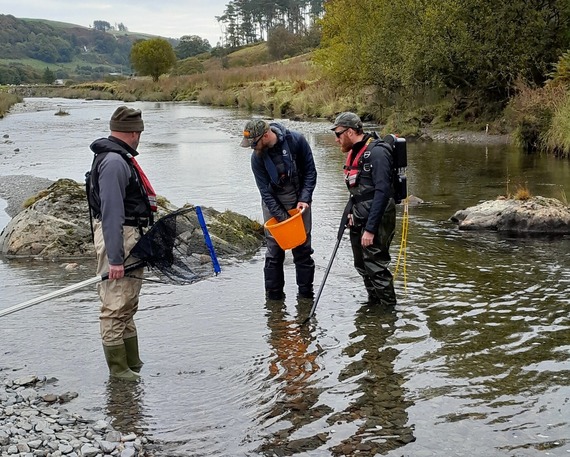 Photo: Electrofishing surveys around natural boulders help us assess juvenile salmonid populations
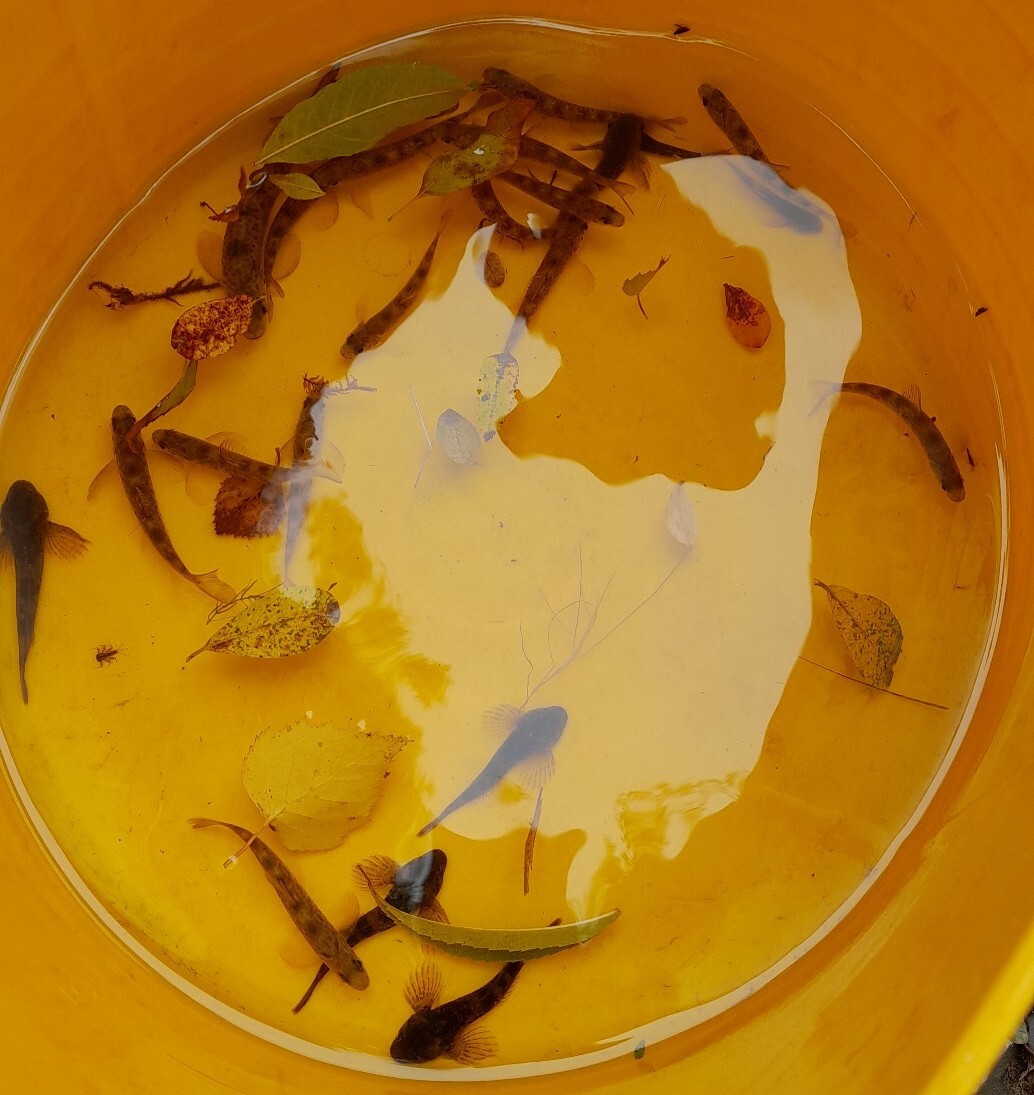 Photo: Salmon fry and adult bullhead found during electrofishing survey - two SAC-listed species
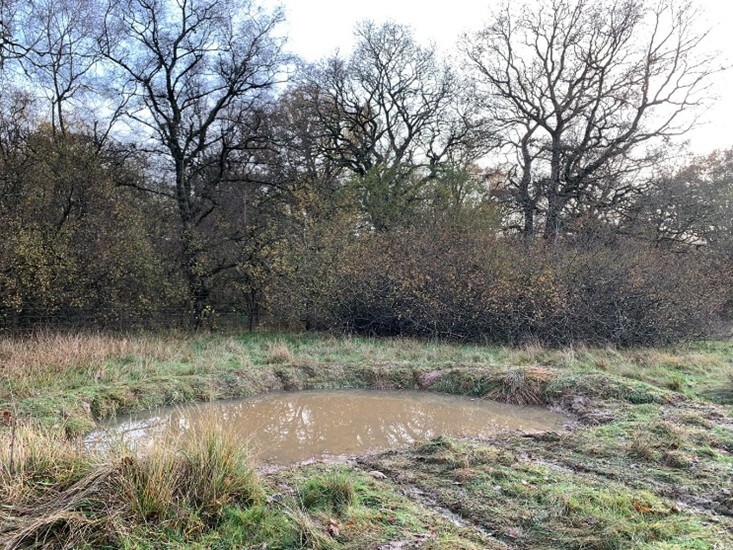
Back in November, our team created a series of new ponds and scrapes at a beautiful site on a tributary of the upper Wye. Designed to provide valuable habitat and slow the flow of water from higher ground, the ponds are already proving their worth.
Just days after they were completed, an inquisitive otter was photographed investigating the new pools - a wonderful early sign that wildlife is responding!
Freshwater ponds are among the most biodiverse habitats in the UK. Even small ponds can support plants, invertebrates, amphibians, small fish, birds and mammals like otters. Yet Wales has lost around two-thirds of its ponds since the late 19th century.
As part of our catchment restoration work, we’re committed to creating and restoring ponds wherever suitable opportunities arise. With the upcoming Sustainable Farming Scheme also supporting pond creation, we hope to see many more of these important features returning to the landscape.
A huge thank you to the landowner for helping make this project possible - we look forward to watching the ponds mature over the coming months.
|
|
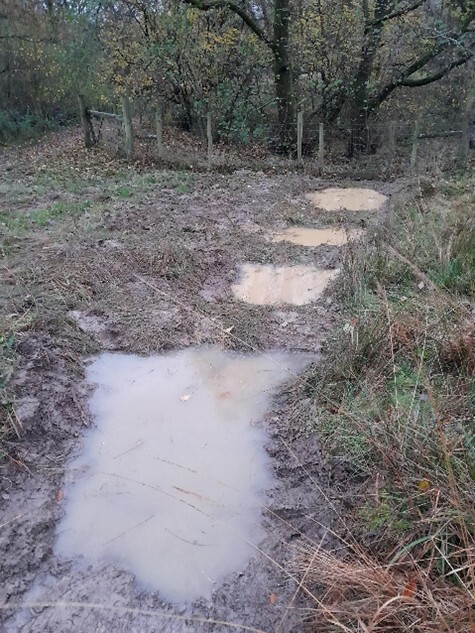 Photos: Some of the newly created ponds beginning to fill naturally after construction
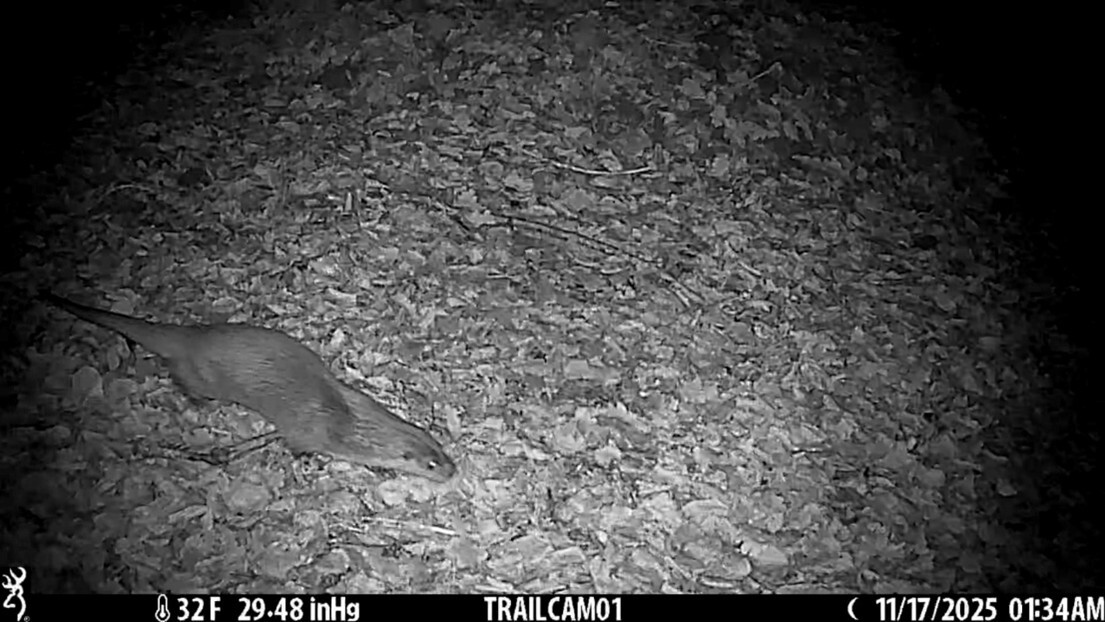 Photo: An otter inspecting one of the new ponds just days after completion. Credit: Sarenta King, Radnorshire Wildlife Trust
The Upper Wye Catchment Restoration Project #RestoreUpperWye is funded by Welsh Government’s Nature and Climate Emergency Fund, part of the Water Capital Programme, to restore the condition of the upper River Wye.
The overall aim of this project is to protect species and enhance habitats by addressing a range of pressures affecting the river.
If you’d like to be added to our mailing list for future updates, please let us know via the email below.
If you’d prefer a paper copy of the newsletter, do get in touch.
Email: RestoreUpperWye@NaturalResources.Wales
Web: Upper Wye Catchment Restoration Project Website
Social Media: Facebook, Instagram, X
|
|
|
|
|