|
|
Welcome to the Autumn issue of the LIFE Dee River newsletter
Our progress to date...
- 20,000 trees planted
- 8,420 tonnes of gravel, boulders and woody material introduced into the river
- 840 metres of natural bank stabilisation
- 42km of riverside fencing completed
- 11 forest drain culverts upgraded
- 10 barriers removed or adapted
- 1 new forestry river crossing installed
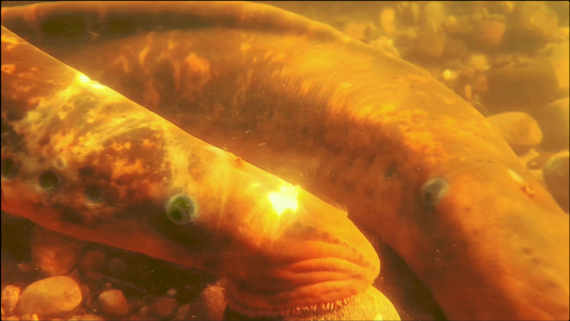
We are delighted to share the fantastic news that following the removal of Erbistock weir last summer, the team have discovered 25 sea lamprey redds (nests) upstream of the former barrier! Drone footage captured during the surveys shows one of these redds just 40 metres downstream of Manley Hall gauging weir. This confirms the removal of Erbistock weir has opened up an additional 4 kilometres of critical habitat, enabling these incredible, prehistoric fish to return to spawning grounds long restricted by man-made obstacles.
Tracking by the team revealed that, previously, most lamprey could not pass the 3-metre-high, 70-metre-wide structure, failing to reach their spawning grounds upstream and jeopardising the long-term survival of this protected species. Similarly, many salmon were delayed or prevented from passing Erbistock weir, also threatening their survival. The weir removal has ensured that passage for all fish species, not just sea lamprey, is now unhindered for the first time in nearly 200 years.
While we’re thrilled by what we’ve achieved so far, the concentration of sea lamprey redds immediately below Manley Hall gauging weir highlights that this structure remains a significant bottleneck to further upstream migration. Many fish are still forced to spawn just downstream of this structure, restricting their natural instinct to migrate further upstream to key spawning areas. That’s why we’re already planning targeted works here for next year, aiming to improve passage and ensure the benefits of a free-flowing Dee are fully realised.
If you’d like to find out more about our work at Erbistock weir, you can watch this 30 minute interview with our Project Manager, Joel, as part of Dam Removal Europe’s live stream series. The weir removal was also featured as a case study in the European Centre for River Restoration’s Technical Newsletter.
|
|
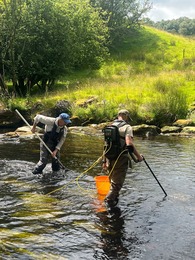
This year’s electric fishing surveys have interesting results for the LIFE Dee River restoration team. For the fourth consecutive year, salmon fry and parr have been successfully recorded upstream of the former Morlas weir site - clear evidence that our restoration efforts are continuing to pay off.
The removal of Morlas weir has opened vital spawning and nursery habitat for migratory salmonids, and the presence of both fry and parr confirms that adult salmon are not only accessing these areas, but their offspring are thriving here too. These findings are a strong indicator of improved river connectivity and habitat quality, aligning with our long-term goals for salmon recovery in the Dee catchment.
Conversely, some sites have shown lower than expected numbers, most notably on the Afon Brenig and Afon Tryweryn. These sites will continue to be monitored going forwards to assess the numbers. Further work will also be carried out in these areas to continue to improve the habitat.
The Dee Stock Assessment Programme also carries electric fishing surveys across the catchment, and we work closely with them to share results. They reported very good numbers of salmon and trout fry just below one of our intervention sites on the Ceiriog near Llanarmon Dyffryn Ceiriog, which is very encouraging. Other sites on the Ceiriog have had lower results than we hoped for, likely because of declining grilse runs. Again, these sites will continue to be monitored going forwards.
We were pleased to host staff from both Chester Zoo and Buglife whilst carrying out the surveys this year, sharing knowledge between organisations is vital to the future of the Dee.
Good news on the Alwen - Whilst carrying out electric fishing surveys on the Afon Alwen, we had a quick look at the site where we installed oak baffles to help fish passage through a 35 metre long culvert. We were absolutely thrilled to find 3 salmon parr and 3 trout living in the culvert! Prior to carrying out the work to improve fish passage, there wouldn’t have been any fish living there at all as there wasn’t any structure or water depth for them to live in. However, following our works in December 2023, the baffles have not only improved fish passage and reconnected vital habitat, they have also provided shelter and created valuable new areas for fish to live.
|
|
|
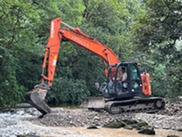
Following the introduction of over 2,000 tonnes of gravel into the upper Tryweryn in 2021 and 2022, last month we topped this up with several hundred tonnes of gravel further downstream. Gravel is vital for fish spawning as it provides a clean, well-oxygenated environment to bury eggs and creates sheltered habitat for fry to develop safely. We are always monitoring these sites, and following our gravel introduction programme over the past few years we’re pleased to see that salmon are indeed spawning in these areas, with as many as 18 redds recorded in 2024. This latest introduction will speed up the spread of the gravel through the upper Tryweryn, extending the available spawning area from the base of the dam at Llyn Celyn all the way down to the Afon Mynach, which is the first major tributary to naturally provide gravel into the Tryweryn.
In October, we will again introduce more gravel into the Tryweryn, this time directly below the dam at Llyn Celyn, to provide a continued supply which will gradually work its was downstream. The structure of the dam itself at Celyn remains a major obstruction to the regular supply of natural gravel and sediment that you would normally expect in a river. The team are in discussions with the asset owners of the dam, Dŵr Cymru Welsh Water, who will hopefully carry on with this important work after the completion of the LIFE Dee River project.
|
|
|
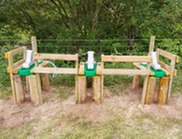
Livestock, particularly cattle, accessing rivers for drinking water is well known to be environmentally damaging, causing bank and vegetation erosion and affecting water quality through nutrient input and sediment disturbance.
We work with farmers to identify river field margins that would benefit from excluding livestock through stock fencing. However, where there is no water mains connection to provide drinking water via a trough, there is often a need to look for alternative solutions – usually through provision of solar water pumps. Their design and durability have improved over recent years although they are still not maintenance free, with time and cost implications.
LIFE Dee River has been trialling Aquamatt II cattle pasture pumps, so far with very good results, and at a lower cost than solar. It is a nose pump operated by the livestock. As the animal drinks from the pump bowl, they push against a lever, which in turn operates a piston and diaphragm which pumps more water from the water course. The smooth pump action is easily operated by cattle, with cattle learning immediately how to use them. The pasture pump can supply 15-20 head of cattle with no power required to operate, providing seven metres vertical lift up a riverbank, or 70 metres horizontal lift. It dispenses 0.5L with each pump lever action, with a trough capacity of 1 litre.
The pasture pumps were installed last summer, and which over winter, are still working efficiently. The wooden stand and frame installed by our contractor helps keep cattle separated at each drink unit. The only maintenance required is to check the intake pipe during low river levels (extending the intake pipe further into the river if needs be), and ideally disconnecting the intake pipe on the pump, allowing it to drain as an over-winter measure.
Will Evans, who’s allowed us to trial the pumps on his farm, said: “The pasture pumps have provided a solution for areas we’ve fenced off from the river. The cattle quickly learnt how to use them, which was a surprise to us! It’s a good solution for areas where mains water isn’t available. They are well suited to summer grazing areas for young stock or low to mid numbers. The solar water troughs have been the preferred option for the milking herd grazing patches.”
Watch a video of the cattle using the new pasture pumps here.
|
|
|
The EU LIFE projects are fundamentally based on collaborative partnership working - sharing knowledge, resources, and experience - which allows projects to achieve a greater impact and develop best practice in their area of work.
One of our project partners, the Eryri National Park Authority, have recently been awarded a grant through the ‘Sustainable Landscapes, Sustainable Places’ funding scheme to carry out Natural Flood Risk Management (NFRM) work on the Afon Mynach catchment in the upper Dee. Having also carried out similar work in this part of the catchment, the LIFE Dee River officers were pleased to be able to support the Authority’s staff with site visits, sharing knowledge of the area and lessons learnt from their previous experiences of delivering work here.
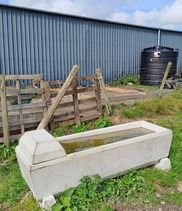
Through this partnership, work has been completed on several sites across the upper catchment, including the installation of two 10,000 litre rainwater harvesting tanks that are connected to drinking troughs in the field below, which has allowed sections of the watercourse to be fenced off to prevent cattle poaching the river. Not only will this work improve NFRM, but it will also offer significant benefits to the SAC species found within the Afon Mynach and further downstream.
Rhys Owen, Head of Conservation, Woodland and Agriculture at Eryri National Park Authority, said: “It’s great to see two organisations being able to pool resources locally to deliver effective conservation measures on the ground with the farming community on the Mynach, and shows how simple measures can yield great results."
The National Park Authority are an associated beneficiary in the LIFE Dee River project, and a key partner in work in the upper Dee, also sitting on the upper Dee steering group which is looking into salmon smolt migration in the Dee.
|
|
|
Forward Look
Afon Teirw
We have recently secured permission to remove two additional weirs on a tributary of the Afon Ceiriog. This work will be carried out prior to the 17th October, which is the cut-off for in-river works, and will open up an additional 4km of spawning habitat to migratory salmon and sea trout. This work is additional to the project’s original targets in the bid document.
Freshwater Pearl Mussels
Work will be carried out to improve the habitat for Freshwater Pearl Mussel at a release site that has been selected by a team of specialists. This will be completed prior to the 17th October and will include gravel introduction and pinning large woody material into the river. Juvenile mussels will then be released at the site in Spring 2026.
Project extension
The team are currently busy working on an extension to the project, with the new project closure to be in December 2027. This will ensure that the team can deliver on all of the work within the Grant Agreement, and ensure the benefits of a free-flowing Dee are fully realised.
|
|
|
|
|