| |
|
The Upper Wye Catchment Restoration Project #RestoreUpperWye is funded by Welsh Government’s Nature and Climate Emergency Fund, part of the Water Capital Programme, to restore the condition of the upper River Wye.
The overall aim of this project is to protect species and enhance habitats by addressing a range of pressures affecting the river.
For more background to the project have a look at Newsletter No 1
Each article in this edition has been written by our project officers to give an on-the-ground experience of the work being completed by the programme.
And now, here's what we've been up to since our last edition....
We will be on the Natural Resources Wales stand at the Royal Welsh Show on Monday 21st and Tuesday 22nd July. We can provide more information about this project and answer any questions you have. You can also let us know if you would like us to visit your farm. If you are at the show, please pop in and see us!
|
|
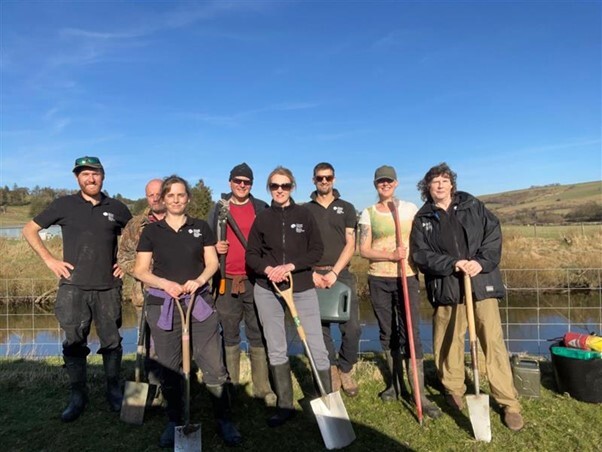
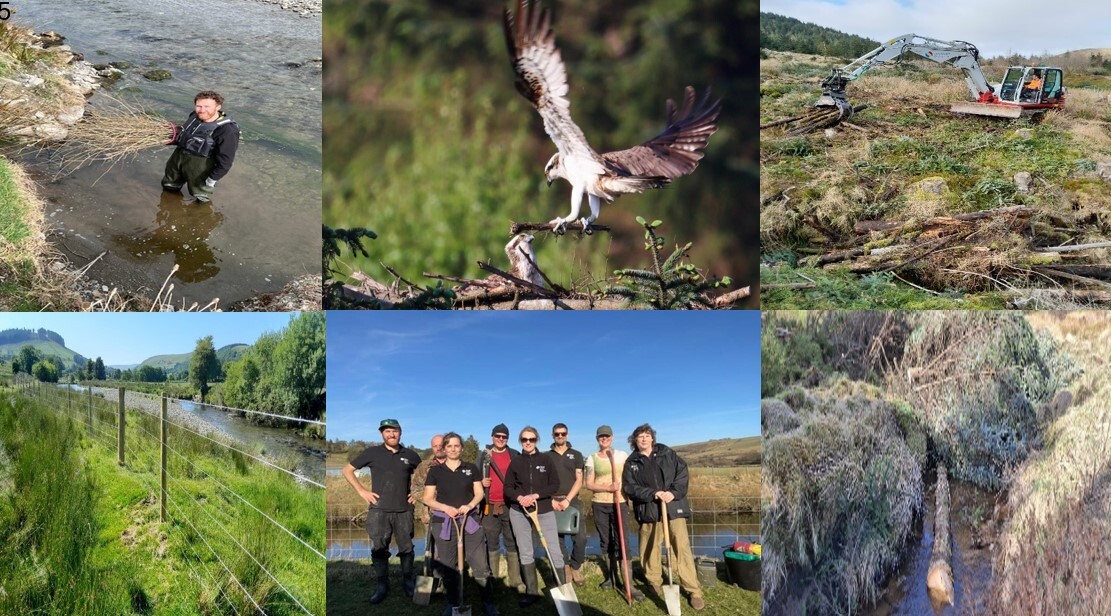
Photo: The team after a hard day’s planting
An important part of our project is to increase tree cover and shade in the catchment to help the river cope with the pressures of climate change. The importance of shading was highlighted during May when water temperatures reached 21oC in unshaded parts of the catchment. This compares to temperatures several degrees lower in reaches with trees. Warming water has both direct and indirect impacts on aquatic life, and further aggravates issues such as algal blooms, pollution, and the spread of disease. Over-warm waters can affect the physiology and behaviour of river species and as dissolved oxygen levels reduce, species such as salmon become distressed and can die.
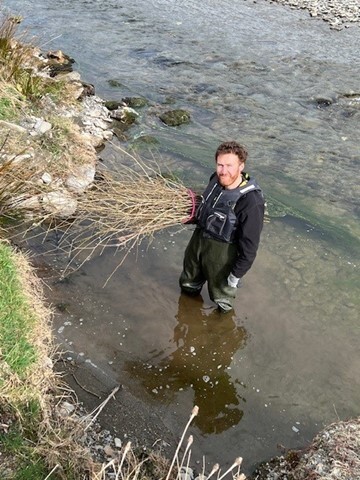
In March the whole team had the opportunity to get out on the river and get our hands dirty! With the blessing of the landowner, we planted hundreds of saplings along a 600m stretch of the upper Wye near Llangurig where shade is needed. The saplings comprised a mix of native species including willow, alder, aspen, birch, hawthorn and oak. We also pushed hundreds of live willow stakes into sections of eroding bank in the hope that they will take root to help stabilise the banks and provide valuable habitat
The very dry spring wasn’t great news for our saplings, but initial signs are hopeful that most have survived and will bring much needed shade to a vulnerable part of the river.
Photos: Willow cuttings ready to plant
|
|
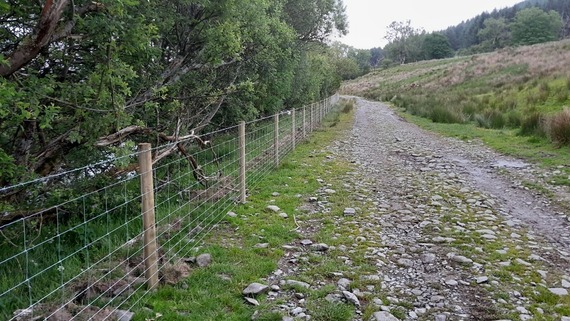
Photos: Standard stock proof fencing installed
Work recently started on a riverbank fencing project on a farm on the upper Wye near Llangurig. We are funding and installing over 2700m of new fencing. When combined with existing fenced off areas, this will mean a stretch of 1.2miles (2km) of the Wye will be completely fenced on both banks.
Although only a few miles from the source, the Wye at this location is already a powerful river which floods regularly. A more flood resistant fencing design is to be used in areas where the river comes out onto the floodplain. By having multiple strands of wire instead of the traditional stock netting, floodwaters and debris can pass through more easily and reduce the risk of the fence being pushed over.
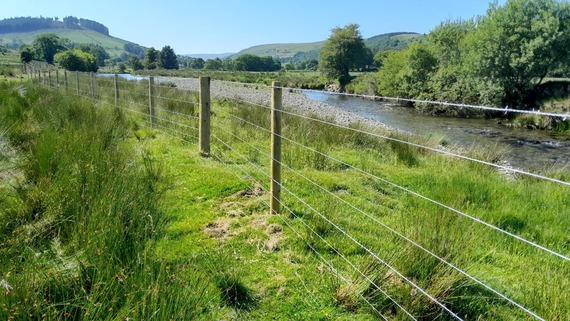
Photos: Flood resistant fencing installed
Rivers are often used for livestock to drink from, however this can increase nutrient inputs and contribute to bank erosion, as well as increasing risks to livestock. An alternative water supply will be provided using a solar powered water pump which can feed troughs away from the riverside.
The benefits to river health include:
- Reduced direct nutrient inputs
- Buffer strips of ungrazed vegetation filter water flowing into the river
- Tree planting and natural growth provide shade and keep water cooler
- Vegetation provides bankside and in-river habitat for wildlife
The benefits to the farmers include:
- Easier stock management- no need to retrieve livestock from the river and prevents stock going up or downstream
- Easier stock checks- more visibility of livestock makes welfare checks quicker
- Shade and shelter for stock provided by trees
- Reliable water supply using solar-powered pump
The Wye catchment above Llangurig is one our project’s focus areas. In addition to this farm, we have been visiting other farms in the area to provide advice and discuss whether there are potential works that could benefit the farm and the river. If you are in this area and would be interested in a visit, please get in touch.
|
|
|
Photo: The newly constructed artificial nest in 2023
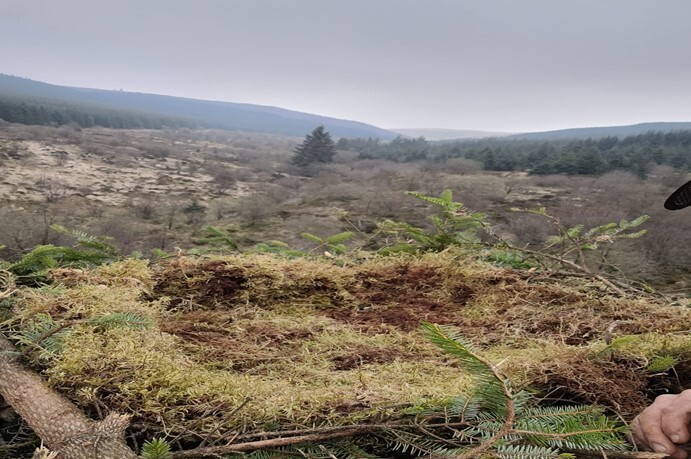
In 2023 NRW staff constructed an artificial nest in a remote part of NRW’s woodland estate in Hafren Forest. The brainchild of NRW’s John Williams and Rhys Jenkins from the Land Management Team, this was an attempt to create a new and uncontested breeding site to attract a breeding pair of ospreys to the area. John used his wide knowledge of ospreys to determine a suitable location.
Things were soon all ready but, alas no ospreys came and used the nest. Unfortunately this was the same in 2024.
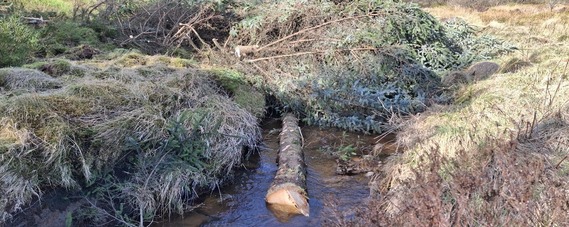
Photo: Felled trees “slowing the flow” in 2025
Earlier this year, as part of our Upper Wye Catchment Restoration Project, we carried out “slow the flow” work very close to the area of the nest site. Under supervision from project staff, contractors felled self-seeded conifers from alongside the river and placed cut material into the water, with the intention of increasing the amount of large deadwood in the watercourse. Deadwood is a vital, and often missing component of our streams and rivers. It has the beneficial effects of altering and slowing water flow and provides a greater variety of river features and habitats for wildlife. The wood also provides food for aquatic insects, and in turn amphibians, fish, and animals like otter.
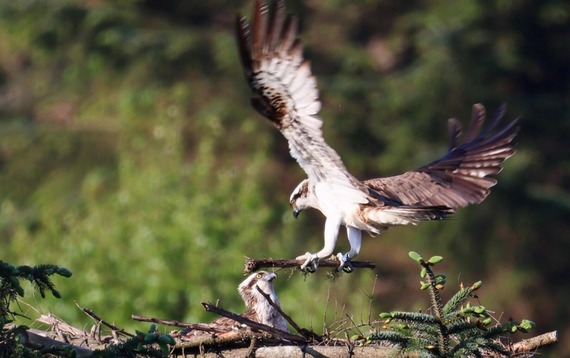
Photo: Adult ospreys on the nest in 2025
Although not by design, it appears that this felling process also helped make the site more attractive to ospreys because in April 2025, for the first time, a pair of ospreys decided to take up residence and use the new nest to breed.
The male had been ringed as a chick at another known nesting site and was born at Llyn Brennig. The female is an otherwise unringed bird who’s previous history is unknown.
This goes to show that seemingly unrelated environmental schemes can have a positive overall effect, working hand in hand to enhance the environment. We will be following the progress of the new family and hope this is another success story.
|
|
|
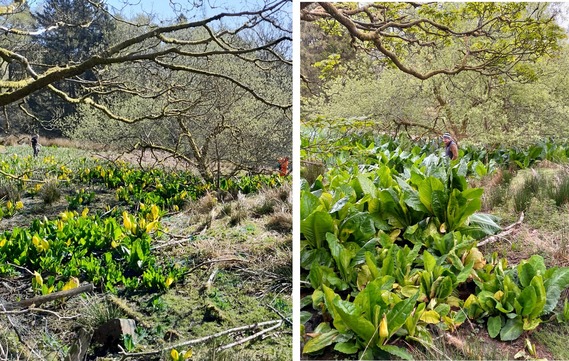
Last autumn we were alarmed to discover the most dense and widespread infestation of American Skunk Cabbage (ASC) we’ve seen so far in the Upper Wye—on a tributary upstream of Rhayader. However, we realised this site could serve as an ideal trial area to better understand this invasive plant, test and monitor control methods, and share our learning with others.
While we’ve encountered several smaller sites where individual plants can be easily dug up or treated - by slicing off the leaves and injecting the core stem with glyphosate—this site presents a challenge on a bigger scale. The plants are extensive, with thousands growing along a 2 mile stretch of river and floodplain.
The stretch also spans several landholdings where we have been provided with access. Two wooded sections of the tributary fall within the Welsh Government Woodland Estate managed by NRW, where tree fall from recent storms have made contractor access difficult and posing a further challenge to ASC control.
Our first herbicide trial in April, conducted while the plants were in full flower, proved ineffective. This is likely due to insufficient leaf surface area for the sprayed herbicide to circulate effectively, as there were too many plants to inject individually. A second application was made in early June, when leaves had reached lengths of up to one metre. We are now monitoring the impact of this treatment. We will continue to treat the ASC over the course of the next few years, using control sites to determine which are the most effective methods and when is the best time to use them.
If you spot American Skunk Cabbage in your area, please report it via the iRecord or INNSMapper app. And if you're located in the Upper Wye, let us know as well. You can contact us via the details below.
Photos: Left: Skunk Cabbage pre-treatment in April. Right: Skunk Cabbage in June showing ineffective treatment
|
|
|
March 2025 saw the completion of works on 45Ha of Tarenig forest, part of the Welsh Government Woodland Estate. The trial site contains six streams, carrying water from almost 250 Ha of productive conifer forest into the Afon Tarennig, on the upper Wye.
The works focussed on managing our forestry land more sustainably. We aimed to improve water management and create habitat, whilst still operating productive forestry. A range of forestry colleagues were involved in the planning of the works, so there was a shared understanding of the objectives and we could resolve any concerns.
On streams, we felled trees to mimic natural events, creating deadwood to slow the flow of the water. We also ‘pleached’ streamside willows (cut partially through as if laying a hedge) to allow these to root into stream beds and banksides to create future willow thickets to slow and filter overland flow. The shade and deadwood created by the willows provides vital habitat and shelter for invertebrates, fish and other river life, and helps keep the water cool.
We used waste forestry brash and surplus logs, laying them lengthways in drainage ditches, so water can still flow, but at a slower rate. We also removed non-native conifers from native riverside woodland, and experimented with realigning trackside drainage.
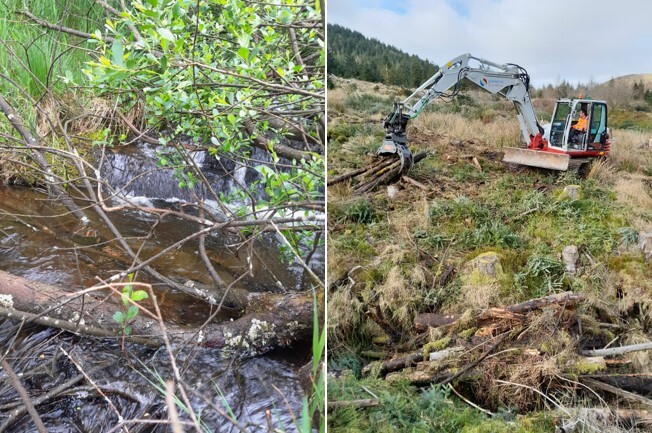
Photo: Left: Felled trees slowing the flow; Right: Contractor ‘stuffing’ ditches
Slower flow allows suspended solids such as soil, peat, and woody material, to drop out of the flow, resulting in cleaner water entering the river. Slowing the flow and creating overland flow, can also delay flood pulses during high rainfall. If scaled up across the forestry estate and beyond, this could compliment other flood management measures.
The site has easy access and a good forest road network, and is thus perfect for a demonstration site. We have installed fixed point monitoring posts across the area, and flown pre- and post-work drone surveys, using software to analyse the effects of the works. These can be repeated regularly to track changes over time.
The weather has been mainly dry since the works were completed, but as soon as the rains hit we will be donning our waterproofs to get on site and see how the works have benefitted the area. We’ll be sharing our learning with both NRW and commercial forest managers in Powys and across Wales.
|
|
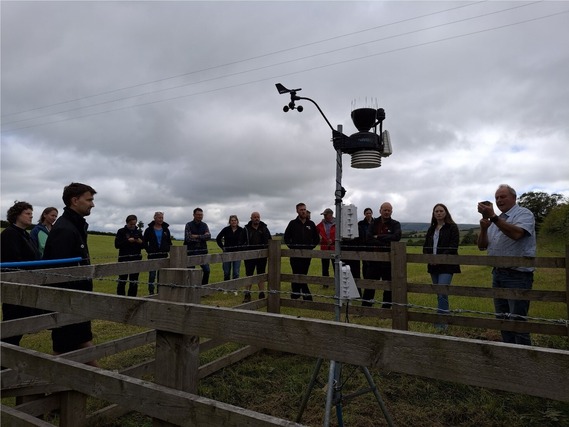
Photo: Hearing how the farmer’s App works for the weather station
We recently had the opportunity to spend a day with farmers from the Beacons Water Group near Brecon. This group of farmers have come together, in partnership with Welsh Water and set up a unique Community Interest Company in the Bannau Brecheiniog/Brecon Beacons. The Group work together to pilot new ways of working and innovative agricultural practices, which provide benefits to farms and protect drinking water sources.
The Group is challenged to develop win-win solutions that will bring long term benefits to both our drinking water catchments and the farming community. They operate on the understanding that no idea is a bad idea and encourage creative thinking among their members.
We were shown work they have delivered on their farms including weather stations to guide the best times to spread muck, stock and land management to maximise grass yield and minimise loss of soil, and hedge management. All the work they have done has delivered benefits to their farm businesses, with the dual benefit of reducing run off, pollution and soil loss into the river.
Many of the practices they are using can be applied to the Upper Wye catchment and the work that we are funding. We will continue to learn from the group and they have offered to help with peer to peer talks to show the benefits to the Upper Wye farming community.
|
|
|
|
|