|
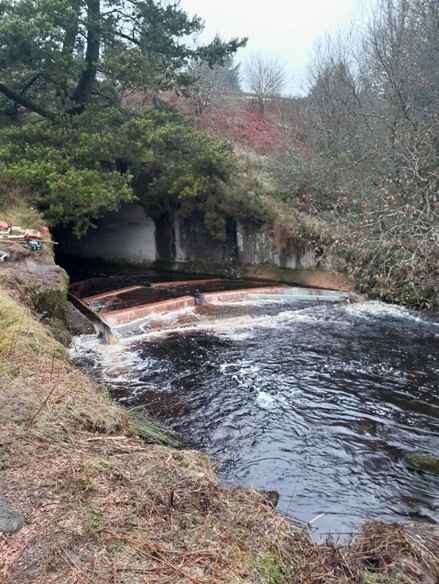
Having been planned for a couple of years, the Alwen culvert project was finally delivered, with the aim of improving access for salmon to reach prime spawning grounds upstream of the culvert.
After initial consultation with the asset owners, we had to carefully design a novel baffle system that spanned the 35-metre length but without being fixed to the concrete base to ensure the structure’s integrity was not compromised. Working closely with David Mould of JBA Consulting, a design was worked up which consisted of 42 green oak baffles being held in place by a ‘Meccano’ like steel structure which is fixed only on the concrete apron above and below the culvert.
The work of installing this fish pass was completed in early December in some challenging conditions of high flows and extreme cold weather. Special thanks go to the asset owner Conwy County Borough Council, DW Jones Fencing and Groundworks and staff for installation, and to Elfed Engineering for fabrication.
We are hopeful that some late running fish will have used the fish pass in December, and we can’t wait to get out to the river Alwen above the culvert in July to carry out electrofishing surveys to see if we can find some juvenile salmon for the first time in many years!
|
|
|
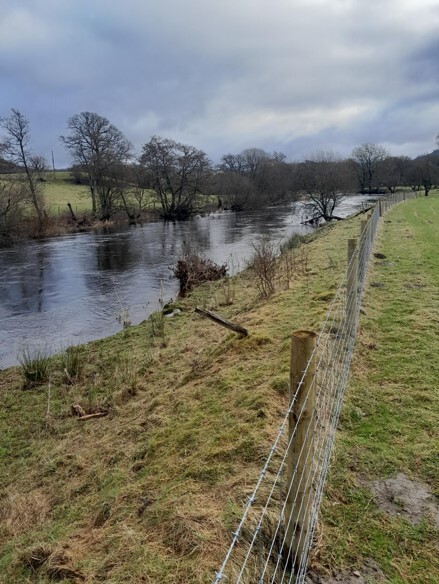
We have recently fenced off around 3km of the main river on the right-hand bank just downstream of Bala, in the same location that we carried out the introduction of 500 tonnes of boulders last autumn. Combined with previous work through various fisheries projects and landowners, the top 3km of the river Dee below Bala to downstream of the Afon Meloch is now fully fenced off on both the left and right hand bank. This includes 600 metres completed last year, which tied in with large sections that Rhiwlas Estate had previously fenced off on the left-hand bank.
In terms of the main spawning tributaries in the area, all the accessible reach for migratory salmonids on the Afon Hirnant is fenced, and the lower 2.5km of the Afon Meloch also has complete livestock exclusion following recent fencing work (this is the same area that we removed a boulder weir in 2022). The result of this is that livestock, particularly cattle, are excluded from entering a significant area of the upper river, ensuring that sediment and nutrient introduction to the watercourse is reduced, which is a major focus of the LIFEDeeRiver project.
|
|
|
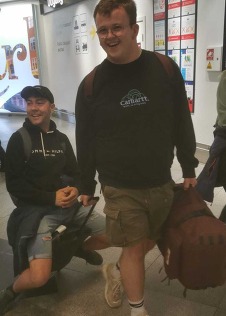
During the project, we have been fortunate enough to work with a range of farmers and landowners in the Dee catchment. As part of our efforts to help improve agricultural practices, we have visited almost 100 farms and have carried out several interventions that have benefited the businesses environmentally and economically.
Farmyard interventions have included installing rainwater harvesting tanks to help use water more sustainably, and installing over 800 metres of new guttering and downpipes on farm buildings to reduce yard runoff into nearby watercourses. We’ve also delivered 21 fencing schemes and six tree planting schemes, reducing livestock access to watercourses while ensuring alternative drinking sources, such as solar powered water troughs are available.
Ifor’s next adventure awaits…
“With my time on the LIFE Dee River project coming to an end, I have decided to take a work sabbatical and will be going travelling for a few months, taking part in a volunteering programme in Nepal! I’ll be volunteering with small-scale farming businesses in rural areas, helping to improve livelihoods in agricultural communities and implementing more resilient farming methods. My time working on the LIFE Dee River project has given me fundamental skills which I’ll be able to apply on farms whilst in Nepal, such as promoting the use of environmentally friendly practices, conserving resources as well as supporting local communities.”
We’d like to thank both Tom and Ifor (second and third from left in the photo) for all their hard work on the project over the past few years, their work has delivered great environmental benefits to the river Dee catchment.
|
|
|
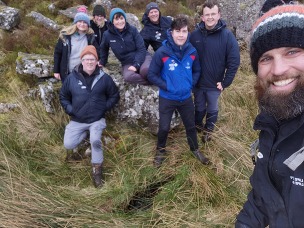
Ever since the project team came together in 2020, we have always dreamed of hiking to the very top of the catchment, where all life begins…the source of the Dee!
Last month, on a damp grey Tuesday, we finally managed to get most of the team together and set off on our adventure. We made our way through the Penaran forestry block, passing over the new bridge we’d constructed in 2022, and up the track where we were treated to a glimpse of three wild ponies galloping past.
As we approached the fringe of the forest and emerged out of the sheltered woods, we could see the imposing dark rock face of the Dduallt mountain (Black Hill) in front of us, which at its foot, is where the river rises. Whilst it felt like we were almost there, the last stretch of terrain was very wet, rough and tussocky moorland which provided plenty of surprise drops and humps to keep us all entertained along the way.
Having stumbled our way across the bog, we finally reached a cluster of large boulders and could just about hear the faint, trickling sound of water…we had found the source. Instinctively, we each cupped some water into our hands and to our delight, tasted the purest, most delicious water we’d ever drank…a fantastic way to celebrate the LIFE Dee River project!
Take a look at the photos here.
|
|
|
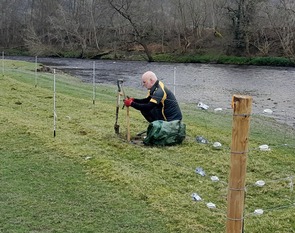
Over the next month or so, we will be planting around 3,000 more trees and an additional 420 willow cuttings in key areas within the fenced off river sections across the catchment.
Planting areas are carefully chosen to improve bank stability, retain sediment, provide shade, enhance biodiversity and other benefits, with a variety of locally occurring species incorporated.
This spring, we will be planting some Black Poplar along the river bank that have been grown from local specimens, following genetic testing by North Wales Wildlife Trust and Eryri National Park to check against hybridisation. Black Poplar have been shown elsewhere to work very well to stabilise open gravel areas and we are excited to see the results. It also helps to preserve this species in the area with genetically local specimens, as it is one of the rarest native trees in Wales.
Since the project began, we’ve planted 12,670 trees. After an estimated 20% loss due to factors such as periodic dry spells, alder leaf beetle, rodent and sheep damage, over 10,000 trees remain that are growing to provide much needed environmental benefits along the River Dee and its key tributaries.
|
|
|
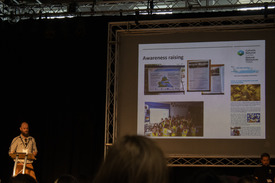
LIFEDeeRiver staff attended the recent Bionet Conference at Venue Cymru and gave a presentation on the work that’s been delivered throughout the project and some of the results we’ve seen so far. The theme of the conference was 'Water Management for People and Nature' and it was heartening to hear about all the other excellent projects that are working to tackle similar issues in the region.
Bionet is the nature partnership for north east Wales, covering all 4 counties. Over 100 people attended the conference to hear about various projects, including Welsh Dee Trust, Hiraeth yn y Mor, work on Sustainable Urban Drainage Systems (SUDS) and tree planting. Feedback from the conference has been incredibly positive, with one of the staff at Venue Cymru stating “today is the closest I’ve ever been to sitting in a room full of superheroes”.
|
|
|
2024 River Restoration Conference, 24 – 26 April
There are only a few weeks to go until we jointly host the 2024 Annual River Restoration Conference in Venue Cymru, Llandudno. The conference brings together national and international experts working on river restoration across many different disciplines, and we are expecting almost 400 delegates to attend. The first two days of the conference will include presentations, workshops and the awards ceremony. On the third day, there will be an exciting tour of the Dee catchment to visit some of the project sites where we have delivered interventions. To book tickets, and to read more about our work with the River Restoration Centre, read our blog here.
Erbistock weir and Horseshoe Falls
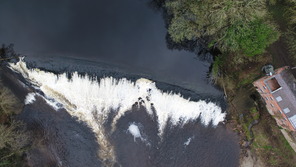
Work is progressing with the Erbistock weir and Horseshoe Falls projects. For new readers of our newsletter, Erbistock weir is a three metre high weir that is approximately 70 metres wide. It is a significant barrier to sea lamprey, and a partial barrier to river lamprey and Atlantic salmon. The proposal is to remove a section around 40 metres wide, which is approximately the natural river width in the area. By opening up this section, it will allow fish to pass through freely, and improve river connectivity, which is vital for the survival of migratory fish, whilst also creating many benefits to the wider ecosystem.
In 2009, UNESCO, designated Horseshoe Falls weir as part of the Pontcysyllte Aqueduct and Canal World Heritage Site. It also lies within a Special Area of Conservation (SAC) and a Site of Special Scientific Interest (SSSI). The weir is a large horseshoe shaped structure that extends for approximately 145 metres across the channel and was constructed around 200 years ago by Thomas Telford to maintain water levels in the canal. Once again, this structure is a partial barrier to fish migration, most notably bullhead, salmon and lamprey. To help improve ecological connectivity, habitat quality and fish passage, we will be creating a bypass channel by digging out approximately 120 metres of land on the right bank connecting the river around the Horseshoe Falls via a partly culverted channel. On completion, this area will be reseeded and returned to grazing land.
|
|
|
|
|
|