|
|
Last month Wales experienced three named storms in the space of less than a week (16 - 21 February 2022).
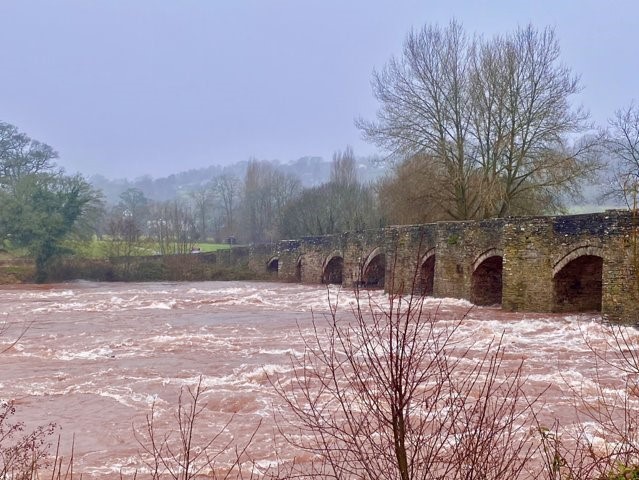 Photo of Crickhowell Bridge, Powys. 20 February 2022
Our Head of Flood and Incident Risk Management, Jeremy Parr, has reflected on the impacts of Storms Dudley, Eunice and Franklin in this blog.
We would like your help and are also here to help you
Any information that you can provide can help us improve our own understanding of the events and our Flood Warning Service for the future.
Do you have any questions about Storm Dudley, Eunice or Franklin?
We will aim to address your queries in our next newsletter. If your query relates to one of our partners, we will do our best to get those answers for you but please bear with us, as it may not be possible at this time or there may be a delay. Answers will be based on information available to date, as investigations continue.
Do you have any information you’d like to share with us?
Please include as much detail as possible:
- the date and time the photo/video was taken and the specific location
(National Grid Reference or What three words)
- which direction the photo is taken from
(for example, left-hand bank downstream or upstream, or ‘Image of Station Road facing towards the train station’, ‘Taken from house 10 looking at house 2’)
- the approximate time the property flooded
(if it did)
- the source of the flooding
(for example from a river, a blocked culvert or from the sea)
- the depth the floodwater reached
(it’s helpful to have something to compare it to, whether it’s a tape measure, mark on a wall or how many bricks it reached on an outdoor wall, or in relation to an object)
- any other details you can provide
(for example, where the water reached, where the river came out of bank, where a defence was overtopped)
|
|
|
We arrange volunteer network events for anyone involved or interested in being in a community flood plan.
The aim is that people who have taken steps to prepare themselves and their communities for flooding can connect. Whether they are in the same river catchment or face similar challenges, we know some communities have found it beneficial to link up with others.
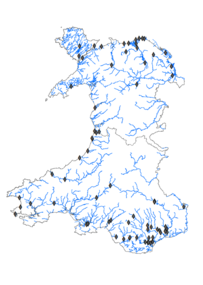
Map of community flood plans and main rivers across Wales
We haven’t been able to arrange an event for some time, and we want to find out from you whether you are interested and feel comfortable attending an event again soon.
|
|
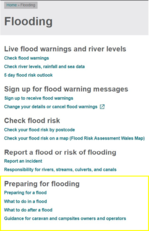
We've recently updated our advice and information pages on how to prepare for and respond to flooding.
Each page concentrates on what information and advice may be most helpful at various stages, and we’ve included improved links to other organisations that can offer help and support.
Take a look at the new pages and share your comments through the feedback button, or get in touch, so we can continually improve what we publish.
We’re going to be developing the pages on flood plans and advice for farmers and agricultural land next.
|
|
|
Fact: Turn off gas, electricity, and water in the event of a flood
Flooding can happen very quickly so planning what you would do in an emergency, before anything happens, can make a big difference in the event of a flood.
If your property is at imminent risk of flooding, you should turn off the gas, electricity, and water. Your safety is the priority, so if floodwater is already in your property – do not attempt to do this, as it would not be safe.
|
Supply
|
Why turn it off?
|
Typical locations in properties
|
Who to contact if your service is impacted
|
|
Gas
|
To help prevent gas leaks
|
Your gas valve is usually located next to your gas meter
|
To report a gas or carbon monoxide emergency call 0800 111 999
|
|
Electricity
|
To protect yourself from shocks, electrocution and to prevent damage to any devices
|
Your electricity main is usually a red switch on your fuse box
|
To report or to get information about power cuts call 105
|
|
Water
|
To prevent more water entering your property
|
Your water stopcock is usually under a kitchen sink or where the water pipe enters
|
Report water or sewage emergency issues to your water company
|
Finding out where they are and how to turn them off before a flooding emergency, helps you to act quickly if you ever need to.
Even if your property doesn’t flood, your services may still be impacted by flooding. So note these important contact details, so you know who can help you in an emergency.
Fiction: Once I have made a Flood Plan, I don’t need to look at it again
If you have completed a flood plan for your home, school, business or community this is a positive step to prepare for flooding. It is important to regularly review your plan (we suggest annually) to check if anything has changed and update your plan accordingly. It also helps to remind you of the steps you need to take when activating your plan. Becoming familiar with these steps may help you in the event of a flood when your decision-making abilities may be affected and/or you may only have limited time to act.
For example:
- Check contact numbers are current
- Ensure any flood protection equipment is maintained and ready for use
- For businesses, check new staff are familiar with the procedures
- Ensure that you circulate any updates to all involved
|
|
|
NRW provides 24/7 flood forecasting and a free Flood Warning Service to many areas at risk of flooding from main rivers and the sea in Wales.
After every serious flood incident, NRW carries out recovery and review work to ensure that we learn from the experience and can make improvements to our services wherever possible.
Our review of the 2020 February floods identified the need for us to adapt the processes we use when issuing our ‘Flood Alert’ messages.
What are Flood Alerts?
There are three types of flood warning message: Flood Alerts, Flood Warnings and Severe Flood Warnings.
Flood Alerts are the lowest level of warning message.
 What is changing?
The purpose of a Flood Alert has not changed, this level of message still warns people of the possibility of flooding, encouraging them to ‘be prepared’.
Our new processes for issuing Flood Alerts ensures a more consistent approach across Wales. It also makes the most of recent advances in Flood Forecasting and the improved services available on our website.
Flood Alerts will be issued on a confidence-based approach; where we have higher confidence that flooding is possible, Flood Alerts will be issued earlier to allow our customers more time to prepare.
We’ve also changed our Flood Alert message content. This will allow us to update our Flood Alert messages only when it is required, allowing our Duty Officers to focus on our higher level ‘Flood Warning’ and ‘Severe Flood Warning’ messages to provide a better, more reliable overall standard of service.
What does this mean for me?
The majority of people won’t notice any changes, simply because we’re bringing processes already in place in some parts of Wales into effect across the whole country.
Future Flood Alert message content will encourage you to view our near real-time River Level, Rainfall and Sea Data pages on our website.
These pages enable you to view the most recent rainfall and water level observations, showing whether they are rising or falling and how levels compare to typical levels, and the highest and lowest recorded levels.
What do I need to do?
Familiarise yourself with our digital services before bad weather arrives, so you know what to expect when you receive a Flood Alert.
To read more about the changes please read our blog or visit our website for information on how we forecast floods, issue warnings and assess flood risk.
|
|
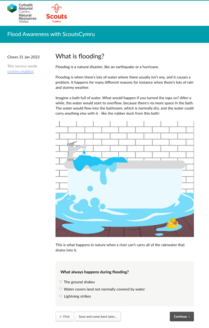
A short quiz is now available for Scouts to complete individually or in their group, to complement the existing Flood Awareness Scouts Cymru badge.
With many activities moving online during the pandemic, our contacts at Scouts Cymru informed us that there’s a greater demand for online materials for groups to complete and we were keen to enable this.
If you or your families are involved with Scouts Cymru, why not give it a try?
Feedback from those completing the quiz will be used to help adapt the resource for other youth groups and is the first in a range of new resources which will be developed in 2022-23.
If you are an Educator you can find a wealth of curriculum-linked resources on our website including sessions and activity plans about flooding and many other topics.
|
|
|
|
When we host our volunteer network events, we try and arrange guest speakers. Whilst we’re unable to meet up, we will continue to share information from other organisations that may be of help.
Ox-Cam Property Pathfinder Project
If you are looking for information on how to prepare your property for flooding, please take a look at the homeowners guide from CIRIA.
You may find the Flood Mobile produced by the Ox-Cam Property Pathfinder Project useful. Using this virtual experience, you can explore different practical measures that could be used in your home and find out how they work.
|
|
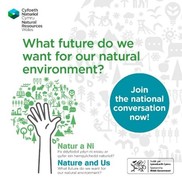
Nature and Us launched in February, and aims to get everyone in Wales thinking and talking about the future we want for our natural environment, and what we can all do to protect it.
This national conversation will examine our relationship with nature and our food, energy and travel systems – and explore how they all affect climate change and the natural environment.
Have your say by completing the survey or registering for an event at www.natureandus.wales
|
|
|
- What would you like to see in future issues of this newsletter?
- Is there something you’d like to know more about?
- Would you be willing to share your experiences of flooding or as a community volunteer?
- Get in touch if you missed any of our previous issues, and we can share them with you.
NRW is not responsible for the content of other sites. We are providing this as a signpost to information, and not as a promotion of other organisations or companies. We believe the advice that they are sharing is helpful to everyone. Links to external sites may only have information available in English.
|
|
|
|
|