|
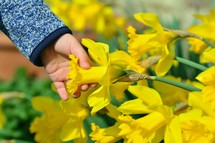
Whether you follow the meteorological definition of the seasons (Spring starts on the 1st March) or the astronomical definition (Spring starts on the 21st March when the sun crosses the equator line, heading north in the sky) the month of March means it’s time to spring forward as we head into British Summer Time 🌞⏰. Increased daylight hours and warming temperatures here we come! Get your learners watching out for lambs playing in the pasture, scanning the hedgerows for a cornucopia of catkins or paying notice to bulbs bursting through the soil – what’s your favourite sign of spring?
A busy month for education settings, March brings St. David’s Day, the day Wales celebrates St. David, it’s patron saint on the 1st March and World Book Day on the 4th March. Whilst both educators and parents alike scramble to sort costumes, World Book Day is all about promoting reading for pleasure. In this issue we’ll investigate how the outdoors can inspire reluctant readers and we’ll celebrate well-thumbed environmental books. Whatever you dressed up as we hope you have ‘Great Expectations’.
|
|
|

Not according to Vicky Lees, Literacy and English Supporting Improvement Advisor for GwE. Providing space to stretch learners both physically and imaginatively, she believes the outdoor environment provides particularly good opportunities for learners to develop their communication and language skills.
“Taking learning into the outdoor environment is one of the most inspiring, motivating and uplifting learning experiences a teacher can offer to a child. It can encourage even the most reluctant reader or speaker to come out of their shell and engage with and be curious about the world around them and begin to communicate in a way that the confines of a classroom can sometimes inhibit. Coupling this with a good book linked to their outdoor adventures, then you have a real recipe for developing a deep love of reading and a genuine association with reading for pleasure. We know that this is one of the surest routes to developing the reading, communication and wellbeing of our children (and our teachers)! I really don’t think I could recommend it enough!”
|
|
|
 |
|
Books can be used as aids to promote learning in, about and for the natural environment as Heti, aged 7 explains in a new short video. Having read the book ‘Tidy’ by Emily Gravett with her Mum, Heti wanted to go out to a nearby woodland to learn more about woodlands and the animals that live there. Enthused by the book, she took part in a range of hands-on outdoor learning activities that relate to the story and concludes by encouraging all of us to do little things to help nature. If you want to know more watch this short video! |
|
|
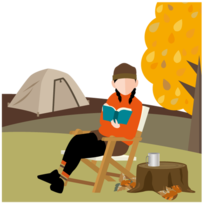
Books are a wonderful resource for introducing and deepening learners’ knowledge and understanding about the natural environment. We’ve developed a ‘Branching Out into Books’ booklist that will help your learners understand trees, woodlands and the creatures that live within them.
We’d love to increase the amount of environmental themed booklists we have on offer. From fire, to plastic pollution, habitats to badgers, if you have been inspired to learn more about the natural environment or used a book as a hook to get your learners outdoors, we’d love to hear your suggestions. Email your thoughts to education@naturalresourceswales.gov.uk. Here are some suggestions to get you going!
“I have just finished reading ‘After the Flood’ by L.S. Matthews and loved every minute. The entire storyline is fantastic and provides so much food for thought on the way we as humans treat our planet and the potential consequences of that, for both our own future and future generations. I am very excited by the prospect of shaping a topic around this story with my KS2 learners and I feel inspired to plan, which is always a good sign!” Millie Jones, Ysgol Maes y Llan, Ruabon.
“With bees under threat, ‘Criw'r Coed a'r Gwenyn Coll’ (The Woodland Crew and the Lost Bees) by Carys Glyn, is a very relevant book that raises several questions for children about their world, helping to develop ethical and informed citizens. The characters within the book easily lend themselves to role play and art activities with the rap in the book helping learners to remember the story.” Rhodri Harries, Teacher and Creative Practitioner, South East Wales.
“Our Year 9 pupils have been reading 'Trash' by Andy Mulligan and will be moving onto 'Flush' by Carl Hiaasen. I feel both these books widen pupils' understanding of global environmental issues, as well helping to develop their English skills. The learners get enthusiastic about protecting our natural environment and enjoy the opportunity to express themselves about environmental issues.” Gail Quick, Literacy Coordinator, English Department, Dwr y Felin Comprehensive School, Neath.
“We’re going on a Bear Hunt by Michael Rosen is an all-time classic, exposing young children to new language as they are taken on a journey through nature. The book comes to life as the words create sound, movement and happiness. Children use their senses outdoors to touch, feel, taste, hear and smell the story, bringing the adjectives to life. The story has many cross-curricular opportunities, children will naturally want to create maps, follow directions and go on an adventure in their local environment. We love to use the story structure and change the characters for example ‘We’re going on a bird hunt’. The children lead the way. The opportunities are endless, a story to treasure.” Gaynor Brimble, Foundation Phase Challenge Adviser, EAS.
|
|
|

Whether you are developing vocabulary, composing poetry or promoting oracy, the natural environment is constantly changing and provides a wealth of inspiration for learners. From Tickly Prickly, which focusses on discovering textures to acrostic poems, the 18 activities and games within the booklet focus on demonstrating how to use the natural environment as a stimulating environment to facilitate language and literacy whilst improving knowledge and understanding of natural features and processes.
|
|
|
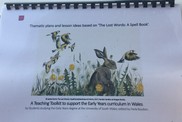
After all is read and done, we know you’re busy and want some off-the-shelf inspiration. Why not check out these great resources our Outdoor Learning Wales network groups have developed?
The Lost Words – A toolkit developed by Year 2 undergraduate Early Years students at the University of South Wales. The Lost Words began as a response to the removal of every day nature words such as acorn, bluebell and wren from a widely used children’s dictionary because those words were not being used enough by children to merit inclusion. The Lost Words became a protest of the loss of the natural world and a celebration of the creatures and plants with which we share our lives. The Lost Words teaching toolkit is available on the Outdoor Learning Wales website and includes thematic lessons plans on ten ‘lost’ words.
Raising Standards through Outdoor Learning Literacy Pack, Newport OLW group. From character development to journey sticks, this resource pack will provide you with all the write moves to take literacy outdoors. The pack has a range of activities designed for all abilities, with an incidental welsh vocabulary box as well as ICT links.
Where my writing takes me – a resource developed by South Powys OLW group. Aimed at developing literacy outside, this resource offers a range of speaking and listening, reading and writing activities to develop children’s understanding and ownership of the environment.
|
|
|

Being faced with a blank page to fill can prove daunting for learners. Taking your learners outside and giving them a change of scenery can be a move in the 'write' direction and spark their curiosity.
Robust and resource rich, calming yet constantly changing, the natural environment provides a multisensory setting to inspire a wonderful story. Maybe a weather-beaten farmer who’s faithfully tended his fields until one day he finds an old coin hidden amongst the freshly ploughed furrows, or a ‘Scaredy Squirrel’ who’s terrified of leaving the safety of the tree canopy. How does the natural environment affect the lives of the main characters? From the mysterious atmosphere of a woodland to the sheer and craggy summit of a mountain, the natural environment can set the ambience for an adventure and offer hazards and obstacles for the characters to overcome. In what season does the story take place? Will the main character drudge through Narnia’s eternal winter or spend long summer days by the river like Mole and Ratty in Wind in the Willows? What impact do the characters have on the natural environment? Do they wreak havoc initially only to learn the error of their ways and go on to become nature champions? Your learners are sure to hit the 'plot'.
Why not try out our Micro Minibeast Safari activity to give your learners an ant’s perspective of the world? Or immerse them in a real life ‘who dunnit’ mystery with our Food Chain Detectives activity. Head outside, you don’t need to go far, and it doesn’t have to be a pristine nature spot. It just needs to be a space to stretch the imagination and allow the creative juices to flow. Something the natural environment can offer in spades!
|
|
|
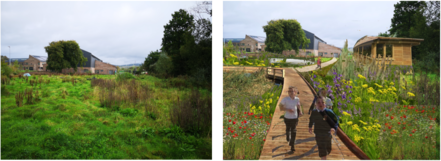
Before and after - Artist’s impression
Ysgol Bro Dinefwr in Llandeilo is developing an outdoor learning area, called Natur, that is fundamental to its vision as a sustainable school of the future.
When the one-acre area is finished, it will have raised beds, chicken coops, beehives, a hydroponic polytunnel, a toolshed, an outdoor classroom and a large graffiti wall. It will be sustainable and off-grid, with photovoltaic panels and its own irrigation system.
The driving force behind the project is Ian Chriswick, Assistant Headteacher, who hopes the project will be used as a model for other secondary schools in Wales. Ian said: “We think outdoor learning shouldn’t stop at year seven - it can be integral to a lot of subjects. Calculating the volume of a raised bed teaches maths. Graffiti art will be taught outside. We’re going to pilot ‘The Built Environment’ GCSE and teach sustainable building skills. Health and well-being will be incorporated by developing a menu using produce the pupils have grown themselves. Selling their produce will allow them to learn business studies too.
“The pupils are very keen to get involved. Young people are bombarded with messages about climate change, so this empowers them to do something about it, helping to ease their climate anxiety and, now, anxiety over Covid too.”
Ian has developed relationships with lots of organisations to help develop the outdoor area. One example is a collaboration with Swansea University Innovation Centre to deliver future studies such as 3D printing with beeswax. Another is a project to create weather stations with live web feeds from the area and the pupils’ homes. The outdoor area will facilitate cross-curricular projects in line with the new Curriculum for Wales and will provide pupils with the skills needed in the future workforce. The school has an ambitious aim to increase the job prospects of the county to allow students to remain locally. Ian sees the outdoor area as a key part of developing this circular economy and the resilience of the area.
Follow Ysgol Bro Dinefwr’s journey to build Natur on Twitter (and maybe offer to lend a hand if you’re nearby!).
|
|
|
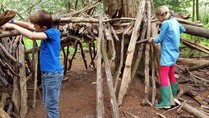
Whatever your topic there are lots of different ways you can use books as a hook to get outdoors during Wales Outdoor Learning Week. Why not host a Mad Hatter’s Tea Party from Alice in Wonderland? Get your learners measuring, pouring and sharing mud cakes and stewed leaf tea.
Learning about the Celts? Lady’s bedstraw, woad and oak bark were all traditionally used by the Celts to produce dyes for clothing and body adornment. Bring the Horrible Histories Cut-throat Celts to life and revive ancient Celtic traditions by having a go at making some natural dyes (Activity 8 - Getting Creative Outdoors booklet).
If your learners were stranded on a remote island like the schoolboys in Lord of the Flies, would they survive or descend into savagery? From instructional writing on how to build a shelter to completing a Wilderness Survival challenge (Activity 11 - Health and Well-being Outdoors booklet), would your learners have what it takes to survive?
Organised by Natural Resources Wales and the Wales Council for Outdoor Learning, all the partners involved will be sharing ideas and training opportunities during the week to enable you to join us as an educator, parent or learner as we celebrate Wales’ biggest and best classroom; the natural environment. Remember to share your experiences on social media using the hashtag #WalesOutdoorLearningWeek.
|
|
|
Whatever your interest or age group you are working with, we’ve got a range of courses coming up.
Naturally Healthy and Happy - This course will give you the tools to make the most of using nature-based experiences to promote positive physical and mental well-being for learners of all ages.
24.03.21 @ 10.15 am, presented in English
24.03.21 @ 4.15 pm, presented in English
12.05.21 @ 10.30 am, presented in Welsh
12.05.21 @ 4.15 pm, presented in English
Treemendous Trees and Wonderful Woodlands: Part 1 – Back by popular demand, a standalone course, interactive activities to get your learners learning about how a tree grows, the woodland cycle, forest ecosystems and much more!
29.06.21 @ 4.15 pm, presented in Welsh NEW
01.07.21 @ 4.15 pm, presented in English NEW
Treemendous Trees and Wonderful Woodlands: Part 2 – A standalone course, you don’t need to have attended Part 1 to attend Part 2. Amongst other things, this session will cover everything from how to calculate how much carbon is in a tree, how to measure trees and everything you need to know about seed dispersal.
19.04.21 @ 4.15 pm, presented in English
20.04.21 @ 10.15 am, presented in English
20.04.21 @ 4.15 pm, presented in Welsh
Peat is Neat – there’s nothing bog standard about peatlands – 3 for the price of 1, celebrate peatlands, Wales Outdoor Learning Week and Earth Day 2022 with us on the 22nd April! We’ll be sharing cross-curricular activity ideas and information to get your learners enthused about these fragile, ancient landscapes. From finding out how much carbon is stored in a m3 of peat to learning how peatland plants were traditionally used to treat wounds, this session is aimed at KS2/3/4 educators.
22.04.21 @ 11.00 am, presented in Welsh
22.04.21 @ 4.15 pm, presented in English
A Natural Childhood - Aimed at pre-school, nursery and Foundation Phase practitioners and teachers, this training course is full of tips and tricks on how to use the outdoors to support children’s development, learning and play.
15.04.21 @ 11.00 am, presented in English
21.04.21 @ 10.30 am, presented in Welsh
21.04.21 @ 4.15 pm, presented in English FULL
06.05.21 @ 4.15 pm, presented in English NEW
18.05.21 @ 4.15 pm, presented in Welsh NEW
To book your place on any of the above courses, please visit the Tocyn Cymru website.
|
|
|
Would you like regular outdoor learning updates and news? Why not follow the Outdoor Learning Wales Twitter account or closed Facebook Group which both offer a platform to keep up-to-date, spread the word of ongoing projects and facilitate discussions with anyone with an interest in outdoor learning in Wales.
You are receiving this newsletter because you have previously attended a training course run by NRW or have requested to join the NRW Education or Outdoor Learning Wales Network Group mailing lists. We hope you found it useful but if you wish to be removed please respond using the Unsubscribe option below.
|
|
|
|
|
|