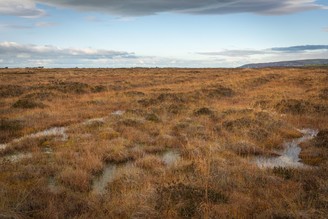
Scientific research over the years has highlighted that a healthy peatland can ‘breathe’ in response to changing water availability.
The ground surface of a bog will track the water level, so that when the weather is dry, and the water levels in the peat drop the peat surface drops.
Then, as it rains and the water levels rise again, the peat surface rises with it. This means that peat at the surface, and the vegetation growing on it, remains wet - even during periods of dry weather.
If peatlands are drained and damaged the peat becomes more compacted. This means that it can no longer ‘breathe’ so easily in response to changing water levels and the water within the peatland can drain away.
Jennifer Williamson from the UK Centre for Ecology & Hydrology (UKCEH) is currently leading on work that is monitoring the bog ‘breathing’ and the effects of the restoration work of our project.
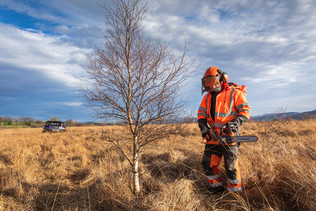
Restoration work such as bunding (creating low level banks of peat), ditch blocking, and vegetation clearance is currently under way on several of our project sites.
The monitoring work done by UK CEH, British Geological Survey (BGS) and the University of East London, will seek to find out how the work is affecting water levels and the condition of the raised bogs.
Read her guest blog to find out more.
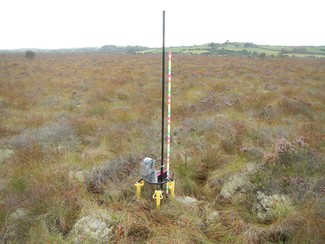
Image credit: Camera installed to monitor peat surface movement at Cors Caron NNR (Photograph credit Nathan Callaghan UKCEH).
|