|
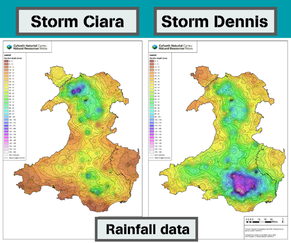
NRW has published its review into the record-breaking February 2020 storms with the aim of learning from the experiences and to make improvements wherever possible.
You can see the full details through our Storymap or by reading the reviews in full: February 2020 Floods in Wales
Here are some of the key facts:
- February 2020 was the wettest February since records began in 1862.
- Wales received 288mm of rainfall during February.
- NRW issued a record 243 Flood Alerts, 181 Flood Warnings & 6 Severe Flood Warnings in February.
- Some areas of Wales received up to four times the average monthly rainfall.
- Some river catchments received about 75% of an entire month’s rainfall in less than a day.
- Almost a quarter of NRW’s 231-strong network of river gauges recorded their highest water levels ever.
As we continue to learn the lessons from February’s flood events and what more can be done to make Wales more resilient to the impacts of more extreme weather events in the future, one thing is clear – there is no single simple solution.
Tackling the climate emergency challenge will need a long-term effort, and the support and commitment of a coalition of governments, authorities, businesses and communities to bring about a seismic change in how Wales manages its flood risk in the future.
|
|
|
|
We have published a new map as part of our long term flood risk service.
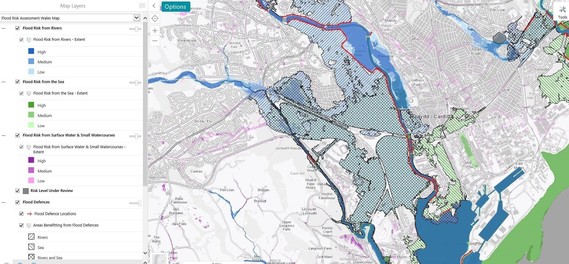 The Flood Risk Assessment Wales (FRAW) map:
- uses new data
-
displays the risk of flooding from rivers, surface water, the sea and smaller watercourses
-
displays extra information, such as flood defence locations and the local benefits they bring
Our new flood information services are now fully operational.
Flood Warnings and Alerts displays live flood warning information – use the new search box and map to find out the current flooding situation for your area. You can also view all of the areas covered by our flood warning service and sign up to receive direct flood warnings for your location of interest.
5-day flood risk for Wales shows the flood risk level for each local authority in Wales for the next five days – take a look to plan ahead and take action when the risk level increases.
River levels, rainfall and sea data displays the latest data from hundreds of monitoring stations across Wales – find monitoring stations in your area using the map and search tools.
Let us know what you think of these services by using the feedback links on each webpage.
|
|
 |
|
Thank you to all of you who completed our survey on the community flood plan template.
You can read a short summary of the results and what is happening next on Citizen Space.
|
|
|

Help us design our new long term flood risk checker.
We’ve listened to your feedback about our current way of checking your long term flood risk and we think we’ve come up with a concept that’s quicker and easier to use.
Could you help us test a new way of checking the flood risk to your property?
We’d love to have your input during a 30 min Skype demonstration, where you can help shape the design from the start.
Help us shape our Flood Warning Service.
In our last Newsletter we let you know that we would be looking for input from community flood volunteers, to help shape the future of the Flood Warning Service. To do this we’re hoping to set up a small user group, so that we can share our thinking, hear your thoughts and get your input.
This is an opportunity to get involved and be part of the user group. To work with us for a small amount of time, every month or two. It would be done virtually, at least to start with, either on a telephone call or by email.
It is really important to us that this group has a diversity of voices, so we hear from lots of different people, at risk of different types of flooding, all over Wales. If you’re interested in getting involved, please get in touch with us and provide the following details:
- where you are in Wales.
- what type of flooding concerns your community has, for instance if you live in a fast-responding catchment.
- whether you would be able to represent Welsh language needs for the service.
- if you could be an advocate for any part of your community that is more vulnerable.
- why you’re interested in getting involved in the group.
|
|
|
Welsh Government published the National Strategy for Flood and Coastal Erosion Risk Management in Wales in October. The strategy sets out how the Welsh Government intends to manage the risks from flooding and coastal erosion across Wales over the next decade in the face of the growing risks associated with climate change.
We will work with Welsh Government and partners, to implement the strategy to make Wales more resilient to flooding in the future.
We wanted to highlight a section, which you may find helpful. There are details about 'Types of flooding & who you should contact' and you can see this in full by clicking the image below.
 It outlines the roles and responsibilities of organisations that prepare and respond to flooding in Wales.
You can the strategy in full or a summary of it here: National Strategy for Flood and Coastal Erosion Risk Management in Wales
|
|
|
We’d like to share five practical steps that you can take to help yourself, and others, to prepare for flooding:
-
Check the long term flood risk for your home or anywhere else important to you. Encourage your friends and family to do the same. Our long term flood maps show flood risk from rivers, the sea, surface water, small watercourses and reservoirs.
- If you’re at risk of flooding from main rivers and sea you can sign up to receive free flood warnings and/or alerts. Or all live Flood warnings and alerts for rivers and seas in Wales are updated on our website or available on Floodline (0345 988 1188).
- Encourage vulnerable neighbours to register for priority assistance from their water and energy suppliers. This is a service which identifies anyone who may need more urgent assistance in an emergency, for example somebody who needs to keep prescription medicine in a fridge.
- You should keep sentimental items in a safe place, upstairs or in a watertight box placed highly on a shelf. So that if the worst happens, you know where all your important items are.
- Take photos of your property and create a list of your belongings before any floods to help with any future insurance claim. Include your most valuable and sentimental possessions, with serial numbers if applicable.
You can find more practical information and advice on how to prepare for flooding on our website, including a personal flood plan template for your home.
Take care of yourself
We are currently living through difficult times, with changing restrictions placed on us to reduce infections in Wales. Now more than ever, it’s important to look after our mental health.
Flooding and anxiety surrounding bad weather can also impact on our mental health. Knowing just one action to be better prepared for flooding can reduce the physical impacts of the floodwater and can also help to ease anxieties associated with flooding.
The following organisations may help:
| SilverCloud |
People aged 16 and over in Wales, experiencing mild to moderate anxiety, depression or stress, can sign-up for a 12-week course of online therapy. |
Self-Referral Guide
|
| Mind |
Confidential mental health information service. |
0300 123 3393
|
| CALL |
Free 24/7 confidential listening and support service. |
0800 132 737
Text the word HELP to 81066 |
| Shout 85258 |
Free 24/7 text messaging service. |
Text the word SHOUT to 85258 |
| Meic Cymru |
Free, confidential helpline for children and young people up to the age of 25 in Wales. |
080880 23456
Text 84001 |
|
|
Flood kits
You may hear about a flood kit referred to as an emergency kit, grab bag or go bag. The idea is to have some items prepared, should there ever be a sudden emergency where you’d need to leave your home quickly. The kit could help look after you and your family, especially if you’re unable to return for a while.
Once assembled, leave the kit in an easily accessible place in your home. It may be that you don’t have to use it, but if you ever did need it, you may be thankful to have important items already together.
We’ve suggested items that would be particularly useful during and after a flood, like a torch if the electricity is cut off or a written list of important phone numbers if the phone or internet lines go down.
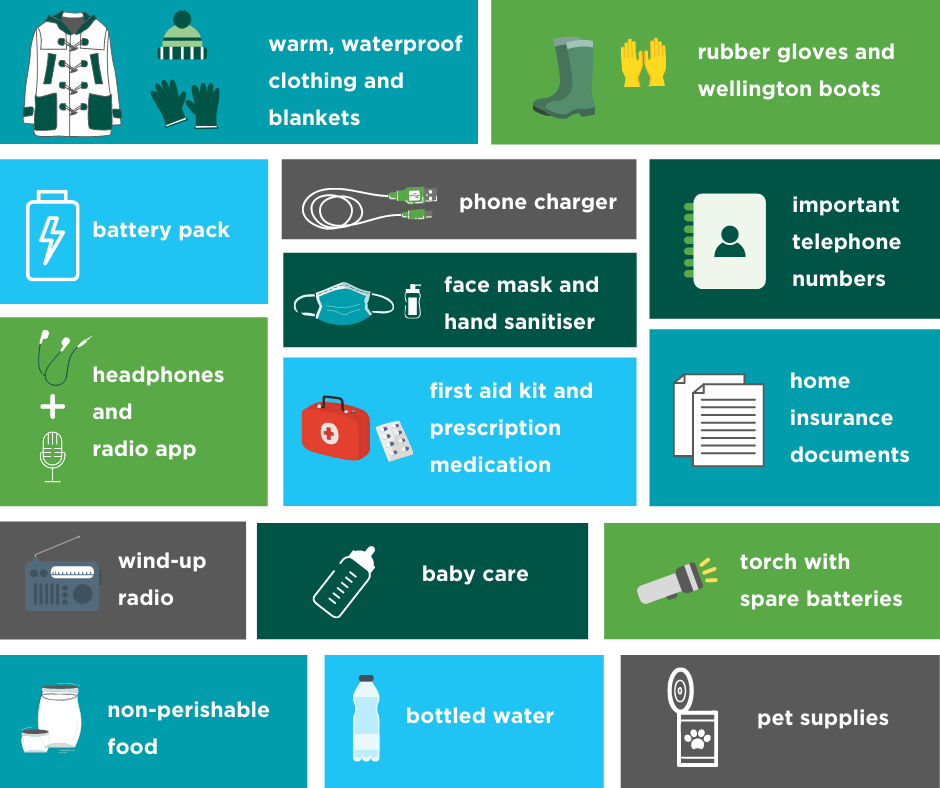 Items to include:
- a phone charger and battery pack
- copies of your home insurance documents
- a torch with spare batteries
- a wind-up or battery radio, or headphones to use FM radio on your phone (to act as an antenna)
- warm, waterproof clothing and blankets
- rubber gloves and wellington boots
- a first aid kit and prescription medication
- bottled water and non-perishable food
- baby food and baby care items
- pet supplies
- face masks and hand sanitiser
- important telephone numbers
We’d recommend having a chat with your household members to think about what you would like to include, as it will be different for every home. For some more ideas, SEPA has a short video about Making a flood kit and the Red Cross has lots of information on preparing a kit in the case of an emergency.
What do you pack in your flood kit?
|
|
Fact: 15cm of fast flowing water can knock you off your feet
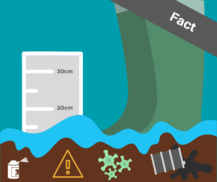
Only a shallow amount of water can knock you off your feet. Flood water is extremely powerful.
Flood water is dangerous because it may:
- be contaminated with sewage, chemicals and animal waste
- be deeper than you expect
- carry debris and hide dangers like missing manhole covers, as flood water can cause them to lift
More information is available from Public Health Wales and the Royal Society for the Prevention of Accidents. We also have educational resources on our website, to help have these conversations with children.
|
Fiction: Sandbags are the best way to stop water entering your home
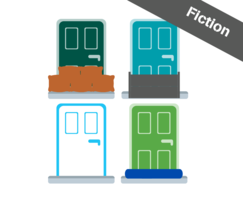
Traditional sandbags are just one option, and to protect your property you should consider the positives and negatives of using them.
You should consider:
- how many sandbags you would need to protect each entry point to your home, who would help you set them up safely and how long it would take
- that they need proper environmental disposal and leak or rot very quickly after use
- that they may be heavier than purpose made flood protection products
- your local authority’s sandbag policy. You should check this in advance, as your local authority may need to prioritise resources in an emergency and sandbags may not be available.
There are also purpose made flood protection products, which include:
- flood boards
- flood doors
- alternative airbricks or covers
- alternative sandbags
There is practical advice in this property resilience e-book produced by Mary Dhonau OBE, in partnership with the Environment Agency and Flood Re. It includes practical guidance, and examples from people who have been impacted by flooding and have adapted their properties. Alternative products can be found on The National Flood Forum’s Blue Pages.
Please note that some insurers require flood defence products to be industry-approved and certified.
|
|
|
|
In this section we can share messages and experiences from across the community flood volunteer network in Wales, and responses to questions we’ve received.
If you’d like to share anything or ask us anything, please get in touch.
|
|
 |
|
|
|
The latest Natural Resources Wales external funding bulletin is now available to read.
It includes details about funding available, which may be of interest to your community.
|
|

- What would you like to see in future issues of this newsletter?
- Is there something you’d like to know more about?
- Would you be willing to share your experiences of flooding or as a community volunteer?
Send any suggestions, ideas or questions to: befloodready@naturalresourceswales.gov.uk
|
NRW are not responsible for the content of other organisations’ websites. We are providing this as a signpost to information, and not as a promotion of other organisations or companies. We believe the advice that they are sharing is helpful to everyone. Links to external websites providing services beyond Wales may only have information available in English.
|
|
|
|
|