|
|
#Patientfirst
|
February 2026
|
|
|
Bringing advanced liver radiotherapy closer to home
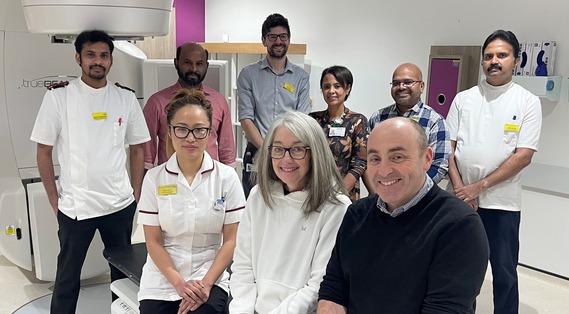 The Trust has become one of only a few in the country to provide liver stereotactic ablative body radiotherapy (SABR).
This highly precise form of radiotherapy delivers a high dose of radiation in a small number of treatments, carefully targeting tumours while minimising damage to surrounding healthy tissue.
Previously, many of the Trust’s patients needing liver SABR had to travel to London for the treatment, which often requires up to 10 separate hospital visits over several weeks. The new service in the Kent Oncology Centre at Maidstone Hospital means patients in Kent can now access the treatment closer to home, saving hours of travel and reducing time away from their support networks.
Sixty-three-year-old Denise from Sidcup (pictured with the team) was the first patient treated with liver SABR at the Trust. Speaking of her experience, she said: “Having my care at the Kent Oncology Centre has saved me having to travel into central London and everyone from my consultant to the registrar to those delivering treatment have been really supportive.”
“It’s really impressive and hopefully it will go on to help many others that are living with cancer. My treatment was done very quickly and I could not fault the care I have received.”
|
|
Robot-assisted surgery benefits record number of patients
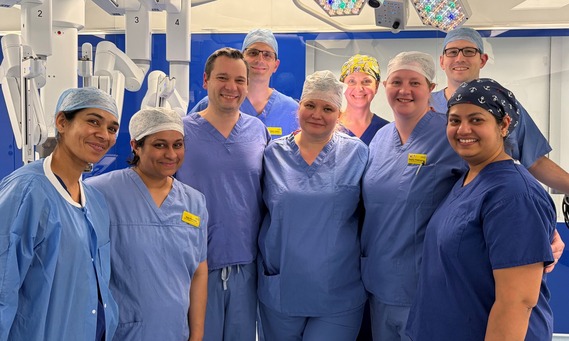 A state-of-the-art surgical robot has helped a team at Maidstone Hospital carry out 40% more gallbladder operations in a single day.
The surgical team, led by Consultant Upper Gastrointestinal and Bariatric Surgeon, Mr Matyas Fehervari completed a record number of surgeries as part of a high intensity theatre (HIT) list.
Carried out using one of the Trust’s two surgical robots, the high intensity list for gallbladder removal was the first in a Kent hospital.
The procedure, known as a cholecystectomy, is traditionally carried out with keyhole (laparoscopic) surgery, which usually means five operations a day. By using robot-assisted surgery instead, where the robotic arms mimic the surgeon’s hand movements through small incisions, the team were able to operate on seven patients, who all went home the same day.
Being able to provide gallbladder surgery to more people, more quickly, means better care for patients, as they experience fewer bouts of inflammation and fewer visits to A&E during flare-ups.
|
|
Taking action to reduce the risk of stroke
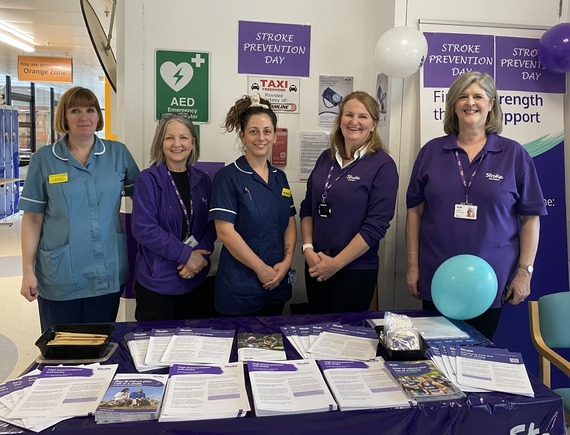 The Stroke team recently welcomed the Stroke Association to Maidstone Hospital, as part of Stroke Prevention Day.
A national campaign run by the Stroke Association, Stroke Prevention Day this year encouraged people to get their blood pressure checked regularly.
Stroke is the fourth leading cause of death in the UK. Figures from the Stroke Association show that 280 people a day have a stroke in the country – that’s one every five minutes.
This is predicted to rise to 414 people every day by 2035 – one every three and a half minutes.
The increase is due to an ageing population and more people living with long-term conditions including high blood pressure, which is the cause of around half of all strokes.
Together, members of the Stroke team and the Stroke Association spoke with staff, visitors and patients about the different risk factors for stroke, recommending lifestyle changes which could reduce any future risk. They also highlighted the importance of monitoring blood pressure (BP), which can be done at a local pharmacy, GP surgery or with a BP monitor kit at home.
|
|
Then and now: nurses unite after four decades
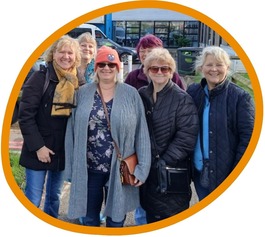
In January 1986, 12 student nurses began training at the then Maidstone School of Nursing in Barming, including MTW Bank Staff Nurse, Nicola Henthorn.
After qualifying in 1989, their careers spread across community nursing, dementia care, cardiology, midwifery, neurorehabilitation, bloodborne viruses and practice development.
Forty years later, on 23 January 2026, eight of them reunited to reminisce, share memories and remember absent friends.
Five of the group are still working in the NHS today, and all acknowledged the impact of their nurse training in Maidstone, and the transferable knowledge, skills and experience that set up their careers and changed their lives.
Speaking after the reunion, Nicola said: "Training and living together in the Nurses’ Home meant that we had, and still have, a special bond. It was emotional to come together four decades later and remember those we worked with and the people we have lost over the years, including Clare Montague, a dedicated tutor and remarkable human who left a place in each of our hearts.”
|
|
|
Experts gather to enhance care for children with upper limb difficulties |
|
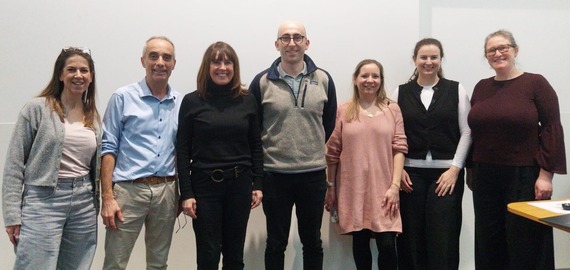 Children with complex upper limb issues were at the heart of a study day hosted by the Complex Paediatric Upper Limb Service at Maidstone Hospital.
The service provides highly specialised support for children and young people with neurological conditions such as cerebral palsy, who experience functional difficulties using their upper limbs. It has been developed into a regional referral centre and treats children with a range of paediatric orthopaedic conditions, helping improve their ability to use their hands.
Occupational therapists, doctors and physiotherapists from across Kent, Surrey and Sussex attended the study day to share ideas about the management of children with complex upper limb issues.
They also discussed working with community services to create a regional care plan for children and young people with arm and hand difficulties due to cerebral palsy.
|
|
World Cancer Day
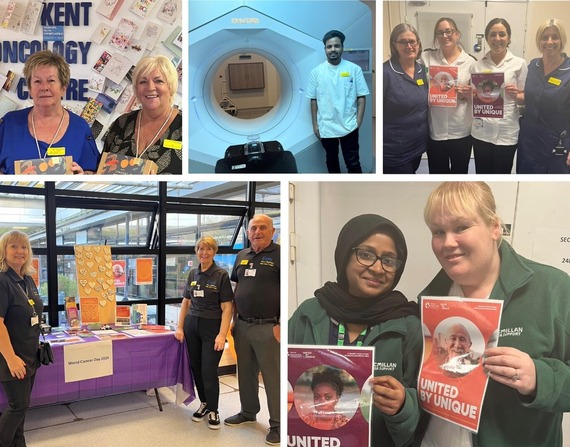 Last week, we marked World Cancer Day and raised awareness of cancer to encourage its prevention, detection and treatment.
The day gave us the opportunity to highlight the symptoms of cancer, and the support in place for the 3.5 million people living with the disease in the UK.
Patients in the Kent Oncology Centre at Maidstone Hospital wrote moving messages of encouragement to others living with cancer, which were displayed in the waiting area in sight of those visiting for an appointment. A number of colleagues also shared their experiences of working in cancer care.
On average, one person is diagnosed every 90 seconds in the UK, and one in two people will develop some form of cancer dring their lifetime. Our teams provide some of the fastest access to cancer treatment in the country, seeing over 600 patients each day and caring for up to two million people across Kent, Medway and East Sussex.
To ensure patients get the quickest possible treatment, the Trust has developed its services in recent years by investing in new technology and refining processes, now meeting all three national standards for cancer care.
|
|
Join MTW's upcoming Board meeting
 |
|
Our next Trust Board meeting takes place on Thursday 26 February at 9.15am.
Members of the public and staff are welcome to join the meeting in person at the Academic Centre at Maidstone Hospital, or online via Teams.
The meeting link will be available on the Trust’s website from the start of that week.
|
|
|
|
|
|