|
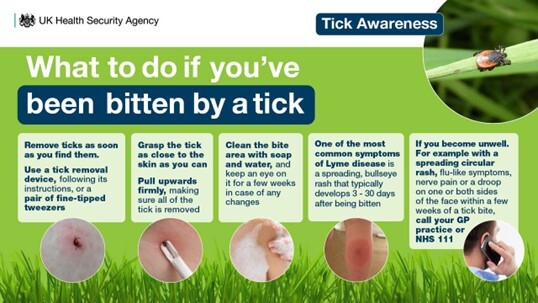
Be tick aware!
With the summer season fast approaching, it’s a great time for children to enjoy being outside.
But when spending the day in grassy or wooded areas please be tick aware. Ticks can carry diseases. Always check for ticks when you return from a day out and remember to check your pets too! For more information to share with your pupils and parents, visit the UKHSA’s tick surveillance programme.
Vector-borne disease teaching resource development
Vector-Borne Diseases (VBD) are infections transmitted to humans by infected insects such as mosquitoes, ticks and fleas. These vectors can carry harmful microbes between humans or from animals to humans (WHO, 2024).
Worldwide, these diseases cause over 700,000 deaths annually. Also, these vectors are moving into new regions (due to climate change and global travel amongst other factors) increasing the risk of transmission and infection, and now 80% of the world’s population is at risk of one or more VBD (WHO, 2024).
To support education around this topic with the aim of improving knowledge and awareness, we are developing new educational resources to help students and teachers understand how tick and mosquito-borne diseases spread and how to prevent them. In collaboration with our international partners and UK educators, we are creating curriculum-aligned lesson plans for KS1–KS4.
If you’re travelling abroad this summer, watch this video for some travel health advice: Mosquito bite avoidance: Advice for travelers - YouTube
Watch this space for more information on the roll-out of the resources. To get involved or stay updated, drop us a line at e-Bug@ukhsa.gov.uk
Teacher IPC training
Preventing and managing outbreaks of infectious diseases in schools can be challenging, and our research shows teachers are seeking training to support their efforts. We surveyed 1,000 teachers to assess their confidence in preventing and controlling infections, and to identify gaps in support (click here to read our published findings).
Following this, e-Bug with UKHSA's Infection Prevention and Control (IPC) and Regional Health Protection teams are in the process of developing an IPC training resource for teachers to support IPC efforts in schools and Early Years settings.
We would like to test out the training with a small cohort of teachers and Early Years educators in September/October 2025. If you would like to be part of this, please fill this form https://forms.cloud.microsoft/e/0rrsBu87nn
Did you celebrate World Food Safety Day with e-Bug?
If you used e-Bug resources in your classroom to celebrate, we would love to hear all about it! Drop us a message e-bug@ukhsa.gov.uk and tell us what you got up to – we are excited to share how your class used our resources this World Food Safety Day!
This year’s World Food Safety Day served as a powerful reminder of the critical role safe and nutritious food plays in protecting our health. With the World Health Organisation (WHO) reporting nearly 200 diseases linked to unsafe food, causing an estimated 1.6 million illnesses every day, the message was clear: food safety is everyone’s business.
To help reduce foodborne illnesses, the WHO promotes the WHO Five keys to safer food, a simple, effective guide to safe food handling practices.
“Was it something I ate?”
This year’s theme highlighted the importance of safe food handling to reduce illness and save lives. Take a look at this example of 11-year-old Harlee who developed unexplained symptoms after tasting raw cake batter. She was later diagnosed with an E.coli infection – a reminder of how small actions can have serious consequences.
Read Harlee’s story on the CDC website: E. coli Illness Linked to Cake Batter: Harlee’s Story | Food Safety | CDC
|