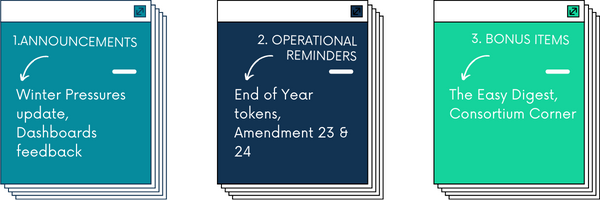
Coming up in this issue...
Announcements
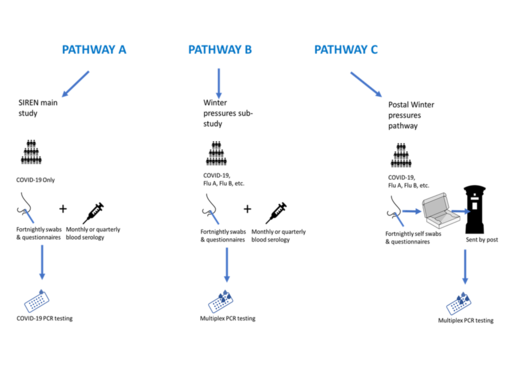
The Winter Pressures Sub-study will enable us to investigate additional respiratory viruses including flu and RSV. The current set-up in the SIREN study is as follows:
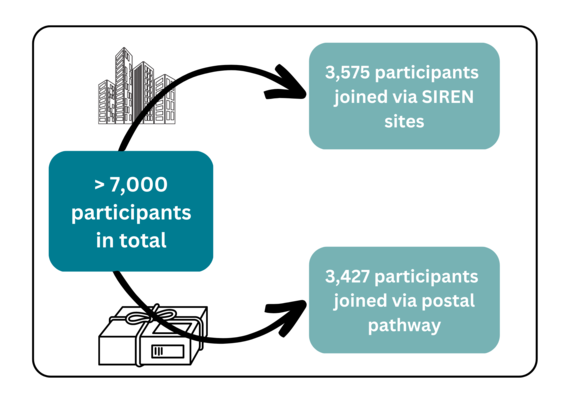
We are pleased to share the latest sub-study numbers with you:
We will be discussing the sub-study at the SIREN All-Sites Debriefs (24 and 26 January) – please do join us if you have any questions to ask.
|
Please keep an eye out for a feedback survey in the next couple of weeks. We would really welcome your thoughts on the SIREN Dashboards, including what works well and what we could improve.
|
|
 |
 |
|
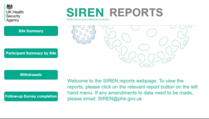
As a reminder, the SIREN dashboards are interactive, site-specific platforms which can be accessed at any time by site teams. Your dashboard will be connected to the SIREN database and showcase key participant information to better visualise and understand this important data. |
If you have yet to access your dashboard or if you have a question please email siren@ukhsa.gov.uk.
Operational reminders
 |
|
We hope sites who have received the End of Year Tokens are enjoying sharing certificates, stickers and pin badges with their participants and research teams.
If you would like to share these on Twitter please use #SIRENstudy and tag @Victoria_jhall and @SMHopkins!
|
For sites who have yet to receive the End of Year Tokens please don’t worry – the final parcels will be sent out shortly. Please keep an eye out for the parcels arriving as they will need signing for.
You will have received an email on 7 December 2022 regarding study amendment 23 and will receive another email this week regarding Amendment 24.
Please note these amendments do not require any additional action from SIREN sites and we are sharing for your information only.
These amendments relate to the Winter Pressures Sub-study and include:
- A new Patient Information Leaflet (PIL) for participants at sites who have needed to send the multiplex samples to regional UKHSA laboratories for testing. This change applies to around 750 participants and ensures that there is clarity on the slight change in sampling and testing. In addition, some of these sites are able to run two pathways within SIREN so changes to the PIL and protocol reflect this.
- An update to the swab packing instruction leaflet for participants in postal pathway C, making it clearer to participants that barcodes should be applied vertically not horizontally.
Amendments are listed on the SIREN Master File.
Bonus items
OVERVIEW
This article demonstrates that the SIREN study acts as an early warning surveillance system for COVID-19 and COVID-19 variants.
KEY POINTS
Making waves:
- SIREN plays an ongoing role in national COVID-19 surveillance by monitoring primary infections and reinfections, and by monitoring emerging variants.
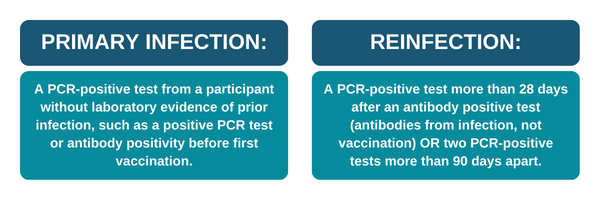
- The paper defines a primary infection and reinfection in the following ways:
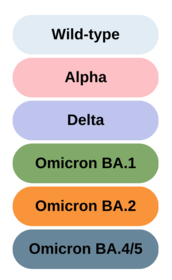
- SIREN data has highlighted six distinct infection waves:
- SIREN data shows that the highest infection rates were recorded during the Omicron BA.1 and BA.2 waves.
Observing Omicron:
- During the Omicron BA.1 and BA.2 waves the reinfection rate exceeded the primary infection rate for the first time.
- Immunity (gained from previous infection or vaccination) was less protective against an Omicron infection.
- Reinfection rates dropped during the BA.4/5 Omicron wave, likely because protection improved after BA.1 and BA.2 infection.
Comparison to other studies:
- SIREN samples with a high enough RNA load can be sent for sequencing. This is known as sequencing yield. The SIREN sequence yield was found to be comparable to other studies.
- COVID-19 waves identified by SIREN waves are consistent with national surveillance trends.
TAKE HOME MESSAGES
- SIREN data showed that Omicron emerged and caused a rapid rise in infection and reinfection rates, regardless of vaccination status.
- SIREN data detected COVID-19 variants within a similar timeframe to national data.
- While SIREN is not representative of the general UK population, the cohort represents a highly exposed group who also have contact with vulnerable patients.
- This, in addition to the relative timeliness of its surveillance, shows the SIREN study plays a valuable role in complementing other national surveillance programmes.
- As the UK adapts to a new phase of the pandemic response with reduced testing, SIREN provides a sustainable and focused surveillance platform.
Follow this link to read the full article.
The SIREN Consortium is a unique, multidisciplinary collaboration established to answer key questions about the mechanisms and durability of COVID-19 immunity.
Consortium members include:
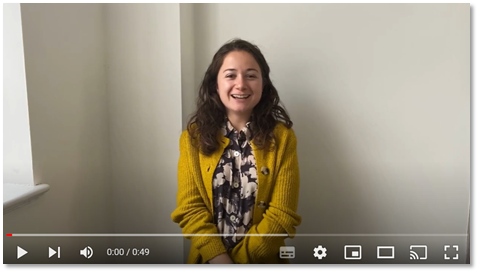
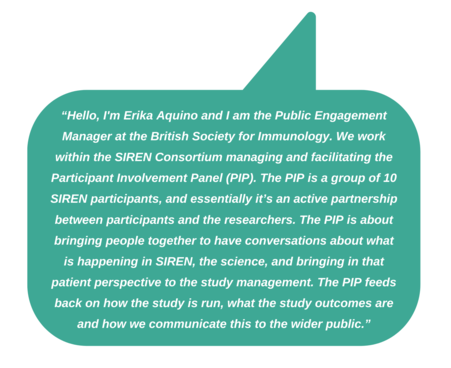
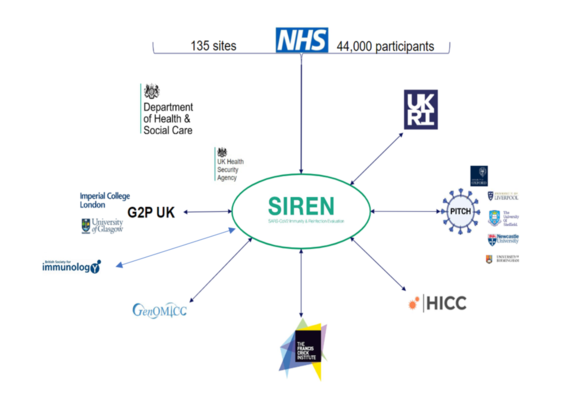 Each SIREN Consortium member focuses on its own particular research area. To provide more insight into the Consortium and some of the people behind the research, we asked representatives from different organisations to share a bit about themselves and their work with SIREN.
We share the first two introductions below, and look forward to introducing more Consortium members in future newsletter issues. Please click on the videos to watch.
Find out more about the British Society for Immunology (BSI) by visiting the website.
You can also read a recent report on Participant and Public Involvement (PPI) written with support from BSI, and featuring the SIREN Participant Involvement Panel (PIP) as a case study!
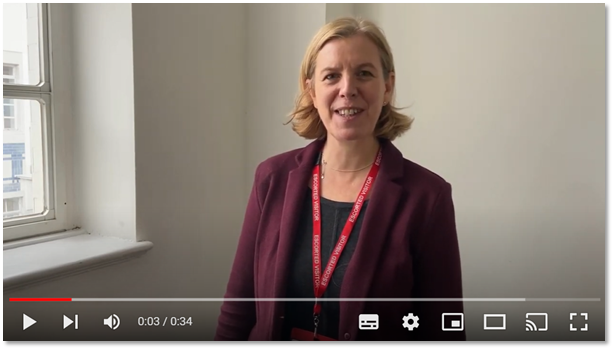
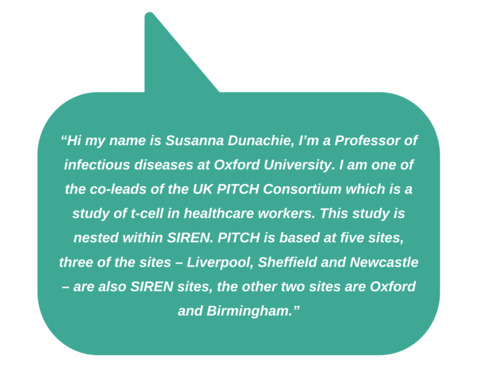
Find out more about the PITCH study by visiting the website.
And finally, as ever, if you would like to share feedback on the SIREN study (whether to flag what is working well or what you are finding challenging) please fill out our feedback form. There is the option to provide your feedback anonymously if you would prefer.
Kind regards,
The UKHSA SIREN Study Team
|