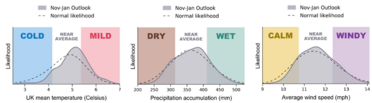
The three month outlook according to both The Met Office and our own forecasters MetDesk indicate the likelihood of a milder, wetter start to winter is greater than that of a colder drier three month period.
However, please bear in mind that the longer term the forecast, the lower the confidence, so we would still recommend all necessary preparations are made sooner rather than later.
Grant funding is available to help Devon Communities be better prepared in the event of an emergency (including flooding)
The Devon Community Resilience Forum has established an Emergency Resilience Grant scheme to support communities across the county affected by extreme weather events.
The initiative offers two funding schemes – scheme 1 up to £250 to help communities to develop emergency plans and scheme 2 up to £1,500 to support small scale works and resilience equipment for those communities that have an emergency plan in place or are in the process of preparing one.
Scheme 1 - up to £250 for communities that wish to develop their own Community Emergency Plan
This is intended to help with organising a public meeting within your community, printing leaflets, hiring a venue and providing some basic refreshments with the aim of establishing a Community Response Team who will take responsibility for developing your Community Emergency Plan.
Scheme 2 - up to £1,500 for small scale works and resilience equipment
For example:
- Rapid purchase of simple flood equipment (PPE, signs, sand bags etc.);
- Exceptionally, a contribution to minor, practical works. (However, this will not cover activity that is otherwise being promoted through the community self-help / Road Warden scheme, such as clearance of drains, or general maintenance works that are the responsibility of land owners).
- For those communities that have recently experienced flooding, works to assist community recovery and getting things back to normal will be included.
Any constituted group (Parish Council or Community Group) with a bank account is able to apply for the grant.

It's important that we hold up to date details for you. Please take a moment to complete your details using our online form, even if you believe the details we hold are correct.
If you're no longer a Snow Warden please let us know by email so that we can remove your details from our records.
|
We have created free online training for Snow Wardens. Topics include:
- Creating your local Snow Plan
- Risk assessments and staying safe
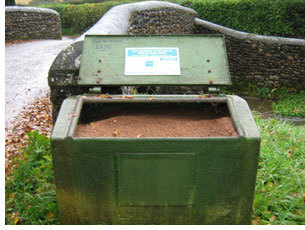
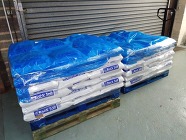
- Grit bins and salt bags
|
|
 |
If you haven't yet completed this training you can email us to sign up.
Once you've signed up you'll be able to order additional salt for your town or parish.
Please check the grit bins in your area as soon as possible; once winter service starts the amount of resource that can be diverted to filling grit bins is limited.
You can use our interactive map to report grit bins
 |
|
- with low salt levels
- that are damaged
- where the salt is contaminated or unusable
|
Grit bins are an expensive asset in terms of maintenance. If you think you need a new bin we will check if it is possible to re-site an existing bin (if there is evidence to suggest it isn’t being used) first.
Where there are no options to re-site existing bins and we agree a new bin is needed then then this needs to be funded through the local councillor budget (where locality budgets are not available then funding may need to come directly from the Parish or Town Council). The cost remains at £350 which covers the installation, filling and ongoing maintenance costs for the life of the grit bin.
If you would like to request a new grit bin please contact our Customer Service Centre to start the process.
If you have completed your online training you can request up to 5 tonnes of additional salt to use in your town or parish. Please only order salt if you have less than 75% of your salt stock still available.
Devon County Council will provide the additional salt free of charge, however if delivery is refused the Parish/Town Council may be asked to cover any costs incurred as a result of the refusal.
-
Listen to local radio for updates on current weather conditions and ensure you are stocked with food and medications.
-
Follow @devonalert on social media.
-
Consider if your journey is essential and be alert to weather warnings.
-
Allow additional time for your journey.
-
Never assume a road has been salted. Remember that showers or rain will wash salt off roads leaving them prone to ice, and in extreme cold even salting will not stop ice from forming.
-
Drive with care and according to the conditions. Reduce your speed and leave more space between you and the vehicle in front and leave plenty of room if you’re overtaking.
-
Be alert to fallen trees and branches, particularly on minor roads where they may not have been reported.
 |
|
Never drive through floodwater or swollen flowing water, you don’t know how deep it is. Find an alternative route. |
|