 |

Dear Member,
Welcome to this monthly briefing dedicated to
updating you about what’s happening in the world of Adult Social Care in Devon.
Adult Social Care is a changing landscape
with significant uncertainties around what the future brings. This uncertainty
makes it hard to navigate the challenges we face here in Devon. As you are all aware,
Devon faces significant resource issues. Central funding is being cut at the
same time as Devon is being challenged by its particular demography and
rurality. Another key challenge is to ensure the sufficiency and quality of the
care workforce to meet rising care demands, as we seek to support a growing
number of people to remain healthy and independent in their own homes. Adding
to these pressures are the recent announcements around National Living Wage and
deferral of phase 2 of the Care Act. Many unanswered questions remain around
these announcements.
I have taken the initiative to seek more
clarity on the government’s plans through a number of channels and I will
continue to keep up the pressure in order for us to get the clarity we need in
order to be able to plan long term. In September, I wrote to local MP Sarah
Wollaston to raise the issues we face in Devon. MP Wollaston has forwarded my
letter to Secretary of State Jeremy Hunt,
and we are currently awaiting his response.
I attended the yearly NCAS conference on the
14-16 October 2015, where I again took the opportunity to raise the issues that
face Devon and seek clarity on the government’s future plans for social care.
It was disappointing to see that Secretary of State Jeremy
Hunt did not attend the conference, and worrying that minister Alistair Burt,
who did attend, indicated that he was in the dark as to what the funding
settlement for local government and adult social care would be in the upcoming
spending review. In spite of this the NCAS conference was nevertheless an
important opportunity for Devon and other local authorities to voice our
concerns.
Meanwhile, we are working hard to ensure
that, internally within DCC, we have the right team in place to face these
challenges. October has seen some significant changes to the Leadership
arrangements for Adults services, and the structures that support service
delivery.
From 1st October, Sally Slade and Jan Ingram
will lead the senior management team for Adult Social Care on a job-sharing basis
until March 2016. More information is available
here about the responsibilities that Sally and Jan will continue to
lead.
I am very pleased to announce that Keri
Storey has been appointed as Head of Service for Adult Social Care from April
2016, by making an early announcement we can ensure good succession planning for this
key role. Keri may be known to many of you through her current role as
Assistant Director in Eastern Devon. Keri is proud to be part of the health and
social care community in Devon, and is looking forward to working with the
social care teams across the county.
Changes are also being implemented to the
Senior Leadership Teams and service structures for both Adult Social care
Operational Services and Social Care Commissioning this month.
I want to acknowledge the contribution of all of our
teams, during this period of significant change, for their dedication and
professionalism in maintaining focus on delivering an excellent service.
If you have any questions about the subjects covered in the bulletin, or about
adult social care in Devon, please do email
me directly.
Kind regards,
|
 Stuart
 Personal care retender – 'Living Well at Home'
The message from the public is very clear
"help us to stay in our own homes for as long as it is safe to do so".
Central to that for many people is high quality, reliable personal
(domiciliary) care, delivered with dignity, compassion and respect. Every
week, the Council and its NHS partners support over 4,000 people with care in
their homes and an increasing number of these have intensive packages of
support, delivered several times a day. Many more choose to buy care themselves
by taking advantage of a Direct Payment.
The current arrangements for this care end on
31 March 2016. The Council, the two Clinical Commissioning Groups and the Devon
Partnership Trust are now in the process of recommissioning that care. Earlier
this summer we launched a tender called Living Well at Home. Shortlisted
providers will shortly be invited to submit
their full tender by 16 December and
contracts will be awarded in March 2016. The intention is to appoint a Primary
Contractor in each of eight geographic zones, who will be responsible for
delivering care in that area, either directly or in partnership with other
suppliers. The contract will for a 5 year period,
with an option of a further two. The successful providers will work with
us as strategic partners with a focus on delivering the right care, at the
right time in the right way – informed by what service users and carers have
told us is important to them.
Care workers are a vital and valued part of
the workforce and we want them to be well trained and supported and to see care
as a fulfilling and rewarding career choice. At the heart of our tender
is a requirement that staff are paid in line with legislation relating to the
national minimum wage and national living wage for all contracted hours,
including time travelling and any other non contact time between visits. Our
expectation is that visits will typically be no less than 30 minutes but we do
allow for some 15 minute visits where this does not involve intimate personal
care.
Across the country, councils are finding care
difficult to source and Devon is no different, especially against a backdrop of
demographic pressures and constrained resources. However, we have invested an
additional 12-16% in this market over the last 18 months to support providers
to recruit and retain staff and to meet the cost of care in our rural county
and have met the needs of an additional 250 people over the last four months.
Our new arrangements will build on that investment, recognising the crucial
role of this sector to the people of Devon and to the successful operation of
the whole health and social care system.
Adult Social
Care Peer Review Action Plan
Following the Adult Social Care Peer Review
in June 2015, DCC has developed and published an action plan in response to the
peer review.
The Peer Review Team will return in Spring
2016 to review progress.
Our 2015 annual report will be published in
early 2016 with input from members via the People Scrutiny Adult Social Care
Overview Group. Input from users/carers will be gathered via the Commissioning
Involvement Group.
Please do take the time to read the action
plan and reports, available on the Peer Review webpage here.
 |
|
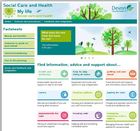
My life – social care and health online
Don't
forget that information about adult social care can be found on our website, including help with living at home,
social care assessments, paying for social care or finding the right care home,
and carers information.
|
|