|
In this edition of the Industrial Strategy Bulletin, we showcase the Offshore Wind Sector Deal's main announcements and highlight next week's EU exit webinars for businesses. The first, on 'Workforce and People', will take place today at 11am today. See below for more details.
Latest posts on the Industrial Strategy Blog
Dr Grace Lordan, Associate Professor of Behavioural Science at London School of Economics, writes about the need for human skills in a technological age.
To coincide with the Offshore Wind Sector Deal, Julian Brown, Vice President and UK Country Manager, MHI Vestas Offshore Wind, writes about the investment being made in the sector on the Isle of Wight.
And Benj Syke, Co-Chair of the Offshore Wind Industry Council and Ørsted UK Country Manager for Offshore, writes about how the Sector Deal will help deliver for our Clean Growth Grand Challenge.
Subscribe to receive Industrial Strategy Blog updates
Bulletin subscriptions
Please do continue to share this bulletin with your colleagues and stakeholders and invite them to subscribe. Sign up or email stakeholders@beis.gov.uk.
The only information we ever store is your email address and we will only ever use it for the purposes of sending our newsletter.
If you wish to stop receiving our bulletins, you can unsubscribe by clicking on the link at the bottom of the bulletin at any time.
 Clean, green offshore wind is set to power more than 30% of British electricity by 2030, Energy and Clean Growth Minister Claire Perry announced with the launch of the new joint government-industry Offshore Wind Sector Deal.
This deal will mean for the first time in UK history there will be more electricity from renewables than fossil fuels, with 70% of British electricity predicted to be from low carbon sources by 2030.
Industry has committed to invest £250 million including a new Offshore Wind Growth Partnership, which will develop the UK supply chain. Global exports are also set to increase fivefold to £2.6 billion by 2030.
This is the tenth sector deal from the modern Industrial Strategy signed by Business Secretary Greg Clark and helps us deliver on the Clean Growth Grand Challenge.
It is backed by UK renewables companies and marks a revolution in the offshore wind industry, which 20 years ago was only in its infancy. It could see the number of jobs triple to 27,000 by 2030.
We have published blogs on regional growth aspect of this booming sector and the sector deal as a demonstration of our Clean Growth Grand Challenge in action.
Find out more about the Offshore Wind Sector Deal here.
 Young people looking to start or grow a business are set to receive more tailored support with the launch of a new review into the barriers to success, Business Minister Kelly Tolhurst has announced.
The review, led by Nick Stace, Chief Executive of The Prince’s Trust, will identify how best to tackle the barriers facing nearly 400,000 aspiring entrepreneurs in England – from access to finance, advice and support to how to access business networks - and how we can close the gap between entrepreneurial ambition and reality.
Through the Industrial Strategy, the government wants to ensure we are improving our business environment and we are driving forward a thriving entrepreneurial culture amongst all corners of society and harnessing untapped talent will be key to achieving this.
Find out more about the review here.
 Competitions aimed at building evidence on how to encourage small and medium-sized businesses to adopt productivity boosting technology and/or management practices are open for applications until 17 April.
The Business Basics Fund supports projects that test methods of encouraging SMEs to boost their productivity through ways of working and technology.
Under the second round of the Business Basics Fund, for which a total of up to £2 million is available, we are funding 2 types of project: trials and proof of concept.
Find out more about the competitions and how to apply for funding here.
BEIS has joined forces with the British Library’s Business and IP Centre Network to host a series of webinars to help businesses understand the possible changes they face, once the UK leaves the EU.
These webinars start on Monday 11 March at 11am, focusing on Workforce and People and there will be a range of topics, advertised on the British Library’s events page where participants will need to register in advance through their website to join.
The webinars will cover similar topics, give you a chance to hear from expert speakers as well as offering you the opportunity to ask your own questions on the subjects to help businesses prepare ahead of the UK leaves the EU. The confirmed webinars are as follows:
 Andy Haldane made his first standalone speech as the chair of the new Industrial Strategy Council in Leeds last week.
Andy, who is also the Chief Economist at the Bank of England, discussed the UK’s “Three-P problem” – slow productivity growth since the financial crisis leading to a “lost decade” in pay for all places across the UK.
Our modern Industrial Strategy seeks to address these structural issues. The independent Industrial Strategy Council will support it by providing rigorous evaluation.
The council’s first task is to develop a set of quantitative measures of success so that Industrial Strategy can be objectively evaluated in the same way as monetary or fiscal policy.
 Thousands of graduates to become qualified experts in artificial intelligence (AI) as part of a new joint government-industry package to drive up skills in the AI sector, Business Secretary Greg Clark and Digital Secretary Jeremy Wright have announced.
For the first time, the UK will have a nationwide programme of industry-funded AI Masters courses coupled with work-based placements.
The new skills and talent package is a major milestone of the modern Industrial Strategy’s AI Sector Deal which was launched in April 2018, which helps respond to our AI and Data Grand Challenge. It is supported by industry funding and up to £110 million government investment in masters courses, PhDs and fellowships.
Find out more about the package here.
 Following on from the Matthew Taylor review into modern employment practices, the government has launched a new campaign to increase awareness of workers' rights to holiday pay.
The new campaign focusses on holiday pay – highlighting that £1.8 billion of holiday pay goes unclaimed each year, affecting 1.8 million low-wage workers.
Called 'It Comes with the Job', the campaign focusses on workers in atypical work such as agency workers and their employers. It encourages workers and employers to have conversations to ensure that workers are receiving the correct holiday pay entitlement.
The campaign is running throughout Great Britain for a month, and will consist primarily of video on-demand, Spotify advertising, digital website advertising, and adverts in train stations and on bus stops.
Resources to support the campaign can be found in this toolkit. For further policy information, please see this page. If you have any questions or comments about the campaign, please feel free to contact simon.kirkland@beis.gov.uk.
 The Greater Manchester Independent Prosperity Review held its London launch at the Resolution Foundation.
The Prosperity Review is a major update of Greater Manchester’s economic evidence base, overseen by an independent panel of leading economists and experts. It is a key input into the Greater Manchester Local Industrial Strategy which is being jointly developed by Greater Manchester and government.
The review provides a detailed and rigorous assessment of the future state and current potential of Greater Manchester’s economy.
Ten years on from the Manchester Independent Economic Review - the first independent economic review of a city region – it provides a fresh understanding of what needs to be done to improve productivity and drive prosperity across Greater Manchester.
The Reviewers’ Report details the panel’s recommendations and can be downloaded here.
 The rules around non-disclosure agreements (NDAs) and confidentiality clauses are set to be tightened under new legal proposals.
This includes enshrining in law for the first-time that individuals cannot be prevented from reporting crimes, harassment or discrimination to the police.
The proposed measures also include extending the law to ensure the worker agreeing to confidentiality agreements receives independent legal advice on its limitations.
The plans are part of the government’s ambition to create a fairer workplace as part of the modern Industrial Strategy.
Read more about the new legal proposals here.
 The rollout of new University Enterprise Zones will strengthen links between the research and expertise developed in universities, and ensure they further align with the needs of local businesses.
UEZs are a form of ‘incubator’ that provide physical space and facilities for small businesses, where they access support, specialist facilities and knowledge.
Helping universities to better understand what employers are looking for from graduates will inform research specialisms while allowing businesses to benefit from a university’s expertise.
The move is part of the government’s modern Industrial Strategy to boost local economies by creating new jobs and harnessing the opportunities of the UK’s world-leading reputation in innovation.
Read more about the new University Enterprise Zones here.
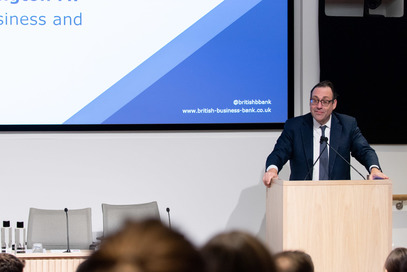
Business Minister Richard Harrington spoke at the launch of British Business Bank's Small Business Finance Market 2018/19 report.
The report includes findings on small business behaviour relating to Brexit and shows there is a declining demand for finance, though awareness and use of alternatives to traditional finance is rising.
Our Industrial Strategy aims to make Britain the best place to start and grow a business, and a global draw for innovators.
Find out about the full report's findings here.
Drivers and cyclists will benefit from quicker journeys across Plymouth thanks to a multimillion pound investment announced by the Transport Secretary.
Chris Grayling has revealed that more than £22 million will be put towards the Forder Valley Link Road, which will help support the city’s economic prosperity and lead to wider benefits.
The new road will also unlock land in the north of the city for development, where 4,300 homes are planned over the next 15 years, and it will include new walking and cycling routes while improving bus connectivity from the east.
As part of our Industrial Strategy's Infrastructure foundation, we are upgrading our transport network to ensure it is modern and accessible to boost future growth and prosperity.
Read more about this announcement here.
|