Phishing text posing as Ofsted
We have received reports from local providers that they have received a suspicious looking text message posing as Ofsted, with an urgent alert telling them that their Ofsted Registration has been ‘suspended’ and asking the recipient to click on a link.
This type of incident is described as a ‘smishing' text message - this is when a deceptive text message is used to trick individuals into clicking malicious links or sharing data sensitive information.
Please do not click on the link and delete the message from your phone.
Ofsted have also released a post on their Facebook site: https://www.facebook.com/ChildcareRegistration
Important updates
We’re excited to share important updates now available in the DDSCP Documents Library
Domestic Abuse Handbook
Launched in December 2025, the DDSCP are proud to share their Domestic Abuse Handbook, created to support practitioners across all agencies in recognising the profound impact domestic abuse has on children—including unborn babies—and to equip them with the tools, knowledge, and confidence to respond effectively.
The DDSCP are keen to seek feedback about your awareness of the handbook, your confidence in applying the tool and how this handbook has impacted your practice. Please do email cs.eys@derbyshire.gov.uk to share your views.
|
The Safest Place - The Lullaby Trust
Safer Sleep Week 2026 runs from 9–15 March, an annual campaign led by The Lullaby Trust to raise awareness of how all families can help reduce the risk of sudden infant death syndrome (SIDS). Sadly, around four babies a week still die from SIDS in the UK — many of these deaths could be prevented if families know and follow key safer sleep advice. The theme for this campaign is Baby Necessities.
|
|
 |
The 2026 theme of "Baby necessities," hopes to help parents navigate essential baby sleep products and aims to reach all new parents and carers with crucial, evidence-based information, emphasizing simple, cost-effective measures for a safer sleep environment.
During Safer Sleep Week the campaign will share practical tips on coping with tiredness, understanding baby’s natural sleep patterns, and following trusted expert advice rather than unverified sleep hacks.
🧡 Get involved:
-
Share safer sleep messages using reliable sources of information such as Home | The Lullaby Trust
-
Talk to expectant or new parents about safer sleep
-
Display safer sleep posters in community spaces
Together, we can spread life-saving advice and help every family achieve safer sleep for their baby.
Have you seen the Derbyshire and Derby City Keeping Babies Safe, Three Steps to Baby Safety strategy? Are you using this resource to share key information?
If you are new to Derbyshire, or need a handy reminder of the strategy, the Early Years Improvement Team have created a short video which explores what the strategy is, how to use it as well as posing some moments to reflect on your practice:
https://youtu.be/He9H7cpGme8
You can find the strategy in the DDSCP documents library: Keeping Babies Safe
Go all in
 |
|
The National Literacy Trust and Department for Education are working together to create a reading revolution, and have named the 2026 campaign, 'Go All In’
The campaign is a challenging all – adults, children, families and communities – to swap scrolling for reading!
|
Jonathan Douglas, CEO of the National Literacy Trust has said: “The National Year of Reading 2026 presents an opportunity to join forces across sectors and redefine reading as a powerful, contemporary activity for a generation.….we will make reading a shared national mission - because every child, no matter their background, deserves the best start in life and every adult deserves to get the best out of life”
What can you do to 'Go All In'?
What's on your bookshelf?
 |
|
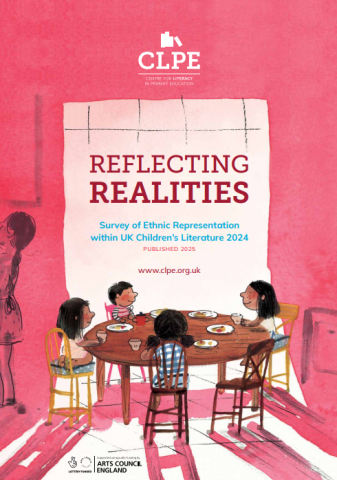
The "Reflecting Realities" report, an annual survey on ethnic representation in UK children’s literature, continues to shed light on an essential aspect of publishing: diversity.
The report published in November 2025 highlights the challenges in ensuring that books for children authentically represent the society they live in. As the UK grows increasingly multicultural, it becomes imperative that children’s literature reflects this diversity, not only to foster inclusivity but to empower young readers from all backgrounds.
Key Findings
The report highlights a positive increase in minoritised presence in both fiction and non-fiction, however in contrast picture books have seen a drop in the proportion of presence reported,
|
Why This Matters
Representation in children’s literature shapes how children perceive themselves and others, laying the foundation for empathy, confidence, and a sense of belonging. Books that reflect a diverse society enable children to see their realities mirrored, fostering pride and self-worth in underrepresented groups while encouraging understanding among all readers.
In a recent survey it was found that there is a 7% presence of ethnic minorities represented in children's books. In this survey 743 books were reviewed - the survey found that only 52 books had Black, Asian and other ethnic minority characters, and only 4% of these books had the BAME community as the main characters - this equates to 2 books. The statistics point to a real gap in representation.
Call to Action
The report is a reminder that while progress is being made, there is still much work to do. What does your bookshelf look like when you shine the lens of representation on it? Do you have stories that celebrate diversity in all its forms? When looking at your picture books, is diversity celebrated? How are you proactively seeking books and picture books which ensure equal representation? Do the books you select show a range of different communities in every-day stories or traditional tales. Do you know about websites such as We Need Diverse Books or CLPE | Centre for Literacy in Primary Education
Only by prioritizing authenticity and inclusivity can children’s literature truly reflect the realities of its readers.
Peepo!
Authors - Janet & Allan Ahlberg
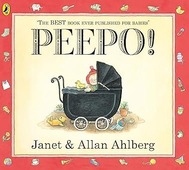
There are so many books I could have selected to share but in the end, my children and I opted for Peepo! It was first published in 1981, but it stands the test of time.
The pattern of the text is so memorable and just flows beautifully as you read it aloud. You can get lost in the everyday detail provided in the pictures.
|
The pictures feel warm and comforting. The spy holes in the pages give you a glimpse of what’s to come as you turn the pages and focus you in on the characters.
We buy this book for everyone we know that has a baby as it should be a book every child has the opportunity to delight in.
Vicky McEwan
Early Years Manager

Leaf Man
Author & Illustrator - Lois Ehlert
This is one of my all time favourite books - I love plants and nature and especially looking at the colours in nature as the seasons change. Leaf Man immediately gives me a feeling of warmth as I anticipate the cosiness of Autumn, but this book can be used as we start to see the first signs of Spring too!
This book provides great teaching memories for me as children always shared my excitement for Leaf Man’s journey. From the first page we felt like he was our friend and wanted to find him. Each page is like a mini puzzle which draws you in to study it closely. With amazement you work out how the leaf shapes have been cleverly used to create different characters in the illustrations, making you eager to turn over and see what you will find next. Furthermore, every page is shaped like the rolling hills which adds to your imagination of Leaf Man’s lengthy adventure. On the final page there is a lovely surprise. You can read this book time and time again and always find something new. Without doubt you will also want to get out on a walk and look for a Leaf Man of your own.
Joanna Bennett
Early Years Improvement Officer
|
 |
|
Screens, social media, smart phones and the Early Years
Campaigners are raising awareness of the harms of social media, too much screen time and the impact of giving smartphones to children at a young age, and there is much talk following recent calls to follow other countries where there are social media bans, and a soon-to-be launched consultation from the Government. Take a look below at the three separate issues from Dr Laura Spells, and its relevance to the Early Years
|
Screentime
This encompasses televisions, PC’s, laptops, tablets, mobile phones and gaming consoles. Excessive use of all these devices has increasingly become the norm throughout childhood and the evidence is mounting about the effects this growing amount of screen time is having on our children, including developmental issues, physical impacts on their growing bodies and societal consequences. However, it’s not just children that are enticed in by bright colours, exciting sounds, short content videos, reels and rewards. It is us adults too!
Social media
It could be easy to think that our young children are not yet affected by social media - however, according to OFCOM, 37% of 3–5-year-olds are using at least one social media app including Instagram (17%), Snapchat (18%) and TikTok (18%). Of these, 60% of 3-5 year olds have their own social media profile and 19% use the apps independently.
Young children using social media are at risk of being exposed to harmful content. They could struggle to identify kindness, to know who to trust and will make unhealthy comparisons between themselves and others from an incredibly early age.
Smartphones
A recent report: Children and parents: media use and attitudes report 2025 shows that 19% of 3-5 year olds have their own smartphone. Today's smartphones are a supercomputer potentially giving 24-hour access to the internet, social media, video sharing platforms, gaming and is a tool to enable high levels of screen time. Evidence from Rapid Report | Age of Smartphone Ownership | Sapien Labs shows that the younger a child owns their first smartphone, the greater the harms can be.
Dr Spells said:
"We know that devices with screens can offer some great educational opportunities, and when used correctly can assist family connection. However, we have to ask whether we have lost our way with what defines a healthy balance? Whilst a social media ‘ban’ for under 16s would help tackle some of the issues above, it wouldn’t address them all. Therefore, we look forward to Bridget Phillipson, the Education Secretary publishing screen time guidelines for the Early Years in April. We also need to continue campaigning, in this ever evolving world, so parents and educators feel empowered again and able to take back control"
Please note these are my own opinions and not those of the NHS or Derbyshire health care or local authority organisations.
|
Childminders from across the High Peak came together in November 2025 to celebrate National Nursery Rhyme Week with a special themed session at the Community Gardens playgroup.
The Childminders all brought resources from home to offer many activities to the children, including nursery rhyme stones hidden throughout the gardens and once found children were encouraged to identify the song and sing and dance along using the musical instruments.
|
|
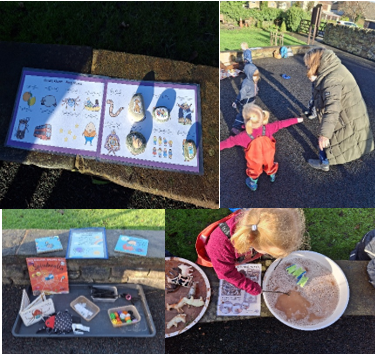 |
The Incey Wincey Spider activity supported the children’s fine motor development by making their own spider using pipe cleaners and baby food pouch lids. Whilst the animals on Old Macdonald’s farm had a well needed bath!
The session highlighted how nursery rhymes support all areas of learning and development - early language, communication, fine and gross motor skills, maths, and imaginative play.
Children enjoyed the open space and the chance to move, explore, and investigate - perfect for supporting holistic early development.
A wonderful morning was had by all!!
 |
|
High Peak Childminders Spread Christmas Cheer at Local Care Home
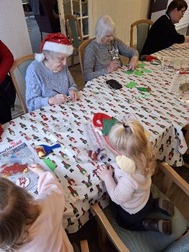
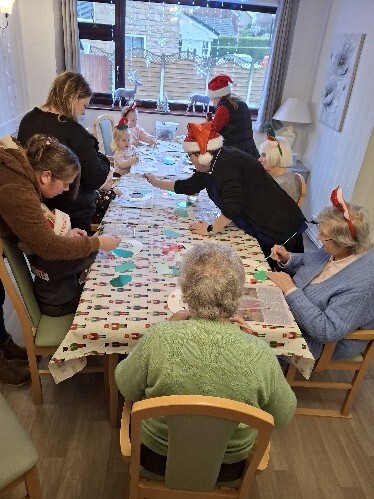
A group of dedicated High Peak childminders brought festive cheer to a local care home this December as children and residents came together for a joyful morning of Christmas crafts, songs, and seasonal sparkle.
The visit was filled with smiles as the children and residents sat side‑by‑side to make festive wreaths, decorated decorations, and enjoyed exploring glitter, paint and sparkly craft materials. The shared activity encouraged conversation, laughter, and gentle support between generations.
|
|
After the craft session, everyone enjoyed coming together to sing familiar Christmas carols, this special moment brought the room to life, filling it with music, memories, and togetherness.
These intergenerational experiences are highly valued by both the childminders and the care home, offering young children the chance to build confidence, communication skills, and empathy, while providing residents with meaningful social interaction and the joy that young children naturally bring.
The event was a wonderful reminder of the power of community - especially at Christmas time. The childminders regularly visit the care home throughout the year and we are looking forward to hearing all about the wonderful experiences for the children and the adults!
|
|
 |
Rainbow Small Talk
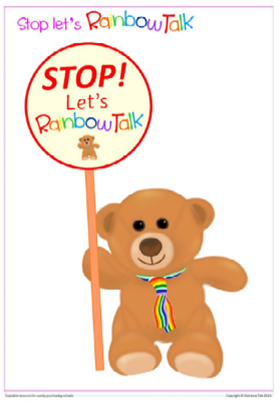
Rainbow Small Talk is a framework, developed by two educators and used by Early Years settings and providers across Sheffield. We invited them into Derbyshire, and we now have 40 trained settings and providers. The goal is to encourage interactions that are straightforward yet foster deep thinking and conversations in the Early Years. The Rainbow Small Talk Fan serves as a visual reminder of the seven elements of Rainbow Talking i.e. hear, see, touch, taste, smell, think, and feel. Below, you'll find examples from three settings using the Rainbow Small Talk Fan to inspire themselves, children, and parents to slow down, observe, and engage in richer conversations with expanded vocabulary, language, and confidence.
 |
|
Descriptions and Connections
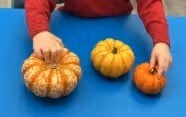
Last term, Lyndsey Wain, Fairmeadows Preschool, grabbed the chance to offer the children three different pumpkins to explore. She noticed “The children stated: I can SEE orange, I can SEE white, I can SEE it is tiny, I can SEE patterns, it FEELS smooth, It FEELS bumpy, It SMELLS sweet, It SMELLS disgusting!! I can HEAR it bumping on the table. It makes me FEEL spooky"
|
" The children were confident to speak about what they could see, smell, feel and hear. The children linked conversations about the pumpkin to Halloween and dressing up, which then led to imaginative play throughout the day.”
|
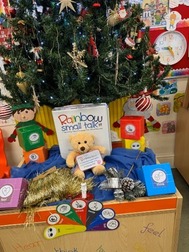
Lainey and Clare, Little Angels Pre-school, set up their environment to spark spontaneous chat.
“During free play a group of preschool children were admiring our tree. Conversations about what they could see began to materialise. A staff member asked if she could join in. This turned into a rainbow talk as they began to sing the song. They talked about what they could SEE: Baubles, shiny stars, a Christmas boot, they listed the colours they could see and spoke about the reindeers. HEAR: As they touched the tree, they commented on the bells tingling and said they were like sleigh bells. FEEL: When asked how they feel and they see Christmas trees the girls answered happy, excited, one commented she would be sad if Santa didn’t come. THINK: What does a Christmas tree make you think of, presents, Santa coming, chocolate, again happy, excited.”
|
|
 |
 |
|
Supporting Parents and Carers
Laura Bowers, Buxton Nursery, decided to focus on sharing with parents. “We shared Rainbow Talk with our families that joined us for a Stay & Play session and had a selection of fans available for them to help themselves to. We have had feedback from one mum who has told us it helped her converse with her little boy and better understand what he was trying to tell her! … We had the rainbow fans in action in the woods this morning and have a lovely little rainbow area now too … we are excited to progress further with Rainbow Talk in our setting 😊”
|
For more information about Rainbow Small Talk please visit the website Rainbow Talk or contact Ruth.Crofts@derbyshire.gov.uk if interested in the final round of training due March 2026.
What's been happening this Term?
Over the Autumn and Spring Terms providers across North East Derbyshire and Bolsover were nominated to participate in a fully funded CPD offer with the amazing Jabadao!
|
|
 |
What have our providers been doing?
Providers have attended both face-face and online training sessions delivered by the wonderful Charlotte Jones from Jababao.
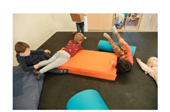
The Jabadao approach champions free flow Movement Play as a key learning tool. It's powerful and joyous body work, good for health, wellbeing, happiness and learning. If you would like to find out more about Jabadao please take a look at the website:Jabadao | Re-imagine Physical Development
 |
|
Training sessions have addressed the following:
Principles and practice - Setting up and running a Movement Play Area.
Movement play practice - Supporting and joining in with child-led movement play; plus, some specifics about the learning that children bring here.
|
Sensory development – The 4 body senses and how movement play supports them. Self-regulation and wellbeing. Social and emotional development
Motor development - A developmental movement approach; movement play and PSE, CLD, problem solving and self-talk.
During the final webinar in March providers will have the privilege of also meeting Penny Greenland MBE and Director of Jabadao - national centre for physical play, where providers will be given a celebratory opportunity to bring back evidence of learning and impact in case studies, observations and learning stories. |
|
 |
The impact so far!
Providers are now over halfway through the CPD sessions and feedback has been positive with all providers fully embracing the Jabadao approach. Providers have been setting up movement play areas with their provision and observing the impact it has had on children. Reactions from providers include:
- Fun! Exciting! Exploring! Rewarding!
- The children REALLY like it!
- The children have had lots of fun!
- Our kids have loved it, the freedom the children have!
- The need for sensory input during the day!
- The joy of movement!
- The freedom of movement
Tamsin, (PANCo) from Sunnybank Day Nursery said:
“It took a while for both the children and staff to understand the area but now that they understand the area it’s been very rewarding and has helped them have that time to release all that pent up energy and move freely whilst understanding turn taking recognising the need for physical contact and touch with each other and us!"
"We have really enjoyed introducing to all the rooms and supporting/showing staff how to use the area correctly. Our SEN teacher from Derbyshire loves it too for the children she is supporting and is currently in there right now in our pre-school. The children have adapted quickly to the rules of the area and use it for its purpose. We have noticed particularly in pre-school children identifying themselves when they need those movement breaks”
Keep an eye out in our next newsletter article where we hope to share a case study or two about how providers in Derbyshire have implemented the Jabadao approach and the impact it has had!
If you would like to find out more about Jabadao and the Jabadao CPD sessions we have held or if you would like to know more about ECaM or Physical Development in the early years please email your named EYIO directly or cs.eys@derbyshire.gov.uk for more details
The Early Years and Childcare Workforce are looking for early years apprentices who would be willing to share their experiences as part of National Apprenticeship Week 2026. The aim is to showcase stories that celebrate the early years apprenticeship route. |
|
 |
The campaign wants to hear from practitioners working in local, independent settings, including smaller providers and childminders, as well as those in larger organisations. If this is something you wanted to follow up please email: luke.prescott@education.gov.uk
What do we have for you this Spring Term
Leadership
Wherever you are in your leadership journey, here at Derbyshire, we have a course for you! Head over to the Eventbrite page Leadership Series by Derbyshire Early Years Service | Eventbrite to see what we have coming in the Spring term including:
- Leading from the Start: Igniting your Early Years Journey
- Leading Change in the Early Years
- Coaching and Mentoring in the Early Years
- Leading on Physical Development in your Early Years setting
|
Strong Practice Hub - Derbyshire Conference 18 March 2026
Tickets will soon be released to attend the Derbyshire Conference which is a collaboration between the Derbyshire and Nottinghamshire Stronger Practice Hub and Derbyshire Local Authority. The event, being held at the Casa Hotel in Chesterfield, has a focus on the importance of relationships with families and has Janet Goodhall as the Key Note speaker. Keep an eye out for your invitation and check on: Derbyshire and Nottinghamshire Early Years Stronger Practice Hub | Stronger Practice Hubs
EYFSP Agreement Trialling: Making robust and accurate judgements for EYFSP
We are pleased to offer six local cluster in person events to support you as you to work collaboratively with other EYFS schools and practitioners with the Derbyshire Early Years teacher team, to moderate children's achievements in regards to the EYFSP related to your cluster data.
These events are for all staff working with reception-aged children and is open to all EYFS teaching teams.
Events are being held at:
- Killamarsh Infant and Nursery School - 16.4.2026
- Grindleford Primary School - 21.4.2026
- Cromford CofE Primary School - 22.4.2026
- Etwall Primary School - 23.4.2026
- Swanwick Primary School - 27.4.2026
- Charlotte Nursery and Infant School - 30.4.2026
Book your place today: EYFSP: Agreement Trialling Making robust and accurate judgements for EYFSP held at Grindleford Primary | Derbyshire Services for Schools
Supporting Children with SEN and Eating in Early Years Settings
From September 2025, the Department for Education’s nutrition guidance became a statutory requirement within the Early Years Foundation Stage (EYFS), meaning that early years providers are now legally required to ensure that food and drink is healthy, balanced, and nutritious, while also being inclusive and responsive to individual needs - read two case studies about how a nursery support children with SEN.
For children with Special Educational Needs (SEN), mealtimes can present unique challenges. Sensory processing differences, anxiety around food, and specific conditions such as Avoidant/Restrictive Food Intake Disorder (ARFID) may lead to restricted diets or increased distress during eating. The EYFS guidance—supported by the Equality Act (2010)—makes clear that settings must make reasonable adjustments so that every child can safely and comfortably participate in mealtimes.
These adjustments may involve adapting food, the environment, or the support strategies used by staff. Approaches such as offering familiar “safe” foods, reducing sensory overload, using preferred cups or cutlery, or providing a calm eating space can significantly improve a child’s ability to engage. Importantly, effective support relies on collaboration with families, careful documentation, and staff confident in understanding sensory and feeding needs.
Case study 1
"In our setting we allow children to bring in their own safe foods from home and encourage the use of familiar beakers from home for familiarity. We talk to parents about how they present food at home so that could be mirrored e.g. cucumber in circles rather than sticks so that they are recognised as cucumber. Our snack timetable is flexible to allow children to eat when needed across the day in case they did not access our social snack time.
We created an inviting and safe environment by making place mats with pictures of interest on and make a point of managing sensory needs before, during and after mealtimes.
We save left over food from the main nursery meals to use in sensory play for children who require messy food play in ‘exploration time’ with no pressure to eat/try or touch."
Case study 2
"In our nursery we recognise that some children, particularly those with Special Educational Needs and Disabilities (SEND) have restricted diets due to sensory sensitivities, medical conditions, or developmental needs. These children may only eat specific foods or prefer their food prepared in particular ways (e.g., cut into certain shapes or sizes).
We work closely with families to support these needs, ensuring that children can eat comfortably at school. This helps reduce anxiety and enables them to participate in daily food routines, such as snack time and lunch, alongside their peers.
Providing reasonable adjustments also helps prevent dysregulation and supports emotional wellbeing, allowing children to feel safe and included in their learning environment.
Examples of Reasonable Adjustments We Offer:
- Environment-Based Adjustments
- Allowing children to enter the canteen before it becomes busy or noisy.
- Providing the option to eat lunch in the classroom if the canteen environment is overwhelming.
- Offering a flexible arrangement where children begin lunch in the canteen and finish in the classroom if needed.
- Dietary Adjustments
- Children with restricted diets who do not eat the standard fruit snack may bring their own snack box from home. These may include:
- Crisps, sausage rolls, bread, breadsticks.
- Vitamin-enriched gummy sweets (as advised by parents/carers).
- Flexibility at lunchtime: children may be offered both a hot school meal and/or their packed lunch, depending on their preferences and needs.
- Routine Flexibility
- No fixed snack times: all children have access to snack throughout the session.
- Children with restricted diets can access their personal snacks at any time, supporting autonomy and reducing stress around food"
The case studies illustrate how early years settings can apply the statutory nutrition guidance in practice. They highlight real‑world examples of:
- making purposeful adjustments,
- understanding sensory and emotional needs,
- working in partnership with families, and
- ensuring children with SEN feel included, safe, and supported during mealtimes.
These two case studies demonstrate that supporting children with SEN at mealtimes is not about enforcing uniformity, it is about flexibility, empathy, and inclusion, tailored to each child’s needs.
 |
|
Update from the Sufficiency Team
The application window is closing soon. Don’t miss out!
To apply for funding for breakfast and after school provision for a full academic year (38 weeks) you must:
- Submit your application by Friday, 13 February 2026.
- Ensure places can be available by Monday, 13 April 2026.
|
Please email the Sufficiency Team: CS.SufficiencyService@derbyshire.gov.uk, if you are considering setting up/expanding wraparound provision and would like to apply for funding or if you would like to find out more about the programme.
EYSEN Helpline: EarlyYears.SENhelpline@derbyshire.gov.uk
Targeted level of the graduated response
EYIF: Early Years SEN Inclusion Fund - Derbyshire Local Offer
Outreach team referrals: EYSEN Outreach team - Derbyshire Local Offer
Specialist level of the graduated response
EYIF: Early Years SEN Inclusion Fund - Derbyshire Local Offer
Specialist support referrals: Early Years SEN Panel - Derbyshire Local Offer
Applying for a statutory EHC needs assessment: Apply for an assessment - Derbyshire Local Offer
 |
|
Are you following us on X (formally known as Twitter)?
Make sure that you don’t miss out on accessing the most up to date information, safeguarding updates, training reminders, and more!
To follow the Derbyshire Early Years Improvement Service on X, search for @DerbyshireEYFS
|
Here to support your families
As many of you know, the Families Information Service (FIS) is always on hand to support parents and carers across Derbyshire. If you’re working with families who may need a little extra help, whether that’s understanding childcare funding, exploring their eligibility, or finding local childcare options, our team is here to guide them.
FIS offers free, impartial information to families with children aged 0–19 (or up to 25 for young people with SEND). We can help parents navigate childcare choices, access funding, and connect with local providers like you.
|
If you have families who would benefit from our support, please feel free to signpost them to us:
If you have any questions or would like more information about our services, please feel free to get in touch!
Thank you for continuing to share our service with the families you work with. Together, we can make sure every family gets the information and support they need to thrive.
Early Years Service general enquiries: CS.EYS@derbyshire.gov.uk
Early Years Service - info on Schoolsnet
Funding & contract queries: cs.enquiries.groupcare@derbyshire.gov.uk
OR cs.enquiries.childminders@derbyshire.gov.uk
OR cs.enquiries.schools@derbyshire.gov.uk
|