|
Through feedback and communication channels, Cumbrian young people and their families told the Cumbria SEND Partnership they were uncomfortable with the inconsistencies reported in use of terminology and language related to autism across multiple services in the county. This included terms such as Autistic Spectrum Disorder (ASD) or Condition (ASC), autism or autistic being used interchangeably.

Cumbria SEND Partnership (now Cumberland SEND Partnership and Westmorland and Furness SEND Partnership) conducted a consultation to find out how Cumbrian residents would prefer services to speak about autism in the county. This was so we could introduce a standardised approach to language and terminology across the county, that suited the majority of individuals and their families.
We hope that by ensuring language and terminology is standardised, we can make people feel more comfortable, reduce confusion, and ensure that everyone, including families and individuals with autism, understands and uses the same terminology where possible.
The consultation ran between Wednesday 28 September 2022 and Wednesday 9 November 2022.
The consultation was written in co-production with National Autistic Society Young Ambassadors, Maya Stretton, Leah Benjafield and Pavan Bhamidipati, parent carers of autistic children and young people from Special Education Needs and Disabilities Alliance Cumbria (SENDAC) and SEND professionals employed by Cumbria County Council and the NHS.
A total of 569 respondents shared their views in the autism terminology consultation. Of the 569, 25% (141 respondents) identified as autistic.
The full consultation report can be read on the Local Offer website:
|
These outcomes are now being implemented throughout services and organisations in Cumbria. They are in line with the most recent research and publications from the National Autistic Society.
When speaking with any professionals, whether this be in an education setting, NHS or health colleagues, social care staff or any wider organisations related to SEND, they should be following the outcomes below.
Please note that outcome 3 emphasises the importance of the preference of the individual. If you find that outcome 1 and/or 2 do not align with you/your child or young person's preferences, please do not worry, and speak to any professionals or service providers you and/or your child or young person interact with.
1. Services and organisations in Cumbria to use identity-first language
Identity-first language is the act of putting the identity first in language and/or sentences, for example:
'An autistic person.'
'I am autistic.'
'They are autistic.'
'He/she is autistic.'
Identity first language is the opposite of person-first language, which often describes the person as 'having'; for example 'a person with autism,' 'a person who has autism,' 'they have autism,' or 'he/she has autism.'
Identity-first language was the preferred response of almost half of all respondents (49%, 227 total respondents). It was also favoured by autistic respondents, with over two thirds (69%, 90 respondents) and similarly, by 66% (103) of neurodivergent respondents.
"Even though I consider “having autism” a perfectly valid term to be used, it is a less-preferred term to me because it feels as though it’s only adjacent to the person or is attached to the person. Autism is intrinsic to an individual’s personality, so “is autistic” feels more accurate."
- Quote from consultation respondent
Please note that the third outcome stresses the importance of an individual's preference when it comes to language, so if identity-first language is not you and/or your family's preference, please do speak to any professionals or organisations.
The below table is from the National Autistic Society resource: 'How to talk and write about autism.' We have linked the full resource below in this newsletter.
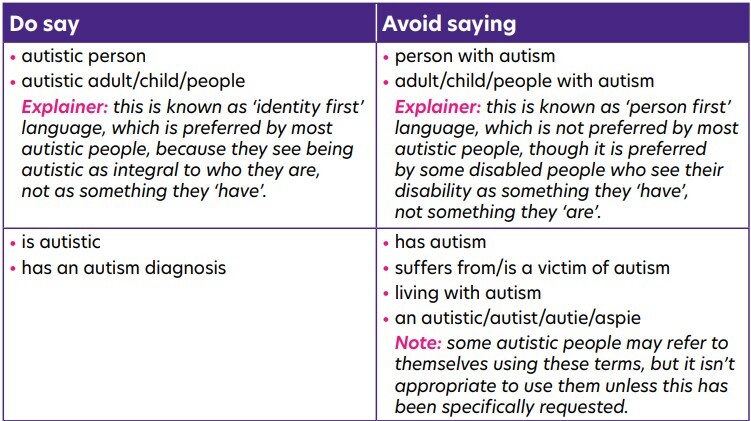 Image Description: Do Say: autistic person. Autistic adult/ child/ people. Explainer: this is known as 'identity first' language, which is preferred by most autistic people, because they see being autistic as integral to who they are, not as something they 'have.' Do say: is autistic. Has an autism diagnosis. Avoid saying: person with autism. Adult/ child/ people with autism. Explainer: this is known as 'person first' language, which is not preferred by most autistic people, though it is preferred by some disabled people who see their disability as something they 'have', not something they 'are'. Avoid saying: has autism. Suffers from/is a victim of autism. Living with autism. An autistic/ autist/ autie/ aspie. Note: some autistic people may refer to themselves using these terms, but it isn't appropriate to use them unless this has been specifically requested.
2. Eradicate the use of the terms Autistic Spectrum Disorder (ASD) and Autistic Spectrum Condition (ASC) unless speaking about an official diagnosis
Due to the negative impact the terms Autistic Spectrum Disorder (ASD) and Autistic Spectrum Condition (ASC) have on autistic people, their friends and family, we have asked services to ensure they do not use these terms when in conversation with individuals and families, unless it is their preference.
Paperwork such as letters and reports should also be updated to eradicate the terms ASD and ASC. The terms should no longer be used in verbal and written communications from Local Authorities and NHS services in Cumbria or employees.
"I don’t favour disorder – it makes me feel there is something wrong with me."
- Quote from consultation respondent
Autistic Spectrum Disorder (ASD) will remain as the medical diagnostic term and therefore will still be used when discussing an official diagnosis or within the formal diagnosis letter.
3. The individual's preference must come first
Although there is a clear preference amongst respondents for identity-first language to be used when speaking about autism which offers an opportunity for services to adopt consistent terminology, it is evident identity should be put first before any diagnosis, disorder or medical condition.
When specifically speaking about autism, if an individual declares identity-first terms are not their preference, they should be asked how they would like to be identified, and their choice should be supported, respected and used whilst communicating with them.
You might not even notice a change! But we hope that use of language and terminology will now be more consistent across various settings and organisations that you may come into contact with.
Professionals that you come into contact with should follow the outcomes above, and use identity-first language, and avoid using the terms 'disorder' (ASD) or 'condition' (ASC) unless in a clinical setting. And as mentioned, they should still respect you or your child/ young person's individual preferences.
We hope that standardising the language around autism will make everyone feel more comfortable and included, as well as reducing confusion around language and terminology. We will be sending out surveys and talking to individuals in future to find out how this change is being implemented, and what effect it is having.
|