 Welcome back!
We are delighted to bring you the second edition of the digital social care newsletter. Thank you for the positive feedback on our first issue. This quarter, we have been busy supporting digital transformation across the sector and are excited to share some highlights, resources and upcoming opportunities.
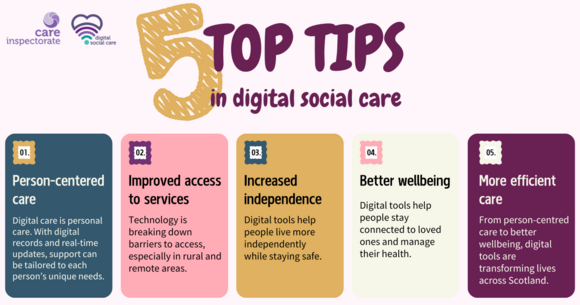
5 reasons to go digital
Our recent media campaign, ‘5 reasons to go digital’, has been making waves across the sector. The campaigns five themes are:
- Person-centered care
- Improved access to services
- Increased independence
- Better wellbeing
- More efficient care
You can download the posters from our digital social care hub and display these in your service to raise awareness.
Upcoming webinar
Join us for our next digital social care webinar from 10:00-11:00 on Wednesday 27 August 2025. We have an excellent line-up of speakers, all providing a unique perspective on digital technology in social care. Find out more and sign up now to reserve your spot.
Webinar recap: AI in social care
On 1 May 2025, we hosted a thought-provoking webinar on Artificial Intelligence (AI) in social care. Speakers shared real-world examples of how they are using AI in practice.
A huge thank you to our guest speakers and all who attended. You can access the recording below and the slides on our digital social care hub.
 Watch the recording of the AI in social care webinar
Enabling digital innovation in social care and social work
The Digital Health and Care Innovation Centre (DHI) are working with social care and social work partners to develop a Hub to support digital innovation across the sector. This follows the report that was published in May, highlighting the need to create the conditions, infrastructure and pathway for digital innovation in social care.
As part of the design process for developing a Hub, DHI and partners are creating engagement opportunities with care providers to understand needs and what value a Hub could bring to support providers in digital innovation. Information about ways to be involved and share your views, feedback and ideas will be available in the coming months.
Resource highlight: Artificial Intelligence (AI) pathway on Turas Learn
Artificial Intelligence (AI) is transforming health and social care, and understanding its potential is key to shaping future-ready services. The AI Pathway on Turas Learn is designed to help you develop your knowledge of AI in a social care context.
Explore the opportunities AI presents, while considering the risks and ethical factors that come with its use. This pathway offers a balanced, accessible introduction to AI, tailored for professionals across the sector.
Case study: embedding digital learning across early years at St Monans
In this edition, we’re highlighting how digital tools are making a real difference in the lives of people who use care services. As part of our ongoing commitment to supporting improvement through technology, we’re sharing a case study that shows how one service embraced digital solutions to enhance independence, choice, and control for the people they support.
Collaborative digital audit and planning
The journey began with a collaborative digital audit involving the school, nursery, and children from the digital committee. This audit aligned with the Digital Schools Award criteria and the Fife Digital Learning and Literacy Progression for Early Years, ensuring a strategic and inclusive approach.
Empowering children through the digital committee
Children in the digital committee demonstrated strong skills in animation and digital tools. Early Years Officers (EYOs) and Pupil Support Assistants (PSAs) adapted these tools to be age-appropriate for nursery use, fostering creativity and digital confidence.
Digital experiences across nursery settings
-
Early entrants nursery: Children were introduced to a variety of digital tools including iPads, laptops, music players, CD stories, Tonie boxes, digital cameras, electronic timers, and online Makaton resources.
-
3–5 nursery: Building on the early entrants' experience, children accessed additional resources such as smart boards and PCs, expanding their digital learning environment.
STEM and digital exploration
All nursery children engaged in STEM activities, with favourites including:
-
programmable mouse leading to Beebot and Lego Spike
-
bug and insect exploration using digital cameras and microscopes
- Internet-based fact-finding with adult support.
Resource and skill sharing across sites
A key strength of the approach is the ability to share resources and expertise across three sites. This ensures equitable access to technology and supports staff development.
Inclusive digital learning: a spotlight on child L
Child L, a non-verbal child with Down syndrome, began his digital learning journey in the early entrants nursery, age 2. He quickly developed independence by learning to operate a CD player to listen to music on his own. As he progressed, he was introduced to an iPad, using it to learn Makaton via Microsoft Teams and to transform drawings into animations—skills brought back by staff from the digital committee. Now in the 3–5 nursery, Child L independently accesses the Bookbug app to enjoy songs and stories during quiet moments. With some assistance, he also engages with the smart board for interactive games and uses the digital camera to explore his environment, demonstrating growing confidence and autonomy in using technology.
Why this matters
This case study is a powerful reminder that digital doesn’t mean distant—it can mean more connected, more empowered, and more person-led. Whether you are an inspector, provider, or improvement adviser, we hope this example inspires you to think about how digital tools can support better outcomes.
Stay up to date with the latest news, resources, and learning opportunities by visiting our digital social care hub. It is your go-to space for supporting digital confidence and innovation across the sector.
The Digital Social Care Team
Find out more about our work at www.careinspectorate.com
Contact us
|