|
(Continued from above)
Vaccine Co-Administration
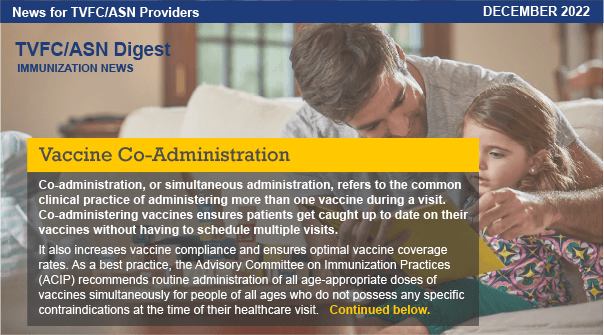
According to the Centers for Disease Control and Prevention (CDC), COVID-19 and other vaccines may be administered simultaneously, on the same day, without regard to timing. Providers can administer both vaccines in one arm (at least an inch apart), or a vaccine in each arm. It is recommended that providers use both arms for vaccine administration if the vaccine being administered is likely to cause symptoms at the injection site. By administering more than one vaccine at a time, co-administration provides quicker protection against vaccine preventable diseases. This medical practice also ensures more individuals are up to date, especially when a healthcare provider is uncertain if a patient will return for additional vaccinations.
Flu and COVID-19 vaccines can also be administered during the same visit, as recommended by the CDC. Encouraging patients to stay up to date on their flu and COVID-19 vaccines can reduce the burden of respiratory illness during influenza season. Providers co-administering influenza and COVID-19 vaccines should use two separate injection sites, one inch or more apart. Patients with concerns about getting both vaccines during the same visit should speak with their healthcare provider.
Vaccines can look very similar once prepared and in a syringe. To ensure safe co-administration practices, providers should adhere to CDC recommendations when preparing multiple vaccines:
- Use two different limbs to monitor for local site reactions.
- Label each syringe with the name of the vaccine and dosage amount.
- Ensure the syringe contains the lot number and the preparer’s initials.
- Label the vaccine with the exact beyond-use time, if applicable.
As a reminder, if a local injection site reaction occurs when co-administering vaccines, providers must report the incident to the Vaccine Adverse Event Reporting System (VAERS).
For more information on 2022-2023 vaccine guidelines, schedules, and co-administration recommendations, please visit the CDC and ACIP websites.

 |
|
TVFC/ASN Program Vaccine Update: PRIORIX® (MMR)
The United States has successfully fought through multiple endemics by pushing for vaccination. Vaccinating is the best practice for the elimination of measles, mumps, and rubella (MMR). On June 23, 2022, the Advisory Committee on Immunization Practices (ACIP) unanimously recommended PRIORIX® as an additional option to prevent MMR. PRIORIX® is a live, attenuated vaccine manufactured by GlaxoSmithKline (GSK) for individuals 12 months of age and older.
As of December 1, 2022, Texas Vaccines for Children (TVFC) and Adult Safety Net (ASN) Program providers are able to order PRIORIX® through the Vaccine Allocation Ordering System (VAOS).
For additional information about PRIORIX®, see resources below:
If you have any questions, contact your TVFC/ASN Program Responsible Entity (RE).
|
 |
|
TVFC Flu Dashboard
The Immunization Section began emailing the TVFC Flu Dashboard for the 2022-2023 Flu season in November.
Your monthly flu dashboard allows you to view your progress on the number of flu vaccine doses you’ve received, and the number of flu doses administered to TVFC-eligible patients. In addition, your dashboard provides a reminder of your total pre-booked doses of flu vaccine and your ranking based on doses administered in your county. It also includes statewide information on the number of influenza-like illnesses and pediatric deaths due to influenza. An explanation of all aspects of the dashboard can be found at on the TVFC Sample Flu Dashboard.
For additional information, visit: https://www.dshs.texas.gov/immunize/tvfc/TVFC-Flu-Statistics-and-Resources.doc
Thank you for your continued partnership with DSHS.
|
|