|
 FWPD West Division Newsletter
February 2026
|
|
Warmer Days Are on Their Way
Spring Break Travel & Home Security: Keep Your Neighborhood Safe While You’re Away
As winter fades and spring break approaches, many residents are preparing for road trips, flights, and family vacations. Unfortunately, this season also brings an increase in opportunistic burglaries and package thefts in residential areas. A few simple prevention steps can reduce risk and help keep the entire neighborhood secure.
Avoid Advertising Your Absence
Social media posts about travel plans may seem harmless, but they can unintentionally alert criminals that a home will be empty. Wait to share vacation photos until after returning, and encourage family members — especially teens — to do the same. When possible, avoid discussing travel plans publicly online.
Make the Home Look Occupied
Most burglars look for signs that a house is empty. Before leaving:
-
Use interior light timers or smart lighting schedules
-
Leave blinds or curtains in normal positions
-
Keep a car in the driveway if possible
-
Pause mail and package deliveries or ask a neighbor to pick them up
A home that appears lived-in is a strong deterrent.
Secure Entry Points
Many break-ins occur through unlocked doors or windows. Double-check the following before leaving:
-
Lock all doors, windows, garage side doors, and slider tracks
-
Verify alarm systems are armed and working properly
-
Secure sheds and back gates
-
Remove spare keys hidden outdoors — criminals know common hiding spots
Coordinate With Neighbors
Neighborhood awareness remains one of the strongest crime prevention tools. Before traveling, let a trusted neighbor know:
-
How long you’ll be gone
-
If any vehicles or workers will be present
-
Who to contact in an emergency
They can also help bring packages inside, which prevents porch theft and signals occupancy.
Report Suspicious Activity
Residents should promptly report unfamiliar vehicles, late-night door checks, and unfamiliar individuals behaving erratically. Most incidents turn out benign, but early reporting prevents criminal patterns from forming.
With a little preparation, we can all enjoy spring break season while keeping our community secure, connected, and attentive. Crime prevention is most effective when we work together.
|
|
Late Winter–Early Spring Scams: Protecting Seniors From Fraud & Identity Theft
As tax season and warm weather arrive, scam activity targeting older adults increases significantly. From IRS impersonators to fraudulent home repair contractors, criminals take advantage of these seasonal transitions. Awareness and early action can prevent financial loss and emotional stress.
Common Scam Types to Watch For
1. IRS Tax Scams:
Scammers call or email claiming unpaid taxes, threatening arrest, or demanding immediate payment.
-
The IRS does not call to demand payment
-
They never request gift cards, wire transfers, or cryptocurrency
-
Hang up and report suspicious contact
2. Refund & Identity Theft Scams:
Criminals may file false tax returns using stolen identities. Filing taxes early reduces risk.
3. Home Improvement Scams:
As spring approaches, fraudulent contractors offer roof, driveway, or yard repairs at special “one-time prices.”
Protect yourself by:
-
Asking for licenses and insurance
-
Getting multiple estimates
-
Never paying large deposits upfront
-
Avoiding contractors who pressure you to "act now"
4. Utility & Medicare Impostor Scams:
Scammers pose as utility companies, Medicare, or government agencies requesting personal information or payment. These agencies do not demand immediate payment over the phone.
How to Defend Against Scams
-
Never share your date of birth, Social Security number, or banking details over the phone unless you initiated the call.
-
Hang up on high-pressure or threatening calls.
-
Use caller ID carefully — scammers spoof local numbers.
-
Shred sensitive documents before discarding them.
-
Monitor bank statements for irregular activity.
-
Ask a trusted friend or family member if something feels suspicious.
If You Suspect Fraud
Report incidents to:
-
Local law enforcement (non-emergency line)
-
The Federal Trade Commission (FTC)
-
The IRS Identity Protection Unit (for tax-related fraud)
-
Medicare Fraud Hotline (for healthcare fraud)
Early reporting helps prevent further victimization and protects others in the community.
Support & Awareness Matter
Scammers often target seniors because they assume they are polite, trusting, or unfamiliar with digital security. By spreading awareness, checking on neighbors, and discussing current scams openly, we build a safer and more informed community.
|
|
West Division Honors Outstanding Service at COP Awards Ceremony
The West Division Citizens on Patrol (COP) volunteers came together for their annual service pin award ceremony—a heartfelt celebration of dedication, teamwork, and community spirit. In 2025, members of the West Division COP group gave an amazing 6,000 hours of their time to help keep our neighborhoods safe. Their efforts included patrolling our streets, serving as radio base operators, checking lighting in multi-family housing areas, updating Neighborhood Crime Watch signs, and organizing beloved events like National Night Out.
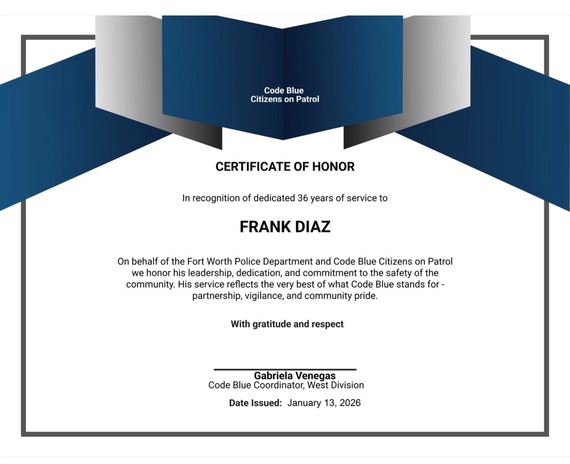
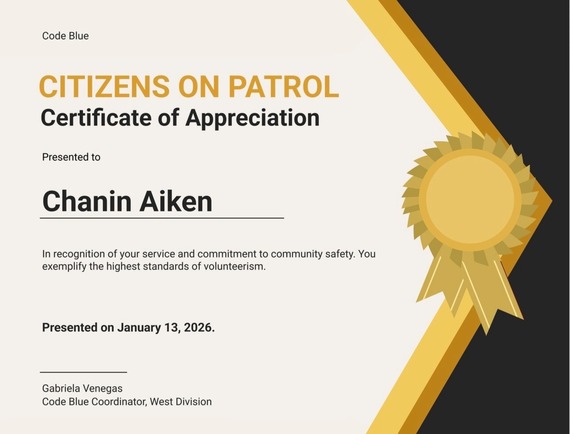
Three outstanding members—Ella Burton, the late Frank Diaz, and Barbara Maloney—were honored with special certificates recognizing an incredible 35 years of service. These three were part of the very first COP training class back in 1991 and have been setting an example ever since. A special certificate of appreciation was also presented to Chanin Aiken for always joining her father on patrols and supporting his dedication to the program.
The ceremony also took time to remember and honor two cherished members, Frank Diaz and Patrick Dupont, who passed away in 2025. Their families joined the event and received certificates in their memory, surrounded by friends and fellow volunteers who continue to carry on their legacy of service.
|
|
We’re seeing a big wave of reports about phone scams claiming you owe back taxes. But it’s not the IRS calling, it’s a scammer using a company name like “Tax Resolution Oversight Department.” If someone calls you out of the blue offering to help you fix a tax issue, hang up. Here’s how to spot the scam.
It starts with an unexpected call from the “Tax Mediation and Resolution Agency,” or another official-sounding (but fake) government agency. They’ll say you haven’t paid your taxes and offer to connect you with a “tax resolution officer,” who can do a “red flag check” on your credit and help you apply for an “IRS liability reduction program.” But those aren’t real programs and that’s your sign to end the call. Some scammers leave a voicemail saying, “This may be our only attempt to reach you” hoping you’ll call back right away. But it’s all part of the story to steal personal information like your Social Security number — or in some cases, charge you an illegal upfront fee for tax debt relief that doesn’t actually help.
Even if you owe back taxes, know this: the IRS’s first contact with you will always come by mail, not by phone. Here’s how to avoid an IRS impersonator and get real help:
-
Never give an unexpected caller personal or financial information. It’s probably a scammer hoping to drain your bank accounts or steal your identity.
-
Check it out through IRS.gov. Contact the IRS directly for trustworthy information about your tax situation. Need to speak with someone? Only use a phone number found on the IRS’s website. Never one a scammer gives you.
-
Read up on how government imposter scams work. Start with ftc.gov/imposters and if you spot a scam, tell the FTC at ReportFraud.ftc.gov.
|
|
Crime Prevention TIP of the Month
“Stay Powered Up During Any Outage”
Burglars sometimes cut the power to a business or home to test whether the alarm still works and if anyone responds. To keep your alarm system and security cameras running in this situation, consider installing a backup battery system like the one described below.
Power outages can happen anytime—whether it’s a big storm or just a local grid issue—but that doesn’t mean your home security should go dark too. Having a battery backup keeps your alarm system and security cameras running even when the lights go out. Most systems have small built-in batteries that last a few hours, but adding a separate battery backup or uninterruptible power supply (UPS) can extend that protection much longer. These devices automatically kick in when power is lost, so your home stays monitored without you lifting a finger.
If you want extra peace of mind, there are plenty of options to fit your setup. Portable power stations and newer lithium-ion battery packs can keep cameras and alarms powered for a day or more. Some homeowners even pair their systems with solar-powered batteries for renewable, long-term security. With the right backup in place, your alarm and cameras will keep doing their job—keeping you safe and connected no matter what’s happening outside.
Follow the step-by-step guide below to "right" size your uninterruptible power supply (UPS)
To choose the right UPS size for your devices, start by adding up how many watts they use, then pick a UPS with at least 20–30% more capacity than that total. This gives your system breathing room for power spikes and future upgrades and helps the UPS run more efficiently.
Step-by-step sizing
-
List every device you want on battery: for example, Wi‑Fi router, modem, alarm panel, cameras, and maybe a computer or TV.
-
Check each device’s power draw in watts (on the label or in the manual) and add them together. If you only see volts and amps, multiply them to get volt‑amps (VA).
-
Multiply your watt total by about 1.25 to 1.3 to add a safety margin, or choose a UPS whose watt rating is 20–30% higher than your devices’ total.
Picking a UPS range
-
For just a router, modem, and small security hub, a compact UPS around 600–1000 VA usually provides several minutes to over 10 minutes of backup.
-
For a home office or multiple devices (PC, monitor, networking gear), look in the 1000–2000 VA range for safer runtime.
-
For larger loads like full CCTV racks, servers, or whole AV cabinets, capacities above 2000 VA are more appropriate.
Don’t forget runtime
-
Manufacturers often list estimated runtime at different loads, so check those charts to see how long the UPS will run at your expected wattage.
-
If you only need your gear to stay on long enough to ride out brief outages or shut down safely, a smaller UPS is fine; for frequent or longer blackouts, consider stepping up a size or using multiple units.
|
|
By having the Neighborhood Patrol Officers dedicated to specific geographic areas, the officers are not only able to become more familiar with the area than regular patrol officers, but they are also able to serve as a resource for and get to know area residents and business owners, learn about neighborhood concerns, and build working relationships with area Citizen on Patrol volunteers to work hand-in-hand in reducing neighborhood crime and promoting crime prevention tools.
Primary Duties:
-
Work with crime analysts to identify crime trends within assigned neighborhoods, maintain open lines of communication with detectives, and assist the Information Management Section and supervisors in planning appropriate actions to address issues.
-
Foster positive community leadership as a means to empower citizens within their neighborhoods by encouraging involvement in Citizens on Patrol, Citizen Police Academy, and Crime Watch to work collaboratively to reduce crime and promote crime prevention tools.
-
Maintain open lines of communication between residents, business owners and the police department by attending community meetings and events, including neighborhood association and other community meetings.
-
Recruit Citizen on Patrol volunteers, schedule them for training, and provide on-going training and correspondence to encourage and retain active memberships.
Enter your address on http://oneaddress.fortworthtexas.gov/ You will find your BEAT and NPO assigned as well as your nearest City Facilities, Services, and Crime Data.
211 Texas
Connecting People and Services
No matter where you live in Texas, you can dial 2-1-1, or (877) 541-7905, and find information about resources in your local community. Whether you need help finding food or housing, child care, crisis counseling or substance abuse treatment, one number is all you need to know.
|
|
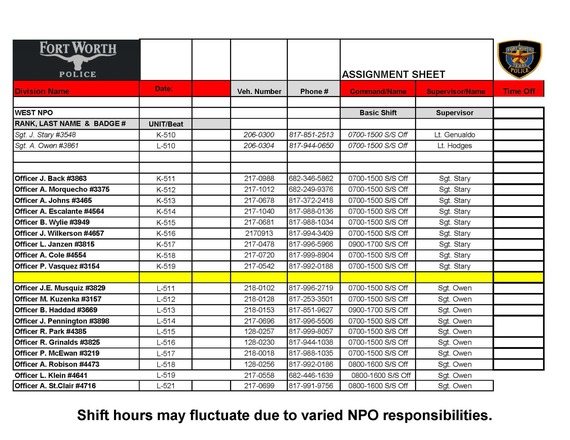
NPO Roster
|
|
Community News
LVT Rise Community Center



|
|

The FWPD West Division Newsletter has gone digital.
To sign up for the newsletter, you have the option to scan the QR code to your right or you can press the subscribe button below.
|
|
|
|
|
|