|
 ,,,and Thank You for letting us serve your educational resource needs!
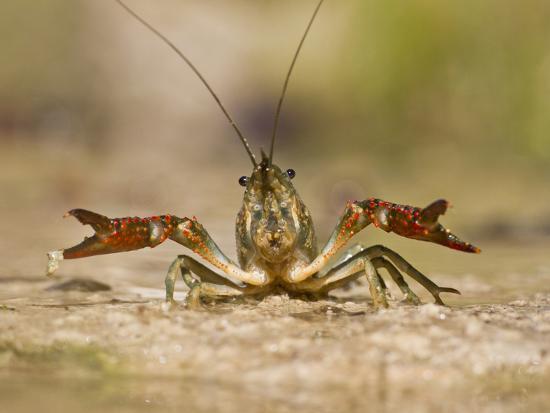
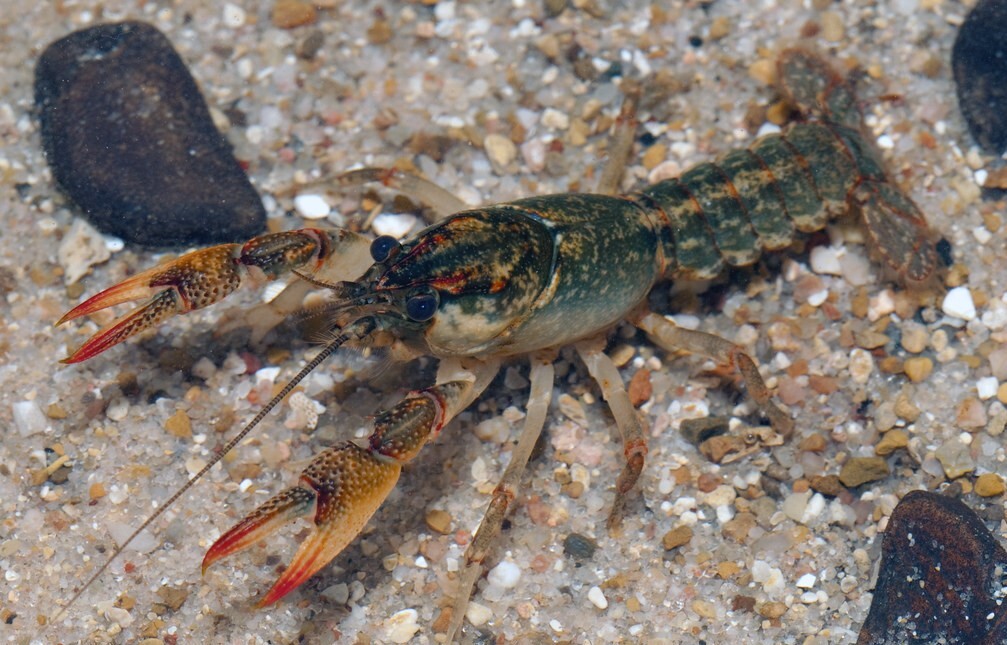 Critter Highlight - Crayfish (Cambarus scotti)
Crayfish, also known as crawfish, crawdads, freshwater lobsters, mountain lobsters, mudbugs or yabbies, are freshwater crustaceans resembling small lobsters, to which they are related.
They breathe through feather-like gills. Some species are found in brooks and streams where there is running fresh water, while others thrive in swamps, ditches, and paddy fields.
Crayfish feed on living animals and plants. There are about 150 crayfish species in North America, and over 540 species worldwide.
We also offer preserved crayfish to be used for dissecting for the study of exoskeletons and internal anatomy.
Crayfish Facts:
- Their bodies are made up of twenty body segments grouped into two main body parts, the cephalothorax and abdomen.
- On average, crayfish grow to 6.9 inches in length.
- Fossilized burrows of crayfish have been found as old as the late Paleozoic or early Mesozoic period.
|
|
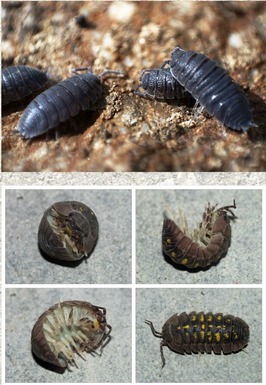 Isopods
|
This month's spotlight is on Isopods.
We carry “sow bugs” and “pill bugs”, also known as roly-polies or doodle bugs. Both have overlapping plates that are connected by flexible joints which allow them to roll up inwards to form their bodies into a ball shape, in a process called conglobation.
It may be triggered by stimuli such as vibrations or pressure, and is a key defense against predators. This behavior is shared with other animals such as armadillos and cuckoo wasps.
The diet of isopods is largely made up of decaying or decomposing plant matter, such as leaves and wood fibers. In wet conditions, they will also eat living plants.
Isopods can be used to teach students about ecological principles, such as food webs and tropical dynamics, and help them understand the importance of biodiversity and conservation.
Isopod Facts:
- They are NOT insects, but crustaceans, which means they are animals with hard shells made from many pieces for protection.
- Their typical lifespan is between two and five years maximum.
- They do not breathe through lungs, they have gills.
- They are more active at night and early morning because they prefer dark, damp places.
|
|
About Living Science

Our goal is to positively impact student learning through high quality materials & customer service.
For PUBLIC and PRIVATE/CHARTER school districts that have joined our CO-OP PROGRAM, the Living Science Center provides a variety of materials such as living organisms and non-living items giving teachers the ability to integrate into their lessons creating a fun, hands-on learning experience for students.
|
Living Science Shade House & Greenhouse
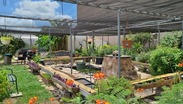
The Living Science Shade House is located behind building 2. The focal point of the Shade House is the Turtle Pond which is the home to over 40 Red Slider Turtles. These turtles are checked out on a 2 week basis to those schools which are members of our CO-OP PROGRAM.
|
Next to the Turtle Pond is the Greenhouse. Here we house various plants which we provide to our clients. They include Geraniums, Begonias, and two varieties of Coleus.

Available Materials
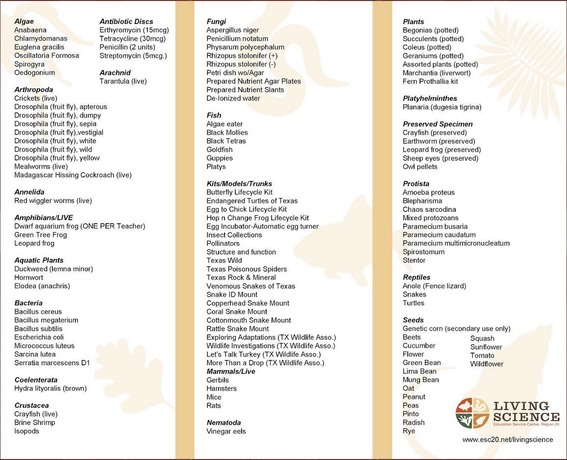 Orders must be placed ONLINE before 3 p.m., 48 hours prior to delivery or 24 hours prior to pickup.
|
|
Labor Day, September 4
Thanksgiving, November 22-24
Winter Break, December 20-January 2
M.L. King Day, January 15
Spring Break, March 11-15
Good Friday, March 29
Battle of Flowers, April 26
Memorial Day, May 27
Independence Day, July 4
Holiday Cut Off Dates Reminder
Spring Break
The last day to order any 2 week check out animals before Spring Break will be Friday, February 23, 2024. We will resume deliveries on Tuesday, March 19, 2024.
End of Year (Summer Break)
The last day to order any 2 week check out animals before End of Year will be Friday, May 10, 2024.
SAVE THE DATES!
SESSION #97868 RLA & SOCIAL STUDIES
SESSION #92997 MATH & SCIENCE
|
|
Deliveries & Returns Information
Living materials are delivered within Region 20 by the ESC-20 Living Science Van on a weekly basis. Non Region 20 schools should check with their Regional Service Centers for delivery schedule.
|
|
|
|
|