Vol. 3 | May 2025
This month our focus is on two hot topics: Smart practices for staying cool in the coming summer heat and how to stay out of hot water with TDLR by following the rules for start and stop dates on jobs.
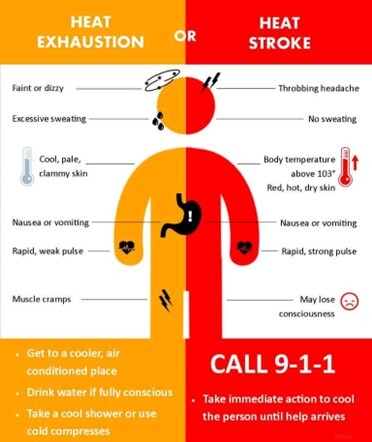
Chart showing differences between heat exhaustion and heat stroke
It’s May and things are heating up! It’ll be 100 degrees or more outside soon, and you, or your employees, will be in an enclosed environment that is just as hot, if not hotter, AND wearing full PPE while performing hard tasks. DO NOT UNDERESTIMATE THE HEAT.
We all know how hot and stressful mold remediation work can be during the scorching Texas summer. It’s important to remember that safety starts before the trucks leave your office – train your workers to know and recognize the warning signs for heat stroke and heat exhaustion. You could save a life.
-
Prevent dehydration - drink water!
-
Take regular breaks – outside of the contained area. Be sure to properly remove any PPE and take a break in some shady or cool area.
-
Watch out for each other – learn how to recognize when someone is suffering from heat exhaustion or heat stroke. Are they disoriented? Get help fast!

Did you know that you’re required to outline the start and stop dates for your project when you notify TDLR of your mold remediation project?
What are start and stop dates? According to Rule 78.10 (40)&(41):
- (40) Start-date—The date mold remediation begins. Preparation work is not considered mold remediation. (41) Stop-date—The date after the day final clearance for a mold remediation project is achieved.
What if something changes at the last minute?
If your mold remediation project has some hiccups that change the start or stop dates, simply return to your original notification and make an amendment changing your start and stop dates. You can also add a description detailing the reason for the change. (Rule 78.110 Notification of mold remediation activities (b)-(d)(4))
Why are start and stop dates so important?
Failure to notify TDLR of changes to start/stop dates is a Class A violation and carries a penalty ranging from $250 - $1,000.
|

The Rules Still Apply
And remember – if you’re a license holder in Mold Assessment and Remediation, all the rules in Chapter 78 still apply – even if the project is indeed less than 25 contiguous square feet.
Every project requires:
- Mold Assessment Consultants Protocol
- Mold Remediation Contractor Workplan
- MRC must be reachable by phone in 10 minutes AND can be on-site within 1 hour
- TDLR Licensed or Registered workers
- Insurance
- List of workers
- Training records
- Fit test records
- Notice signs at all accessible entrances
Minimum Area Exemption
Is a licensed Mold Remediation Contractor (MRC) exempt from all the mold rules if they’re hired for a project where the mold contamination affects a total surface area of less than 25 contiguous square feet of visible mold? No.
The exemption in §1958.102(a) or (c) only applies to persons who are not licensed to conduct mold remediation and was meant to allow small projects to be handled more simply and economically. A licensed MRC performing a small mold remediation project (less than 25 contiguous square feet) is not exempt from the law and rules. Regardless of the size of the area affected by mold contamination, if a licensed MRC is hired by the consumer, the MRC must comply with the requirements in the law and rules, including the development of a work plan that follows a protocol developed by a licensed Mold Assessment Consultant (MAC). The MRC does not, however, have to submit a notification for the project.
|
-
Failure to notify TDLR of a project - 1958.153(a)-(b),78.110(a)(1), 78.110(e)(1)
-
Failure to specify the estimated amounts of materials to be removed or cleaned in a protocol - 1958.151(b), 78.100(e), 78.100(g), 78.100(h), 78.100(i)
-
Performing mold remediation without a license - 1958.101(a)(2), 78.20(a),78.30(e) 78.56(a),78.56(c), 78.58(a), 78.60(a)
-
Performing work before or after the notified stop or start date - 78.110(b), 78.110(c), 78.110(d)(2), 78.110(d)(3), 78.110(d)(4), 78.60(e)(7)
-
Failure to have a work plan on site - 1958.152(b), 78.120(c)
Many violations can be corrected onsite during an inspection. Please remember that TDLR is the official source for interpretation of the Department’s rules. Don’t rely on the opinion of anyone outside TDLR for the meaning of a rule or law regarding mold remediation.
|
Easy! Email the team at mold.inspections@tdlr.texas.gov and one of our Environmental Protection Specialists will be able to assist you with your questions. |
|
 |

If you wish to file a complaint or inform TDLR of unlicensed activity or potential violations of the laws and rules, follow this link.
|
Sign up to receive automatic email updates from TDLR. Be sure to select the Mold program, and any other programs you may be interested in. Sign up to receive updates.
|
|