 The reason humans
congregate in cities is proximity. Cities maximize the potential for
economic exchange and interaction with other people. In modern American life,
one of the primary competitive advantages of cities over suburbs is the ability
to walk to services, stores, to socialize, etc., because those places are in
closer proximity and the space typically exists in the street (sidewalks) for
us to walk comfortably.
In the automobile
era, the design of our streets, sidewalks, development, and cities was focused
on making it easier for people to move around in cars, often at the expense of
safety for people walking. At some point, the occasional death or serious
injury of a pedestrian became an accepted or unrecognized part of the tradeoff
of being able to move around quickly in our cars.
Walking is one of the
most basic of human activities, and when walking we experience our city and surroundings
in a very different way than in a car. We are much more likely, when walking,
to interact with our neighbors in a positive way, to feel connected to our
neighborhoods and neighborhood businesses.
Walking (or wheeling) is something that almost everyone can do for
physical activity.
The sense is that it
is unsafe to walk places changes our behavior and makes us less likely to
choose to walk. This is especially true where our children and elderly
populations are concerned. The perception that it is unsafe to walk is the most
common reason why many parents do not let their kids walk to school, for
example.
Pedestrian safety is a two-way street between people driving and people
walking. In a crash, however, the person walking is always the more vulnerable
party. Most St. Paul and Minnesota residents do not seem to be
aware of the law regarding crosswalks and who has the right of way. Minnesota
law requires that a person driving a car stop for a pedestrian in a crosswalk.
This does not mean that a pedestrian is within the law to simply dart out at
any time. It does mean that if a person driving has a reasonable amount of time
to have seen the pedestrian and does not stop, they are then breaking the law.
Most people are also unaware that a crosswalk exists even if it is not painted
on the street. A crosswalk is simply the place where two streets
intersect, unless crossing at that location is specifically prohibited.
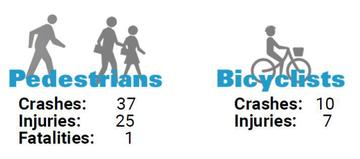 January 1-April 1, 2016
Beginning in late 2015, the St. Paul Police Department began closely tracking crashed involving motor vehicles and pedestrians (and separately motor vehicle/bicycle crashes) after receiving some funding from MNDOT’s Toward Zero Death Program and encouragement from some of my colleagues and me. Thus far, the data have revealed that there is a pedestrian involved in a crash with a vehicle about every other day in St. Paul.
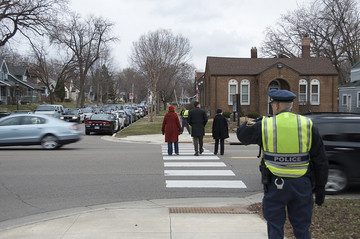
2015 also saw the first phase of a pedestrian safety enforcement campaign led by the St. Paul Police Department, who partnered with District Councils, St. Paul Smart Trips, the Ramsey County Sheriff’s Office, and the State Patrol. The program involved events where the law enforcement community closely monitors particular crossing locations and does a combination of education about and enforcement of the crosswalk law.
After seeing some success with the 2015 pedestrian safety campaign, I led a City Council effort to increase the funding for this work in the 2016 budget. As a result, the efforts in 2016 will be double what they were in 2015 and have already begun.
I believe that this campaign will be an effective way to change the culture of driving in St. Paul and will make it safer to walk in our City. One of the most common types of fatal crashes involving in a pedestrian in St. Paul occurs on 4-lane streets, where a driver in one lane stops for the pedestrian and the driver in the second lane traveling in the same direction doesn’t see or stop for the pedestrian. In these situations, it’s imperative that motorists slow down or even come to a complete stop if they see a vehicle in the other lane stopped, even if they are not sure why the other vehicle is stopping. To be safe, it’s also incumbent upon pedestrians not to assume that the vehicles in other lanes have seen them when one vehicle has stopped for them to cross.
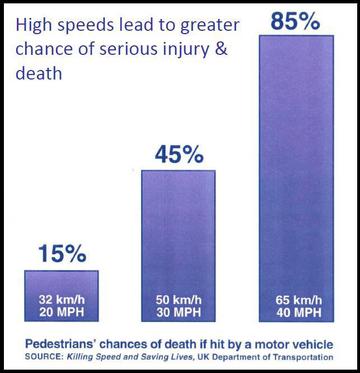
Longer term, we need to design streets that encourage lower speeds and that pedestrians feel safe crossing. But infrastructure changes take time, so it's all the more important that we focus on behaviors and attitudes via campaigns like Stop for Me in the meantime.
By making it safer to walk in St. Paul, we have an opportunity to reduce preventable deaths and serious injuries AND make walking more appealing for residents and visitors alike. If we change our culture to make it safer to walk, more people will feel safe walking in our City and letting their children walk as well.
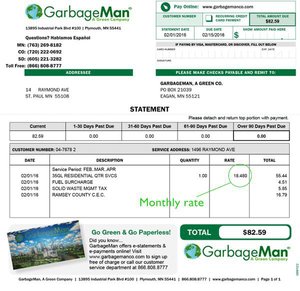
As the City works to hone in on the details of moving ahead with an organized trash collection system, we are asking residents to share their bills with us. Residents should obscure their name and the last 2 numbers of their street address and send their trash bill to public works via:
* Mail: Public Works, 1500 City Hall Annex, 25 W. 4th Street, Saint Paul, MN, 55102
* E-mail: allinprogram@ci.stpaul.mn.us
* Facebook: Post a status with a picture of your bill and the hashtag #ShareYourBillStP
* Twitter: By tweeting to or a direct message with a picture of your bill to @cityofsaintpaul, or utilizing the hashtag #ShareYourBillStP
You can also help inform our work by completing a survey. The survey is open until April 30. Please be sure to register yourself and not just respond, so we can track and ensure that we are getting responses from all parts of the city.
The Earned Sick and Safe Time (ESST) Task Force is several meetings into their process of developing recommendations for an ESST policy in the City of Saint Paul. Check out the ESST website for resources and data they are reviewing, meeting minutes, and a meeting schedule. All meetings are open for the public to listen in.
May 4 is Bike Walk to School Day. If your St Paul Public Schools student
plans to walk or bike to school that day, please think about helping to
organize a celebration at your school! Register here.
|