 February 2025
 Summer 2025 Archaeology Internship Program
Applications for the Summer 2025 SCDNR Archaeology internship program are available here. Applications close at 5 p.m. EST on Friday, February 7, 2025. This six-week internship will begin on Monday, June 2, 2025 and end on Friday, July 11, 2025. The internship is in-person and will take place at SCDNR's Parker Annex Archaeology Center (2025 Barnwell Street, Columbia, SC 29201).
Up to eight interns will be selected for this term. Applicants must be enrolled at the time of the internship as a rising high school senior, undergraduate student (B.A./B.S. and Associates), graduate student (M.A./M.S. and Ph.D.), or a recent graduate (high school to Ph.D.). Interns at the undergraduate and graduate levels, and those who have recently graduated, are paid $12 per hour. High school interns are unpaid. All interns may work up to 40 hours per week. Housing is not provided.
The primary focus of the summer internship is for interns to gain a greater understanding of the diverse field of archaeology and to discover if archaeology, or a closely related field, is the right career path for them. Interns will attend guest lectures that cover topics including, but are not limited to terrestrial and maritime archaeology, forensic anthropology, visual anthropology, archaeology public engagement, museum studies, geographic information system (GIS), and disaster preparedness and recovery. Summer interns will also assist the SCDNR Archaeology team with ongoing public engagement projects and research in the field (e.g., shovel testing) and/or laboratory settings (e.g., processing artifacts).
Please email SCDNR archaeologist Meg Gaillard (GaillardM@dnr.sc.gov) with any questions or concerns.
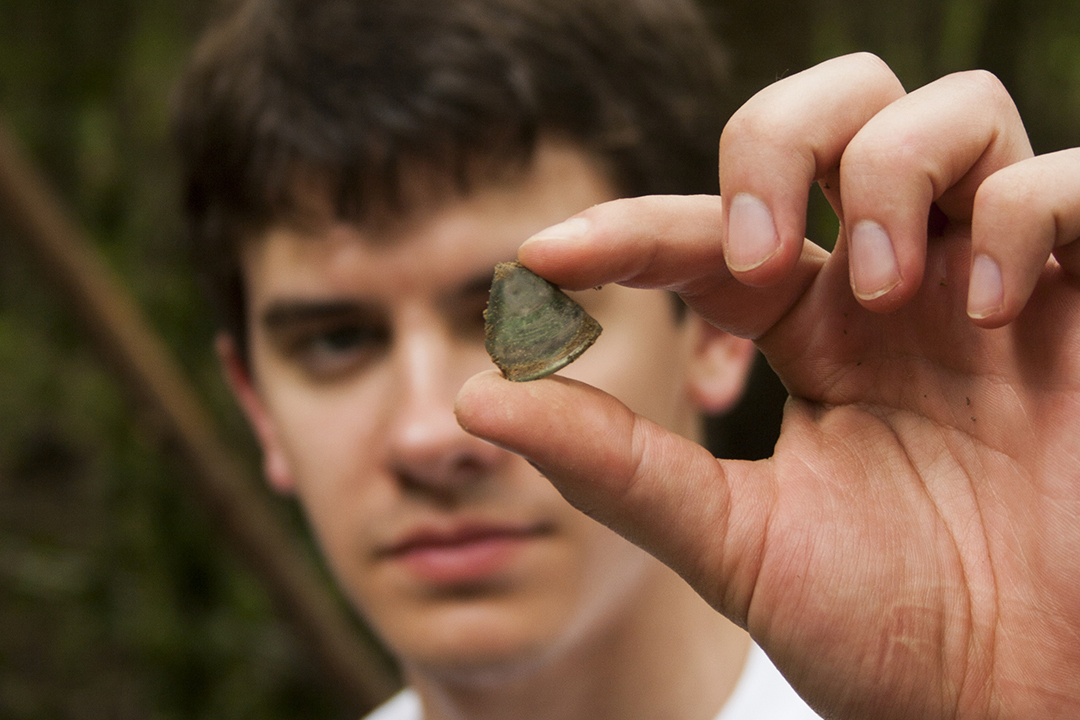
Image features an archaeology student holding a piece of green British bottle glass. Image courtesy of Meg Gaillard, SCDNR.
 Thank You for Visiting
Green's Shell Enclosure Heritage Preserve
Thank you to everyone who visited our team and took a guided tour of Green's Shell Enclosure Heritage Preserve during the January 2025 field season. We welcomed nearly 300 visitors during the two-week field season, and we look forward to welcoming folks to future archaeological excavations across the state. More information about Green's Shell Enclosure Heritage Preserve can be found in the story map Skull Creek Chronicles: Stepping in the Past at Green's Shell Enclosure Heritage Preserve.
Image features SCDNR archaeologist Gabe Donofrio guiding visitors during the Green's Shell Enclosure Heritage Preserve excavations. Image courtesy of Larry Lane, SCDNR.
 Cultural Heritage Trust Program
Receives 2024 SEAFWA C.A.R.E Gold Award
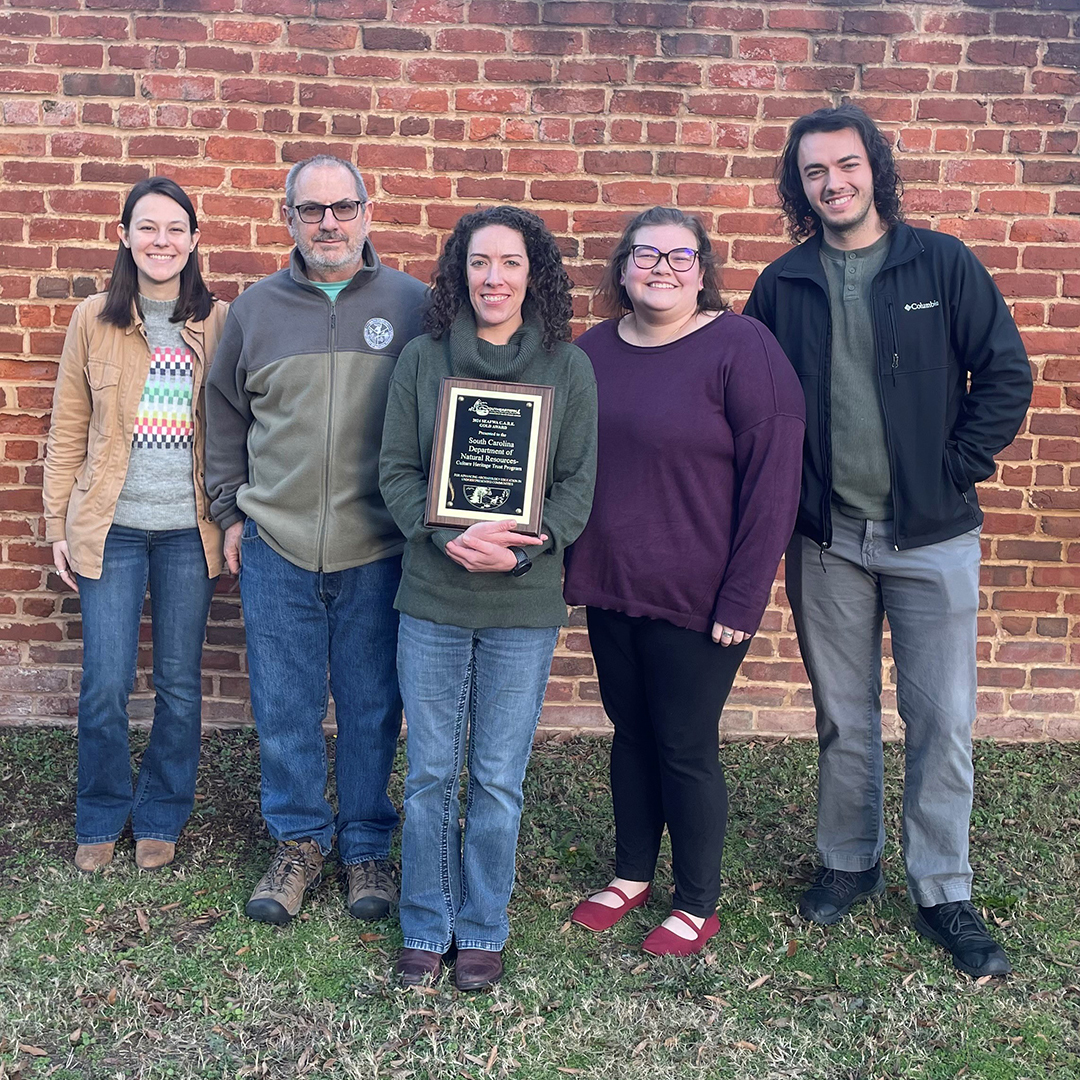
In December 2024, during the 78th Southeastern Association of Fish and Wildlife Agencies (SEAFWA) annual conference, the public outreach archaeologists of the Cultural Heritage Trust Program (SCDNR Archaeology team) were recognized with the 2024 Conservation, Access, Relevancy and Engagement (C.A.R.E.) Gold Award for advancing archaeology education in underrepresented communities.
The award nomination highlighted multiple archaeology education and public outreach program categories that have been developed and offered by the SCDNR Archaeology team over the past 10 years such as the Archaeology Internship Program; Archaeology for Kids Program; Archaeology Summer Series; Cultural Heritage Trust Children's Book Series; and online resources including 3D artifact models, story maps, the monthly archaeology newsletter, documentary films, and lesson plans.
Image features from left to right SCDNR public outreach archaeologists Reece Spradley, Larry Lane, Meg Gaillard, Lelia Rice, and Gabe Donofrio. Image courtesy of Kiersten Weber, SCDNR.
 SCDNR Heritage Trust Program Collaborating
with Comparative Archaeological Study of Historic Pottery
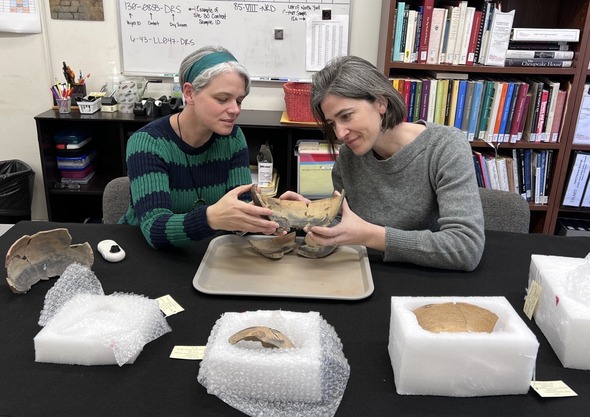
The National Science Foundation, the independent federal agency that supports scientific discovery across all 50 states and U.S. territories, has awarded a $254,602 grant to Monticello’s Digital Archaeological Archive of Comparative Slavery (DAACS). The grant funds new research to advance the understanding of the lives of ordinary people in Colonial Virginia and the Carolinas who made and used pottery vessels known as colonoware. Collaborating on this study is the S.C. Department of Natural Resources Heritage Trust program.
Learn more in the press release.
Image features Drs. Beth Bollwerk and Lindsay Bloch examine a mended colonoware vessel discarded over 200 years ago at the Accotink site from Fairfax, Virginia. Image courtesy of Catherine Garcia, DAACS.
|