|
A note from OWRD Director Ivan Gall
 |
|
We're excited to share the new OWRD Policy and Partnership Update. It's an exceptionally busy time for the agency. Below you'll find information on:
- An ambitious rulemaking update to improve our processes and better serve customers.
- A push for more data to better understand groundwater conditions throughout the state - we'll be emphasizing static water level measurement reporting compliance.
- An upcoming Water Resources Commission decision on how to best address groundwater declines in the Harney Basin.
You can read about all of these and more below. If you find this informative and helpful, let others know about this new outreach effort!
|
|
|
Seeking groundwater stability in the Harney Basin
In December, the Water Resources Commission will consider agency-proposed rules aimed at stabilizing groundwater levels in the Harney Basin.
The Commission will also consider a petition that seeks to achieve reasonably stable water levels, but with less curtailment across fewer areas. After receiving the petition, OWRD took public comment on the petition and re-opened comment on the proposed agency rules. In December, the Commission must either initiate rulemaking on the petition or deny it. Elements of the petition could also be included in the agency’s proposed final rules.
This upcoming Commission vote comes after a decade of OWRD's community engagement and outreach in the Harney Basin, most recently with several Rules Advisory Committee meetings, nine public hearings and six information sessions held in the Harney Basin.
Community feedback was fundamental in shaping the agency proposal, including:
- Delaying reductions until 2028
- Implementing adaptive management to ensure the reductions are making the desired impact on groundwater levels
- Aiming for stability in 30 years rather than recovery
You can learn more about the process and sign up for updates at owrd.info/Division512.
For Harney-area households experiencing dry, declining or at-risk domestic wells, assistance funding applications will be available starting October 28. See below for more information or visit the agency website.
A push for increased Static Water Level reporting
Having ample, high-quality groundwater level data helps OWRD better understand whether groundwater in an area is declining, stable, or increasing. A key source for these data comes from measuring static water levels in wells. Static means the well is not being actively pumped and water has stabilized in the well.
When reported on time and over a period of years, the data informs a better understanding of local conditions. This helps OWRD and other water managers make better-informed decisions about future groundwater allocations and maintain stable groundwater levels.
Most groundwater rights issued in the 1990s or later have a condition requiring static water level reporting. Starting this fall, OWRD is making a push for more rights holders with this condition to submit timely static water level reporting.
OWRD is sending Notices of Violation this fall to permit holders with this requirement who did not submit any measurements in spring 2025. They can remedy the violation with timely measurement and reporting in 2026. Non-compliance in 2026 will result in orders to stop water use and may be subject to further agency action, including assessment of civil penalties.
To review your permit’s conditions, find a professional to conduct the measurement, and learn how to report it, visit owrd.info/staticwaterlevel.
|
|
Water Resources Commission visits Warm Springs projects on Central Oregon tour
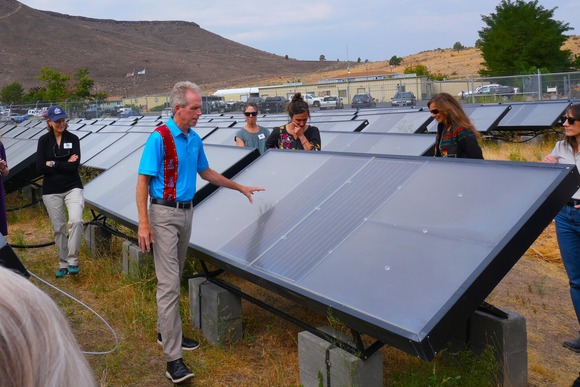 In September, the Water Resources Commission traveled to the Warm Springs Reservation and Central Oregon to hold their quarterly commission meeting. The area is home to the Confederated Tribes of Warm Springs, which includes the Warm Springs, Wasco and Paiute Tribes. Stops included the North Plains Seed Company, the Pelton-Round Butte Dam Complex, and an innovative solar-powered hydro panel project that produces water for Warm Springs residents while long-term infrastructure projects are completed.
2025 Integrated Water Resources Strategy adopted
Addressing Oregon’s water challenges is an all-hands endeavor: Oregonians are best served when agencies are working toward common goals. Those goals are articulated in the 2025 Integrated Water Resources Strategy (IWRS), a roadmap for numerous agencies interacting with water to address these issues head-on through coordinated action. The Water Resources Commission adopted the strategy in September. A key improvement in the 2025 IWRS is clear prioritization of actions, helping agencies with limited resources identify the most promising pathways to progress. The IWRS lays out key actions that fit within three priority areas:
- Act with urgency to protect in-stream and out-of-stream uses
- Assist the state and communities to prepare for water scarcity
- Adapt to water scarcity by stretching our water supplies
At OWRD, next steps include developing a workplan with partner agencies to begin taking action on IWRS recommendations. The agency will continue to offer opportunities to weigh in as these plans take shape. You can view the strategy online and sign up for updates at owrd.info/iwrs.
Looking back at water year 2025
Water year 2025 began with over 61% of Oregon in moderate drought and just over 1% in severe drought, mostly in central and eastern Oregon. Normal to above-normal precipitation and snowpack through fall and winter brought significant drought recovery, briefly making Oregon free of all drought conditions for the first time since 2019. However, below-normal precipitation and above-normal temperatures during spring and summer led to drought reemerging, first in western and northeastern Oregon, then later across much of the state. By the end of the water year, over 47% of the state remained in moderate drought, more than 24% in severe drought, and just over 1% in extreme drought.
- Did you know? The “Water Year” runs from October 1 to September 30.
- Sign up for drought and water conditions updates every two weeks at owrd.info/email-signup
|
|
|
2025-26 Water rights improvements rulemaking: Get involved!
OWRD has heard clear calls to action from water law experts, through customer feedback, in the recent passage of bipartisan process improvement legislation, and most recently in a signing letter from Governor Kotek. With clear momentum to act, in September we launched a rulemaking to update 17 rule divisions to implement 2025 legislation and other policy and process improvements.
Members of the public interested in attending or providing comment at an upcoming Rules Advisory Committee meeting can find more information on our rulemaking webpage. A formal public comment period is expected in January 2026. The Department plans to present the draft rules for adoption to the Water Resources Commission in spring 2026.
The upcoming meeting schedule is below. It’s possible more meetings may be scheduled. Stay in the loop by signing up for emails about OWRD rulemaking.
- Wednesday, October 29: 8:30 a.m.-noon and 1-5 p.m.
- Friday, October 31: 10 a.m.-noon
- Wednesday, November 12: 8:30 a.m. - noon
- Friday, November 21: 8:30 a.m. - noon
|
|
Grant opportunities
Harney Domestic Well Remediation Fund
Purpose: Reimburse part of the cost to repair, replace, and abandon dry or at-risk household wells impacted by declining groundwater levels.
Eligibility: Qualifying homeowners in the Greater Harney Valley Groundwater Area of Concern. Well must have provided household water for individual households. Deadline: January 30, 2026
Apply: owrd.info/hdwf starting October 28
Place-Based Water Planning Fund
Purpose: Support collaborative, place-based water planning and coordinate implementation of state-recognized plans.
Eligibility: Public bodies, Indian Tribes, non-profits, or person, as defined in ORS 536.007.
Timeline: Final Handbook and applications available late 2025/early 2026. Applications will be due in spring 2026.
More information: owrd.info/planninggrants
Water Project Grants and Loans
Purpose: Fund implementation-ready projects that meet Oregon’s instream and out-of-stream water supply needs and deliver economic, environmental, and social/cultural benefits. Requires 25% cost match.
Eligibility: Local governments, Indian Tribes, or person, as defined in ORS 536.007.
Deadline: January 21, 2026
Apply: owrd.info/wpgl
Well Abandonment, Repair and Replacement Fund
Purpose: Reimburse up to $40,000 for repair, replacement, and abandonment of dry or wildfire-damaged household wells.
Eligibility: Low- to moderate-income homeowners or members of federally recognized Tribes in Oregon. Well must have provided household water for individual households.
Availability: Starting November 2025; first-come, first-served
Apply: owrd.info/warrf
Grants awarded in September 2025
Corbett Aquifer Storage and Recovery Feasibility Reassessment Study
Awardee: Corbett Water District
Amount: $157,154
Purpose: Re-evaluate potential for Aquifer Storage and Recovery as a supplemental or emergency drinking water source for the Corbett Water District.
Deschutes Basin Water Bank Feasibility Study
Awardee: Deschutes River Conservancy
Amount: $330,000
Purpose: Explore formalized water reallocation through voluntary, market-based transactions via the Deschutes Water Bank pilot program.
Lacomb Irrigation District Water Conservation Study
Awardee: Farmers Conservation Alliance
Amount: $248,423
Purpose: Assess feasibility of converting 3.5 miles of open canal to buried pipeline and retrofitting the fish screen facility.
Molalla Aquifer Storage and Recovery Feasibility Study
Awardee: City of Molalla
Amount: $203,927
Purpose: Evaluate potential of Aquifer Storage and Recovery as an emergency water supply and to enhance system resiliency of the City’s water system.
Natural Aquifer Recharge Feasibility Study (Upper Klamath, Coos, and Coquille Basins)
Awardee: The Nature Conservancy
Amount: $100,000
Purpose: Assess conditions necessary for implementing natural aquifer recharge projects in the Upper Klamath Basin, the Coos, and Coquille Basins.
|
|
 Resiliency in the 'Inland Rogue'
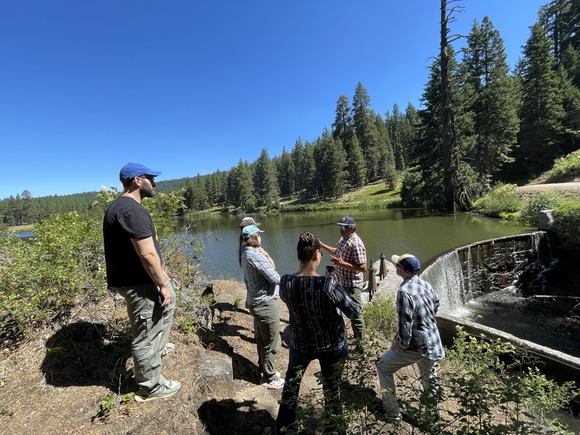
Increasing water pressures in the "Inland Rogue" (Jackson & Josephine counties) are impacting the area's economy and way of life, which largely depends on surface water. Local organizations, with support from OWRD, convened the Rogue Water Forum in September, bringing together over 100 people with diverse water interests to initiate resilience-focused regional water strategies. Pictured above, OWRD also toured the area to build relationships and learn from their regional staff and local water professionals about these challenging topics. Having seen and heard about the region firsthand, staff are now finalizing the Rogue Hydrology Primer, which will be a resource for OWRD staff and interested Rogue Basin water interests. The Primer will also inform any future technical assistance OWRD provides.
A Q&A with OWRD's Water Availability Team
This team provides Oregonians with valuable resources about drought conditions, like a drought information page and a status map showing where drought has been declared in the state. That is only a small portion of the work they do, however. Hydrologist Cameron Greenwood contributed a Q&A about the Water Availability Team to provide a better understanding of everything the team does.
Data release on 400+ streamgage sites across state
In support of the Statewide Recharge Project, USGS recently published a comprehensive data release estimating baseflow for 471 streamgage sites across Oregon. The Statewide Recharge Project is an ongoing partnership between USGS and OWRD to investigate recharge and groundwater budget components statewide. OWRD is currently analyzing and summarizing the newly available data into regional profiles that will be shared later this winter.
|
|
Know someone interested in OWRD? Forward this!
Stay informed about opportunities to get involved and have your say on OWRD rulemaking processes: Visit owrd.info/email-signup to receive future updates. You can sign up for email updates on all OWRD rulemaking, legislation and budget updates, and a whole lot more.
|
|
|
|
|