All portfolios require rebalancing from time to time. Since I took office Treasury’s investment team has been driving down the portion of the Oregon Public Employee Retirement Fund (OPERF) that is invested in private equity.
- Today private equity holdings account for 23% of the OPERF portfolio (as of July 31, 2026), down from a high of 28.4% as of March 31, 2024.
- The share of OPERF holdings invested in public equities (24%) now exceeds private equity for the first time in nearly five years (the last time was in January 2022).
This private equity reduction is consistent with my investment principles and the Oregon Investment Council’s (OIC) current asset allocation policy. I appreciate all the hard work Treasury’s investment team has done to make this shift—while achieving profitable returns on aggregate within the private equity portfolio.
That hard work is paying off. Over the past one-year period – from July 1, 2025, to June 30, 2026 – OPERF returned 8.6%, outpacing the pension system’s 6.9% assumed rate of return, with positive returns across all asset classes.
Now we look to the future. We all want OPERF to sustain return rates that lead to lower PERS costs, even in today’s uncertain economic environment.
Last week, the OIC voted to chart OPERF’s investment strategy for the next four years. This year-long process requires OIC members to consider what today’s mixed economic signals mean for OPERF’s investments today, tomorrow, and for years to come. We listened to the advice of a wide range of investment experts. We consulted Treasury’s expert investment staff. Then OIC members had to make hard decisions on how to invest OPERF’s $104 billion in assets under management, choosing how much to allocate to stocks, bonds, private equity, real assets, emerging markets, and other investment vehicles.
As Treasurer, this was my first opportunity to shape OPERF’s strategy and results.
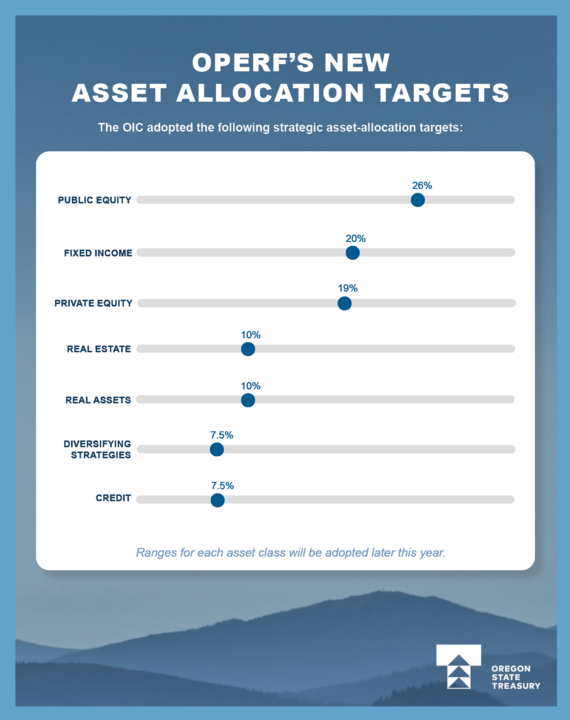
Based on extensive expert input, the OIC voted to distribute risk more evenly across the portfolio while increasing the fund’s forecasted future earnings compared to the previous allocation targets. The new allocations also establish Credit as a standalone asset class. These changes include:
- Forecasted earnings for the newly adopted allocation targets (+7.3%) that would continue to exceed the current PERS assumed rate (+6.9%).
- Lowering the allocation target of the Private Equity portfolio to 19%.
- Allocating the largest percentage of investments to Fixed Income and Public Equity, 20% and 26% respectively.
- Increasing the allocation for Real Assets, which has been OPERF’s best performing portfolio (+12.23%) over the 5-year period ending July 31, 2026.
- Minimal adjustments to the allocation targets for the Real Estate and Diversifying Strategies portfolios.
|
 Since more than 70% of the benefits Oregon’s public employee retirement system (PERS) beneficiaries receive are based on investment returns, these choices are important for public employees and every Oregonian who relies on a service provided by a state or local government, a school district, or other public employer who pays PERS rates.
As Oregon State Treasurer, I’m one of five voting members of the OIC. I support this strategy. I believe the lower private equity ceiling and the other asset shifts in this strategy are consistent with my principles of diversification, climate-positive investment, and learning from the past.
Treasury ensures wildland firefighter payments
This has been the worst—and most expensive—wildfire year on record. My heart goes out to everyone who has lost a home, evacuated from an approaching fire, or had their life disrupted by smoke. I am grateful to all the brave people who have fought the fires and protected threatened communities across the state.
While the federal government reimburses Oregon for most wildfire fighting costs, it can take years for federal money to arrive. By the start of August, firefighting costs from this year’s blazes had already exceeded Forestry’s ability to pay. However, a new law allows Treasury to loan the Department of Forestry the funds to pay the courageous crews fighting wildfires across Oregon’s forests and grasslands and keep them on the lines. Last month Treasury informed legislators that we would deliver on that commitment and are ready to issue $150 million in short term loans to allow Forestry to pay our firefighting costs.
Fighting the EEOC’s decision to gut antidiscrimination rules
Last week I released a letter I sent to the Equal Employment Opportunity Commission (EEOC), urging the commission to maintain decades-old rules that track the demographic make-up of companies. The data have been a cornerstone of antidiscrimination enforcement. I felt compelled to speak out against this attack on civil rights for many reasons. One reason is that my father was the EEOC’s general counsel in 1969, when his investigation into Hollywood’s discriminatory hiring practices made national news and was a factor in the establishment of the rules. His values around equity helped shape my passion for this issue.
- Elizabeth Steiner, MD, Oregon State Treasurer
|