Candace at Work
Thoughts on the Moda negotiations
I won’t go deep into what happened around the non-binding Moda term sheet vote, since I went over that in my last newsletter. But I want to spend some time here explaining what comes next, and my reflections on the process now that that the dust has settled down.
As I explained last time, Council will not have any direct decision-making power in the negotiations until we vote in December on the final lease agreement. The appointed Joint Authority (made up of City, County, and State representatives) and our professional negotiating team will be the people directly in contact with the Blazers. We’re already seeing news articles about how the three-month timeline to reach a deal is a tall order and casting doubt on whether or not all parties are coming to the table in good faith. I don’t have a crystal ball, and I can’t predict what comes next: what I can tell you is that October 12 is when we’re expected to have a public work session to get an update on the Moda negotiations.
I’ll also try to keep you informed with the latest via my newsletter.
On this process overall: since the beginning, there’s been a tension between those who believe that asking for anything in return is going to doom the future of the Blazers in Portland, and those who believe that it’s not an option to NOT ask for anything back for Portlanders. I think it’s clear where I stand on the issue.
While I wasn’t completely satisfied with what ended up in our approved term sheet, or the way we got there, the fact that it moved at all proves to me that it’s worth pushing for more. It’s still worth asking questions about the benefits and financial return on investments Portlanders are expected to pay for with their taxes.
I believe that we can get to a place of “yes” on all sides. But we won’t get there by just going along.
Stay tuned, Portland: these next couple of months will be busy.
Garden Park Estates Grand Opening
 It’s been a while, but you might remember that I talked about how housing is a climate policy, and why it was important that we protected a $15 million PCEF investment in heat pumps and weatherization for affordable housing developments in my February and March newsletters.
The Garden Park Estates, an affordable housing development in Powellhurst-Gilbert is proof of concept that our PCEF dollars can maximize our other housing investments, so we create safe, stable homes for all our neighbors.
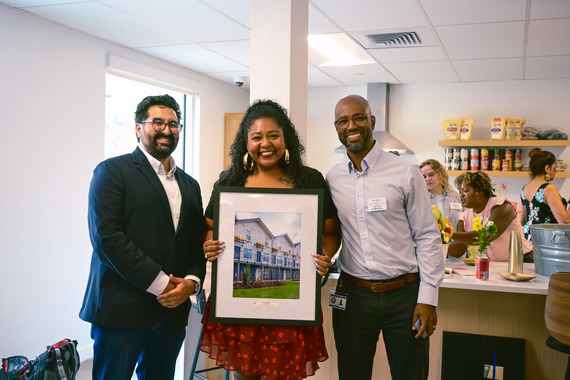
I joined Metro President Juan Carlos Gonzalez, PCEF Program Manager Sam Baraso, developer Innovative Housing, Inc., and East Portland residents at the August grand opening of the newly redeveloped site, where I learned more about how PCEF helped pay for a new community solar array, efficient mini splits, and heat pump water heaters that are lowering energy costs while also making homes more comfortable. The Metro Housing Bond funded the construction of new units (residents were rotated throughout the property in stages so no one was displaced during construction).
By preserving existing affordable housing while expanding our supply of in-demand homes (including family sized units!), this development helps our East Portland neighbors stay housed while increasing access to the services they need. And it’s exactly what our PCEF dollars were meant to build.
Inner Eastside for All hits a milestone!
In April, I joined my colleagues Councilor Green and Councilor Morillo and advocates from Portland: Neighbors Welcome to successfully lead the unanimous passage of the Inner Eastside for All resolution. How we build and how we create density shapes our neighborhoods, our economy, and determines whether families can afford to stay in the communities they love. The Inner Eastside for All project is meant to look at how we could open up opportunities to build different types of homes in some of Portland’s most amenity rich neighborhoods (that, more often than not, are mostly expensive single-family homes).
In response to our resolution, the City released a Inner Eastside Status and Timeline Report at the end of July. It includes:
- A description of Statewide land use law, Portland Comprehensive Plan policies, and code requirements related to land use changes
- Work-to-date on existing conditions, providing context and potential approaches to transportation and economic analysis
- A proposed timeline that includes outreach and engagement opportunities and best practices
- An analysis of the potential tax impacts of a zoning change in Portland's Inner Eastside
For the Inner Eastside Zoning Project, BPS is estimating a roughly two-year timeline with the goal of having any zoning changes in front of Council by Spring of 2028. These next couple of months are intended for public engagement, so keep an eye out for future events. You can also learn more at Portland: Neighbors Welcome.
Your Chance to Testify on Data Centers
Data centers have been a hot topic for a while, and it seems like every week we’re seeing a new headline about their enormous energy and water use, their pollution, or local elected officials getting flak from their constituents about signing off on a new tax break or a non-disclosure agreement (NDA). But we haven’t really talked about data centers at Portland City Council.
Until now: On Tuesday, September 1, at the Housing and Permitting Committee, we’ll be hearing a proposed resolution from Councilor Green and Councilor Koyama Lane that would urge City leaders to refrain from signing NDAs related to data center development, and to ensure that decisions affecting Portlanders happen in the open.
Candace Call to Action: Sign up to testify on the resolution at the 9/1 Housing and Permitting Committee meeting here. The item will be heard around 2:30pm.
On its own, this resolution wouldn’t ban or restrict the build out of data centers in our City. But it can send an important signal to potential data center developers that Portland is not welcoming any kind of backroom talks or sweetheart deals.
Candace in Community
D1 People’s Picnic
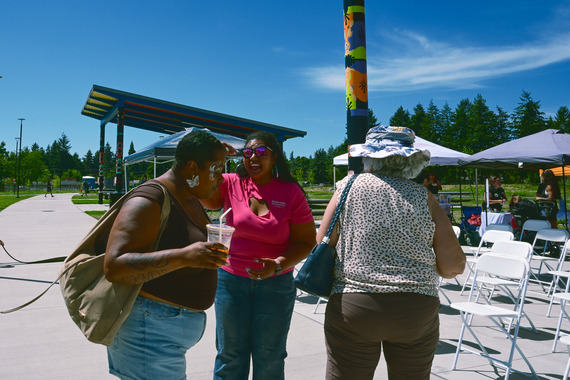 Leading up to this year’s D1 People’s Picnic, I said my intention was to make it even bigger and better than last year’s. And our community ABSOLUTELY understood the assignment.
In 2025, more than 300 neighbors came out to Parklane Park. This year, we had more than 600!
That’s double the attendance in just a year. At this rate, we might run out of room in 2027.
I had such an amazing time catching up with new and old friends, and hearing from East Portlanders about their thoughts on issues affecting the neighborhood and City. I saw so many families and kids spanning the diversity of our district, and all sorts of folks mingling and enjoying the festivities.
We had face painting, balloon art, a bouncy house, a photo booth, food vendors, and many tabling partners from City bureaus like PBOT and Parks to community partners like Historic Parkrose and Latino Network. E-San Thai Lents and L&M Ice Cream returned to provide delicious local eats, and we also had new food vendors like Acapulco Grill. And DJ Chaach was setting the vibes right with a bumping setlist that had everything from reggaeton to cumbia.
Candace Call to Action: If you had your picture taken at the photo booth, don’t forget to save it at DaBoothPDX’s website here!
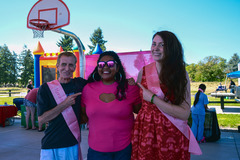
As for our 2026 Honorable East Portlander, my choice this year was easy.
The neighbor who received the award at the D1 People’s Picnic has defied all odds and expectations. He’s a relentless optimist who tackles challenges head-on. He’s an upstanding citizen who has donated his time, efforts, and resources to improving the lives of Parkrose kids and families.
And when his grocery store was forced to close, he didn’t give up. He said that we can do better and build a store that’s truly by and for our community.
Don and the Parkrose Local Grocery effort are inspiring, and he truly embodies what makes East Portland, East Portland!
|
|
Your 2026 D1 People’s Choice Winners:
-
Favorite Park: Parklane Park (for the 2nd year in a row!)
-
Favorite Neighborhood: Centennial and Mill Park
-
Favorite mural or public art: Many different picks! Neighbors chose street art like the one near Lincoln Park and the new Parkrose Plaza; murals like the one on Octapharma Plasma and Parkrose Coffee; and art adorning public trash cans and traffic signal boxes.
-
Favorite Restaurant or Food Cart: La Isla Bonita
-
Favorite Grocery Store: WinCo and Supermercado
|
|
 |
Mill Park Block Party
Mill Park Neighborhood Association is my local NA, and joining their block party was the perfect way to ease into Council recess!
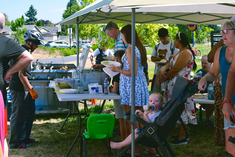
There were sweet treats from L&M Ice Cream, a live band, BBQ, and even a stage for a talent show put together by our 2025 Honorable East Portlander Elizabeth and her partner. Neighbors were also excited to see a new trash can at the park (after years and years of asking for one), which might seem like a little thing until you’re constantly having to pick up other people’s trash.
Neighborhood associations don’t just hold meetings to talk about local issues! A big part of what NAs do is putting on fun events that celebrate the places and people that make Portland home. Interested in getting involved? You can look up your local NA by visiting www.portlandmaps.com.
Supporting Black Businesses with Commissioner Singleton
 |
|
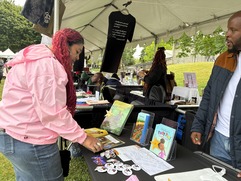
August is Black Business Month, and Commissioner Shannon Singleton created a Scavenger Hunt that features Black-owned businesses throughout Multnomah County (including some of our East Portland favorites!).
Even if you missed out on participating on the Scavenger Hunt during August, it’s never a bad time to support your local Black-owned businesses! See if you can solve the clues or visit my Instagram page to see some of the featured small businesses!
|
Candace at City Hall
Housing and Permitting Committee
Committee time isn’t just about tweaking and moving policies forward. It’s also a space where we can discuss ideas or policies that might not be ready to move yet or just talk about something that excites us. A good example is the presentation we heard on the Portland: Neighbors Welcome Single Stair Design Competition. You can see a full livethread of the presentation here.
Single stair construction for multifamily buildings is the norm in many peer countries across the world, including places like Japan and Australia. In contrast, basically “all modern building codes in the U.S. require two stairways in buildings above three stories tall.” Portland actually adopted a local version of single stair for buildings up to four stories, but the fire code requirements make it infeasible for local developers (explained in the presentation!).
Why single stair? Proponents say that the way we build multifamily housing is inefficient, backwards, expensive, and does not produce the results we deserve. Single stair allows us to build on small lots that currently are untapped to their maximum potential, which is especially important given that almost no large multifamily buildings are being developed in Portland right now because of economic headwinds like high interest rates.
Where we have seen promising construction and permit activity is smaller projects (like infill) – for example, the February report we received on the temporary SDC waiver noted “the projects that have recently advanced and had their building permits issued are mostly smaller-scale projects, shown below as single-family dwellings (sometimes built as part of cottage clusters or other middle housing projects), duplexes, and townhouses.”
The student submissions to the design competition are beautifully rendered proposals that are meant to inspire us to think beyond what’s currently possible in Portland. Single stair isn’t a panacea (and no one is calling it a silver bullet to our affordable housing issues), but it is another tool that could let us safely build more housing, on more sites, by modernizing regulations that were developed decades ago.
What’s been heard, what’s been moved:
Our next Housing and Permitting Committee meeting is on Tuesday, September 1, at 2:00pm.
City Life Committee
In the City Life Committee, we advanced two different policies related to the future of our public assets.
The first one was a proposal to set the future of the proposed PSU performing arts venue and the aging Keller Auditorium. For years, community groups, arts organizations, unions like IATSE Local 28, and local leaders have been discussing and debating the best options for Broadway-ready venues in Portland. The resolution we passed supports moving the PSU venue forward, while also planning for the use of the Keller as a renovated smaller performing arts venue.
I introduced 3 amendments – all passed – that made it clear that our support today is not a signed check or a dollar amount. We don't yet know the full cost, the City's contribution, or our long-term financial obligations. These amendments make sure Council has that information before the City makes a financial commitment.
We also advanced a resolution that directs the City Administrator to identify and negotiate with a development partner, Albina Vision Trust, for the Moda Center renovation project. The resolution DOES NOT by itself give development rights – it just starts a process.
My amendment, which passed 5-0, created a firm 12-month timeline for Council to receive binding agreements back. It might seem like a small change, but I think the defined expectations will help negotiations move forward with more clarity and greater purpose.
Throughout the discussions around the proposed Moda renovation, I’ve learned that it makes a difference to set a clear process and goals from the outset. Thanks to the support of my City Life colleagues, we’re advancing the work while also committing to a high-level of due diligence I think these important public assets — and the Portlanders who ultimately own them — deserve.
What’s been heard, what’s been moved:
Our next City Life Committee meeting is Tuesday, September 8 at 2:00 pm.
Committee of the Whole
The federal government’s aggressive and unjustified use of chemical weapons has harmed thousands of Portlanders over this past year, including residents of an affordable housing building, children, and elders. Many have raised concerns about potential health effects, something I’ve been interested in since my time serving as Chair of the Citizen Review Committee. At the 8/13 Committee of the Whole meeting, we heard more from a panel of experts about the public health impacts of chemical weapons like tear gas and how they affect more than just their targets.
Presenters talked about the unprecedented level of tear gas used in Portland from 2020-2021, studies that have shown negative effects of chemical weapons on everything from reproductive health to fish and wildlife like rainbow trout, and the lack of research on long term effects of chemical weapon exposure.
These aren’t just theoretical issues. One local doctor said, “I have a patient with obstructive lung disease who lived in a building where tear gas was being used nearby. It infiltrated her building and she almost couldn't live in her own home.”
Another retired medic who volunteers outside of the ICE facility said that another volunteer medic broke down when asked about the gassing of a peaceful labor protest, saying that “there were strollers while [federal agents were] deploying tear gas indiscriminately.”
As these stories show, chemical weapons are indiscriminate by nature. Councilor Kanal and I are developing an ordinance to protect Portlanders by prohibiting anyone in Portland from using chemical weapons like tear gas in our city.
Candace Call to Action: If you’d like to help prevent the use of chemical weapons in Portland, please fill out this form.
What’s been heard, what’s been moved:
Our next Committee of the Whole meeting is Thursday, September 3 at 9:30 am.
|