|
Hey Portland,
I hope your holiday season is going well. This is when many of us take time to reflect on what we’re grateful for in our lives. I’m thankful for my community and - as someone who personally experienced housing instability when I was growing up - I’m grateful that I have a roof over my head and a safe place to sleep at night. But for too many of our neighbors, that’s not the case.
Mayor Wilson set a goal of ending unsheltered homelessness by Dec 1. We’ve passed that deadline. While the mayor has opened new overnight shelter beds, that’s not the same as ending unsheltered homelessness. Meanwhile, I remain laser focused on root cause issues to make sure we are following through on the long-term strategies we need to meaningfully move people off our streets – and importantly prevent people from ending up on our streets in the first place.
When we listen to Portlanders experiencing homelessness and housing insecurity, their number one need is housing assistance. A recent comprehensive two-year study that surveyed people with lived experience in our region found that 91% of respondents said they would move into housing if they could afford it.
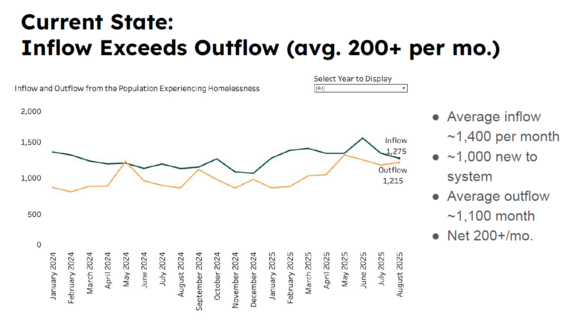 We also know that more people in our region are becoming homeless than we can house people. At a recent joint work session with the County, we heard that, over the last 18 months, we’re seeing an average inflow of 1,400 people per month - 1,000 who have never been in our homeless system before. We’re only moving 1,100 people out of homelessness per month on average. Our current approach isn’t good enough and more and more people are being pushed into precarious situations.
That’s why, as Chair of the Homelessness and Housing Committee, I’m leading efforts to keep Portlanders in their homes in the short term and to align the City’s shelter to housing continuum under one unified strategy in the long term. We know what works – this is a matter of following through.
Slow the Inflow into Homelessness Resolution
 A recent memo outlined that the Portland Housing Bureau discovered that there was close to $21 million in unspent Rental Services Office (RSO) funds. While it’s still unclear why PHB had so much unspent money, one factor could be the large boost in federal funding for rent assistance during the pandemic. Because RSO was focused on quickly getting federal funding to renters and landlords, it’s likely that there were missteps in monitoring RSO’s cash balance.
Slow the Inflow into Homelessness is my resolution to tell the Mayor how we want the city to prioritize approximately $21 million in unspent RSO funds – specifically, programming that stabilizes renters and prevents homelessness.
That means investing in rent assistance. It means putting dollars toward eviction defense and mediation. It means funding our Rental Services Office so they can scale up outreach and services. We need to work upstream and slow the inflow! As you saw in the chart earlier, more people are becoming homeless than they are being housed in our region.
Our focus is not to start or develop any new programs. We are asking this administration to invest in what works to stop more Portlanders from losing their homes.
Our resolution is coming to the next Homelessness and Housing Committee meeting on December 9th, from 12:00pm - 2:00pm.
Candace Call to Action: Sign up to testify or submit your written testimony at the Homelessness and Housing Committee meeting! Our resolution to Slow the Inflow into Homelessness will be heard around 1pm on Tuesday, December 9th.
The Parks Levy passed!
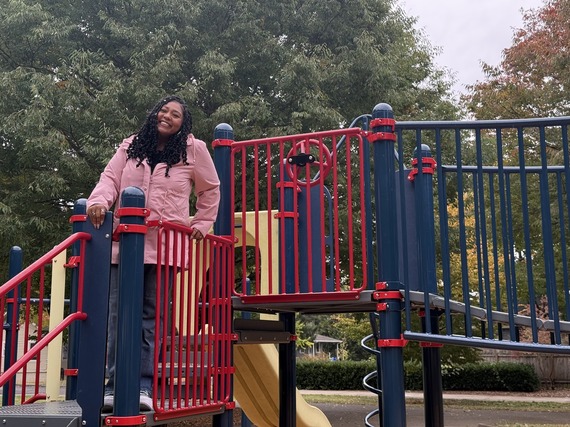 In November, voters passed the Parks Levy and ensured that current parks programming and maintenance will be sustained going into the future. This result was officially certified on Dec 1st. Without this investment, Portland Parks and Recreation (PP&R) would be facing hard choices and significant budget cuts.
Let me be clear: the Parks Levy doesn’t solve the vast deferred maintenance backlog or cycles of underinvestment that have left East Portland with fewer parks and crumbling playgrounds. Going forward, PP&R will have to show that they’re making the necessary reforms to balance new construction with preserving current services. I’m also interested in fixing a state law that prevents System Development Charges from being used for maintenance.
The issues that the auditor’s report on PP&R revealed are a direct result of our previous form of government that prioritized the pet projects of individual commissioners over systems thinking. I’m hopeful that with old silos broken down, experienced city administrators leading our bureaus, and a new Council-mandated Citywide Asset Management Strategy being drafted, we’re entering a brighter chapter for Portland’s parks.
What’s Happening with the National Guard?
In the last newsletter, I explained that there’s two different cases involving National Guard deployment to Portland. There’s a federal district court case, presided by Judge Immergut, and then there’s the case being heard by an 11-judge panel on the 9th Circuit of Appeals (“en banc” appeal). Our legal teams at the city and Oregon Department of Justice continue to win, and the deployment of the Oregon National Guard continues to be blocked.
On Nov 7th, Judge Immergut issued a permanent injunction that blocks the Trump administration from deploying any National Guard members to our city. That was the final decision in the district court.
On Nov 19th, the 9th Circuit stayed part of Judge Immergut’s ruling, meaning that 200 Oregon National Guard members continue to be federalized (but NOT deployed). This order will remain in place until the 9th Circuit can hear the en banc appeal. The 9th Circuit said that they will hear the case after the Supreme Court rules in a similar case involving the Texas National Guard to Illinois.
It’s unclear as to when the Supreme Court might issue a ruling and it could come at any time.
The courts can be confusing, and the process tends to be drawn out. But the most important thing to remember is that we have to continue to work as a community to protect our neighbors — especially our immigrant neighbors.
Representing Portland at the National League of Cities Summit!
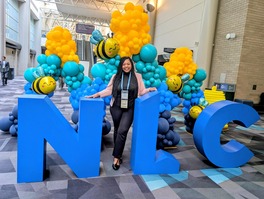
I’m always looking to learn more from my peers in local government, and at the National League of Cities Summit in Salt Lake City I had the opportunity to join informative sessions and connect with other elected representatives. It was inspiring to hear about the work that’s happening in other parts of our country, and I came home with a lot of ideas of how we can make Portland a better place to live!
At the summit, I had the opportunity to represent Portland on a panel on local strategies to address extreme heat with leaders from Utah and Southern California. Extreme heat is a new threat in our region, so it was interesting to hear how cities in hotter climates are grappling with some of the same issues (like how to reduce demand on power grids). During the panel, I was excited to share more about the incredible heat mitigation work that’s happening through the Portland Clean Energy Fund (PCEF). Many cities are having to scale back climate resilience projects because of federal funding cuts. Our city continues to invest in life-saving work like tree plantings and free heat pump installations because we have PCEF.
Starting this month, Councilors are going to offer their feedback on the update to PCEF’s five-year Climate Investment Plan, which determines where funding is directed. I’m committed to working on strengthening our city’s position as an environmental justice leader.
|
ICE in Our Communities
There’s no way to get around this: ICE is getting more aggressive by the day, and we’ve seen an alarming increase in detainments and raids. In October, the Portland Immigrant Rights Coalition (PIRC) saw 329 arrests in Oregon. The actual number is likely much higher: Trump’s cronies bragged on social media that, in October, they made over 560 immigration arrests in the Portland area. At the end of November, ICE agents even arrested a McMinnville high schooler during his lunch break, breaking his car window in the process.
When he told them that he was a U.S. citizen, the agent said, “I don’t care.”
These stories make me furious. Like many of you, I’m trying to make sure we’re getting the most out of our limited options at local government. Council passed the Protect Portland Initiative (PPI) and codified our Sanctuary City status and we’ve recently passed a policy to charge detention centers a fee for causing harm to the community.
Candace Call to Action: Check out a new immigration and know your rights resource page on my website.
But keeping our neighbors safe won’t be achieved alone at City Hall — we need to organize our community. Here are some ways you can help:
-
Help advocate for other cities and jurisdictions to act: Do you have friends or family living in other parts of the state or country? Talk to them about what their local government can do: while not every city has the same laws or system as Portland, they have options to enact similar policies like the PPI.
-
Save the PIRC hotline number and know how to make a report: The PIRC rapid response hotline (1-888-522-1610) is the best way to report ICE activity. If you see something suspicious, like a group of masked agents talking to one person, call the hotline immediately and record the scene if you’re able. Even an audio recording can be helpful in fighting someone’s deportation.
-
Make sure you’re being CLEAR (Count, Location, Equipment, Activity, Recording Time): For example, you might say that there’s three ICE agents at 122nd and Glisan who are driving unmarked white vans. They’re checking the IDs and you’re calling on November 30th at 1:30pm.
-
Attend a Migra/ICE Watch training: At the training, you’ll learn how to identify ICE and how to plug in to the rapid response system. PIRC is holding in-person and virtual trainings and their Instagram page is the best place to be notified of new opportunities.
-
Support immigrant-owned or immigrant-serving small businesses: People are afraid to leave their homes, and small businesses that cater to our diverse immigrant communities are being hit hard. If you have the ability, please consider shopping or eating out at local immigrant-owned businesses this holiday season.
We, as a city, have a responsibility to show our immigrant, refugee, and asylee neighbors that they are not alone.
Day of Remembrance for Road Traffic Victims
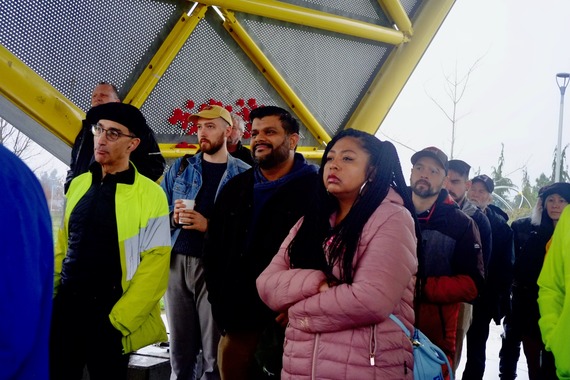 November 16 is the World Day of Remembrance for Road Traffic Victims. I joined local leaders, advocates, and Portlanders at Luuwit View Park to remember those we’ve lost and recommit to taking action on traffic violence. Speakers included my colleagues Councilor Dunphy and Council Vice President Koyama Lane. We also heard from families who have lost loved ones and survivors of road traffic violence.
In East Portland, we’ve added too many names to the list of people killed on our streets. At the end of October, three of our neighbors were killed in traffic crashes on the same day, all within 1-mile of each other. The roads where they were killed — NE Glisan, NE 122nd Ave, and NE 102nd — are all known to be deadly. All three streets are on PBOT’s High Crash Network.
We can’t talk about Vision Zero without talking about the fact that East Portlanders are killed and injured at higher rates than people living in other parts of town because our streets are dangerous as designed. A week before the deaths of three East Portlanders, I heard from constituents Julian and Jennifer about unsafe speeding and crashes on Glisan — people regularly go 50 MPH even though the speed limit is marked 30 MPH. And these are concerns I hear again and again when I speak to community members.
The best way we can honor those we’ve lost is by making the evidence-backed infrastructure changes that prevent deadly traffic crashes from happening in the first place.
D1 Voter Listening Session
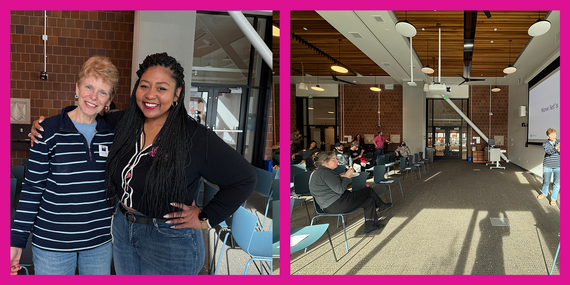 How can we increase voter engagement and education in East Portland? That’s the question that participants were asked to help answer at the D1 voters’ listening session hosted by the City Elections Office and League of Women Voters at Midland Library. A special moment for me was seeing my friend and former Charter Review Commission colleague Melanie at the session, who presented with the League of Women Voters! Some of the topics that came up during discussion were how to better reach renters, families, residential treatment facilities, seniors, and non-English speakers.
East Portland had lower levels of voting in the last presidential cycle compared to other parts of town, but I want to dispel this myth that more people skipped voting in local elections because it was too complicated. As Fair Vote found in their analysis, voter participation in District 1 in 2024 was similar to other years.
I think what we’re really seeing in the numbers is a results issue: East Portland has never been given a good reason to vote for City Council because they’ve always been underrepresented in City Hall. Now that we have three councilors for East Portland and lessons from the last council election cycle, we’re only going to see more voter engagement in our part of town.
East Portland PSR Town Hall
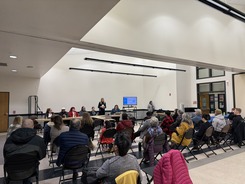
I helped lead the successful effort with Councilors Kanal and Morillo to recognize Portland Street Response (PSR) as a co-equal branch of our first responder system because Portlanders should swiftly be connected with the right resource at the right time when they call 911. At the East Portland PSR Town Hall, it was exciting to learn how the PSR team is already serving our community with a trauma-informed, compassionate response to emergencies.
One of the main topics of discussion was how our city can help PSR staff do their jobs. We heard everything from more subsidized housing to a health clinic on the eastside, but the throughline connecting all these issues is that people need a place to go.
PSR can help stabilize a person going through a crisis, but we need to put more resources toward the next step – if a client needs medical care, do we have a clinic that can take them in? If someone is experiencing homelessness, do we have a safe bed and room where they can stay?
True public safety will be achieved when we meet the needs of everyone in our community. PSR is just one piece of that puzzle.
Candace Call to Action: If you missed the East Portland PSR Town Hall, you can still attend a future town hall in Districts 2, 3, and 4 — keep an eye out for announcements on times and dates!
|
Portland Dream Plaza Tour
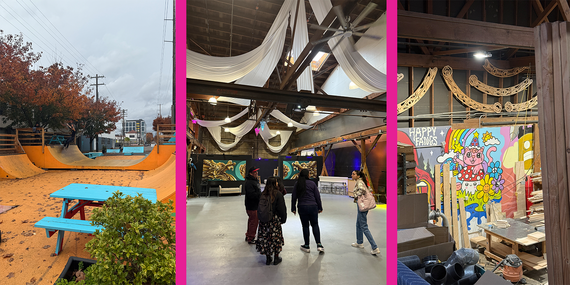 In East Portland, I hear constantly that we need more activation of our spaces and streets. At a tour of the Dream Big Plaza in inner SE Portland, I had a conversation with leadership from Dream Big Plaza and Division Midway Alliance (DMA) to talk about how we can bring similar projects to our part of town. I invited DMA to join me because I was upset to learn that none of PBOT’s Street Plaza pilots were in East Portland.
Dream Big City Founder and Executive Director Alex Murrell showed us around their space. The street area had skateboard ramps and basketball hoops, and the inside of the building was filled with multidisciplinary studios, such as pottery, screen printing, and woodworking. We talked about how these creative, accessible spaces are changing people's lives. Through creativity, music, skating, basketball, and community engagement, all within safe, alcohol- and drug-free environments, their organization is bringing people together and creating a sense of belonging.
Dream Big Plaza already has partnerships with East Portland groups and artists. Their model for activating community spaces is one that we can look towards as we think about ways to bring even more space activation to District 1 — especially in places that need it the most, such as Gateway, Parkrose, and Division neighborhoods.
Homelessness & Housing Committee
In November, the Homelessness and Housing Committee heard presentations on the work being done to advance the City-County joint homelessness response, the 2025 Point-in-Time count, and the Welcome Home Coalition’s Finding Home Report. We also heard updates on Portland Permitting & Development’s (PP&D) budget and staffing, and the Inclusionary Housing (IH) Program.
Here are some notable takeaways from November’s H&H meetings:
- Councilor Morillo asked whether people are having trouble staying in housing because they have other unmet needs (like behavioral health issues), or if they’re just having trouble being placed in housing in the first place.
- Homelessness Response System Deputy Director Ryan Deibert answered that “we just need more housing placement” because that’s the “bigger problem numbers wise,” but that there’s also a slice of individuals getting placed in permanent supportive housing who are not successful.
- One common misconception is that people experiencing homelessness in Portland are mostly not from the area. Professor Marisa Zapata, director of Portland State University’s Homelessness Research and Action Collaborative, clarified that’s simply not what the data shows us:
- In the 2025 Point-in-Time count, 73% of people who responded to the question “Where were you last housed?” reported that they lived in the tri-county area (WashCo, MultCo, Clackamas) before experiencing homelessness.
- That percentage increases to 83% if you include the rest of Oregon and Clark County (Vancouver area).
- Welcome Home Coalition’s Finding Home report found that 91% of respondents said they’d move into a home if they could afford it at their current income and 9 in 10 respondents need rent assistance and other forms of financial assistance to stay housed.
- PP&D is mainly funded through development fees. Because of declines in development after the pandemic, PP&D has been forced to draw on reserves to pay for staff and programs. This trend continues through FY 2025-26.
- From 2017-2025 (year to date), IH has:
- Created 1,208 new private market housing units affordable at 60 or 80% AMI;
- Created 63% for households earning 60% AMI.
- Collected $5 million of in-lieu fees that go to affordable housing.
I recommend you listen to some of the stories that were shared at the Nov. 18th renter’s feedback forum. We heard how renters are struggling with unsustainable rent hikes and unresponsive property management companies. Councilor Kanal challenged us to listen to renters all around the city, and you can be sure that this isn’t the last time Portlanders will have a chance to weigh in on H&H policy!
The next Homelessness and Housing Committee meeting is on December 9th, from 12:00pm - 2:00pm. We’ll hear an update on the social housing study, the Unified Housing Strategy, and consider our resolution to Slow the Inflow into Homelessness.
Climate, Resilience, and Land Use Committee
In November, the Climate, Resilience, and Land Use Committee heard a staff update and public testimony on the Zenith Energy Investigation. Zenith Energy is the owner of a liquid fossil fuels facility located in the Critical Energy Infrastructure (CEI) Hub and there are an ongoing investigation and lawsuit over a land use credential that was issued to Zenith by the City. The Climate, Resilience, and Land Use Committee also advanced a resolution, introduced by Councilors Morillo and Zimmerman, to analyze the City's current design review process and identify legislative reforms that could increase development in Portland.
Here are some notable takeaways from the Nov. 13 committee meeting:
- City Attorney Robert Taylor noted that environmental advocates prevailed in their bid to reverse an earlier Land Use Board of Appeals (LUBA) decision related to the permit issuing process for Zenith. Instead of being heard in Multnomah Circuit Court, the lawsuit over whether the city followed due diligence in issuing the Land Use Compatibility Statement (LUCS) to Zenith will be heard by LUBA.
- Council passed a resolution requiring that the Mayor investigate Zenith’s potential violations in April; that final report is expected in January or February 2026.
The next Climate, Resilience, and Land Use Committee meeting is on December 11th, from 9:30am - 11:30am. Highlights from the agenda include presentations on large scale development sites and the Parks Levy Key Performance Indicators.
Finance Committee
In November, the Finance Committee advanced a number of administrative items and appointments to the Fire and Police Disability and Retirement Board of Trustees and Revenue Division Appeals Board. We also heard updates on the state emergency transportation package that Governor Kotek recently signed into law, and the Sidewalk Improvement and Pavement Program (SIPP).
Here are some notable takeaways from the Nov. 17 committee meeting:
- The Portland Bureau of Transportation (PBOT) had budgeted about $11 million for FY 25-26. The state transportation funding nets about $8.5 million over the budgeted amount, but in the end that extra funding will go to backfilling holes in PBOT’s budget. In recent years, PBOT has had to borrow against or eliminate future reserves and set asides because of financial strain. So, while an extra $8.5 million sounds like great news, it doesn’t do much to address the many needs at PBOT.
- SIPP is a policy Council passed in May to create a plan to build more sidewalks in D1 and D4. Part of that plan is figuring out how to come up with the $200 million over four years that’s needed to build out sidewalks and pedestrian infrastructure. CFO Biery brought up that issuing bonds at that level could prevent us from financing other large projects, because the amount of bonds we can issue is limited by how much debt we can pay back.
The next Finance Committee meeting is on December 8th, from 12pm - 2:00pm. Highlights from the agenda include presentations on the annual Comprehensive Financial Report and City reserves and contingency amounts. We also will consider several ordinances from the administration and Councilor Zimmerman’s resolution to use PP&R’s upcoming budget as a pilot to provide greater details during the budget cycle.
Fall TAO
The Fall Technical Adjustment Ordinance was intended to be exactly what it says: technical adjustments to make good on decisions we already made during the past budget cycle. My biggest concern was the fact that some of the adjustments we were being asked to make weren’t just technical, they were policy related. If we have to spend less on A-B-C to fund X-Y-Z, that has policy implications. Issues like shelter funding and bureau reorganization are more than just administrative tweaks, and Council — not the budget office — has budget authority in our new form of government.
There was a whole lot of debate on the Fall TAO and the amendment Councilor Morillo introduced that would have, among other changes, shifted funding from homeless camp sweeps, added dollars for public safety needs in East Portland, and allocated funding for rent assistance, food assistance, and support for immigrants and refugees. The Fall TAO passed, unamended, with 10 votes in support and two absences.
Ultimately, the Fall TAO was always going to be an imperfect venue to have necessary conversations on how we handle our city’s finances and direct policy as a council. But it speaks to the discussions we need to be having as we enter a new budget cycle.
- ICYMI: East Portland Voice wrote a great profile of D1 People’s Choice award winner Parkrose Coffee!
- PBOT is looking for feedback on their SE Stark and Washington safety project in the Gateway District. Learn more here.
- Applications are still open for the BIKETOWN Youth Ambassador Program! Students who attend Roosevelt, McDaniel, and Parkrose high schools can apply by Monday, December 15.
- Curious about what’s next for the bus lanes on 82nd? TriMet’s Policy and Budget Committee will discuss the different proposals at their next meeting on December 12.
- Are you a business owner who needs help paying for damage caused by break-ins or vandalism? Prosper’s Local Small Business Expanded Repair/Restore Grant is now open for applications.
- Council approved the community members who will help shape the three new East Portland TIF Districts!
In solidarity,
|